 Netwrck
Surrealism.
The Last Supper at Dusk
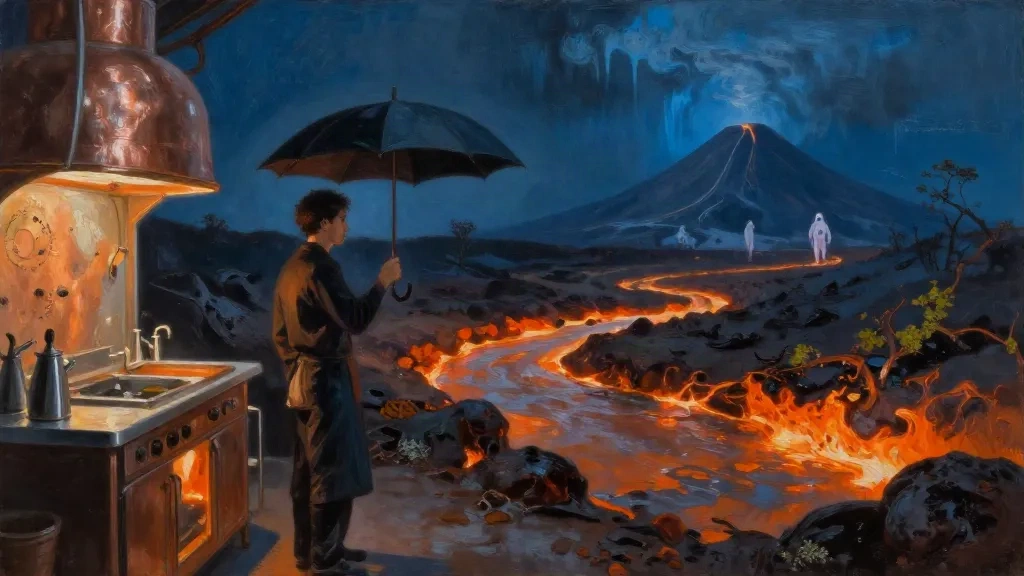
The mountain observatory was cut into the sleeping volcano’s throat, its windows aimed at the sky as if the mountain were an old telescope. Ina arrived before sunset carrying a black umbrella, a copper pot, and the recipe her grandmother had left beneath a loose tile.
The recipe began with burnt orange peel, lichen, and three grains of rice. It ended with a line in handwriting Ina did not recognize: When the table is full, the mountain will send back its guests.
For twelve years, Ina had believed that was a lie. Her family claimed the observatory was built over a gate, but the gate had vanished beneath the dry riverbed. They spoke of ancestors returning at the first meal after rain, drawn by the scent of food and the promise of a place beside the fire.
That evening she wanted proof. The observatory kitchen was a narrow chamber behind the western instruments, where copper pans hung from hooks shaped like antlers. Ina set the pot on the stove and watched the first peel darken.
At the table, the black umbrella leaned against the wall. It had belonged to her grandfather, who had carried it through every storm and refused to explain why one rib was made from bone.
Guests Beneath the Stone
The rice began to glow. Not brightly, only enough to color the lichen a sickly blue. Outside, thunder moved through the mountain without lightning. Then the dry riverbed answered with a low metallic rolling, though rain had not fallen for nine years.
People appeared in the kitchen, arriving without crossing the door. A child with blue-stained hands. A woman in a burned coat. A man carrying a broken surveying instrument. They sat where Ina had set bowls, though she had set only three.
“You’re late,” said the woman.
“You’re impossible,” Ina replied.
“The dead are always late. We have to travel around the living.”
Her grandmother appeared last. She looked younger than Ina remembered, and her hands smelled of wet soil.
“You proved the table can call us,” her grandmother said. “Now prove the gate.”
Ina lifted the black umbrella. The riverbed outside had filled without water. A seam of blue storm-light ran through its stones, and beneath it something vast turned, patiently, in the mountain.
“What does it want?” Ina asked.
Her grandmother glanced at the recipe.
“The first person who learned to cook for us.”
Ina understood too late. The cost was not a life. It was the memory of learning.
The Price Beneath the Umbrella
She could forget the first meal her mother had taught her: burnt onions, a chipped blue bowl, the rain striking the kitchen window. The memory would open the gate.
Ina opened her hand beneath the umbrella. Lightning entered through the bone rib and touched her palm. Heat, then cold. The taste of onions rose in her mouth, vivid and unbearable.
“Wait,” said the child. “If she forgets that meal, will she still know how to feed us?”
No one answered.
Then the man with the surveying instrument pointed toward the riverbed. A figure stood in the blue seam, carrying an empty bowl. It was Ina’s mother, younger than Ina had ever seen her.
Ina stepped onto the dry stones. The gate opened only halfway. The cost had been paid, but the gate demanded another thing now: a promise made by the living.
“Come home,” Ina told her mother. “We have enough.”
“There is never enough,” her mother said.
Ina thought of the observatory, its empty years, the black umbrella opening above one stranger and another. She placed the copper pot between them.
“Then we will make some,” Ina said.
She promised to return every winter with food, and to leave one bowl for anyone who came.
The gate opened. The dry river flooded with blue storm-light, carrying every lost guest toward the kitchen. Ina kept her mother’s memory for another breath—only long enough to see her smile—before it disappeared.
The Table After
At dawn, the river was dry again. The kitchen held no ghosts, but the bowls shone from washing that no one remembered doing.
On the recipe, beneath her grandmother’s final line, a new sentence had appeared in wet ink: A promise is a door. A promise is a debt. A promise is supper.
Ina hung the black umbrella above the stove. Outside, the volcano breathed orange light across the lichen.
She did not know whether her mother had crossed the river or only remembered how to. Still, she cooked. Flour, rain, burnt peel, the sharp green scent of mountain moss.
And when the blue storm-light gathered under the observatory, she set another place at the table.





