 Netwrck
Mythic Fiction.
The Films That Missed Tomorrow
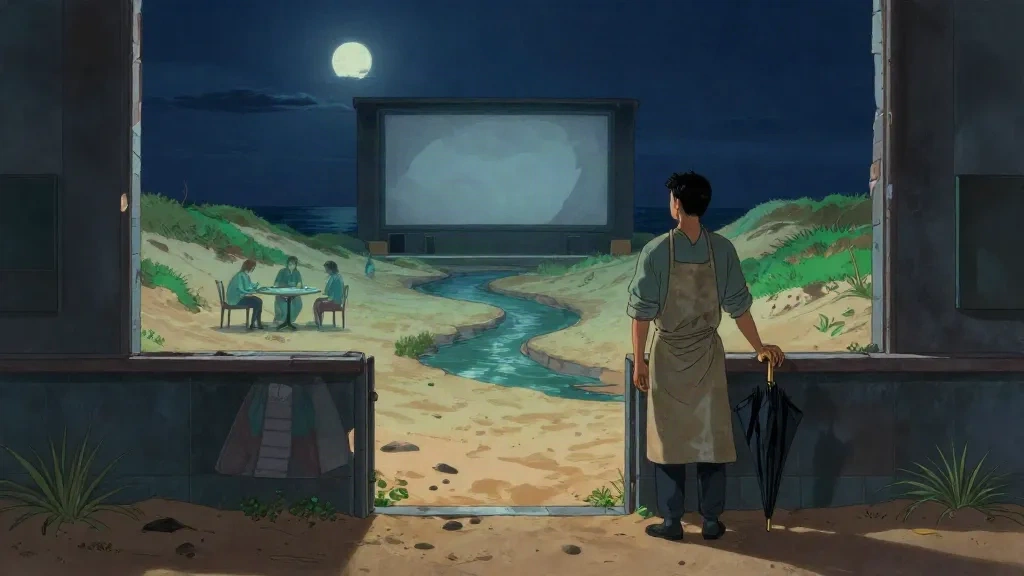
The abandoned cinema stood behind the salt dunes, its ticket window clouded with years of weather. MARA KELL learned of it from her mother, who said the place showed only futures that had nearly happened. In the projection room, a cobalt beam awakened whenever Mara laid out a table.
She was a cook with a narrow gift: her recipes summoned the people who had once eaten at her table. Not ghosts. Not exactly memories. They arrived with the patience of guests who had been waiting outside the door, carrying the smell of rain on their coats.
Mara set three bowls of sea-glass soup before the empty screen. Her father appeared first, younger than she remembered. Then her brother, then the daughter who had gone beyond the dunes eleven years ago and never returned.
“Tell me which night,” her daughter said.
Mara named the night. The film bloomed across the wall: a kitchen bright with sea-glass green, her daughter alive, a black umbrella hanging by the door. The dry riverbed outside had been full then, silver water running beneath the moon.
“You told us the legend was true,” her daughter whispered. “That our family’s last meal opened the way home.”
The Gate Beneath the Seats
The next film showed Mara’s mother entering the cinema. She carried a black umbrella, though the sky was clear. At the rear wall, a narrow gate appeared beneath a faded sign: RETURN REQUIRES ONE TRUTH ALREADY GIVEN.
The cook understood then. The family legend had omitted its final line. Her mother had opened that gate once, trading a truth about the vanished daughter so the child could be sent home. Mara had grown up believing the daughter died in the dunes. The truth was that she had chosen another future, one where the family never learned to live without her.
“If I pay again,” Mara said, “does the gate return her?”
Her mother’s face appeared in the film, calm and older. “It returns the future you name. It cannot restore the one you surrendered.”
Outside, the cinema’s dry riverbed stirred. Sand lifted in a narrow column, and beneath it appeared a second black umbrella, folded tight around a shape no larger than a seed.
Mara understood the cost. A gate could be opened only once by a bloodline. Her mother had already spent the family’s right to ask. To force the entrance would require paying again, and the price was not a memory but the ability to remember what had been bought.
What the Pot Remembered
She cooked anyway.
The recipe was old, older than her mother’s explanation: barley, bitter greens, salt from the dry riverbed, and one black peppercorn crushed in the hand. Mara had prepared it every birthday since the disappearance. Her guests appeared one after another, taking their former seats. The daughter sat closest, watching her mother’s hands.
“I wanted to know whether I was missed,” she said.
“You were.”
“That is not the same as being loved.”
Mara’s father stirred his bowl. “It was the only thing left to cook.”
The screen changed. A film showed Mara entering the dunes, following the umbrella past the riverbed, opening the gate with her daughter’s name. At the threshold stood a small figure in cobalt shadow, holding out one pale hand. Behind it stretched a house, a table, and every life her daughter might have lived.
The daughter looked at the film. “That future nearly happened.”
“Yes.”
“And the one where I stayed is nearly happening too.”
Mara turned from the screen. She had wanted proof because proof could be placed on a shelf, unlike grief. Proof could tell her whether the family had been brave or merely ruined. The gate offered no verdict. It offered a choice, and the choice cost the one thing no one could spend twice: the certainty of which loss was true.
The Seat Left Empty
At dawn, the cinema began filling with sand. The projector clicked, and the dry riverbed appeared on the screen, empty to its cracked stone heart. The black umbrella lay open beside the gate.
Mara served the final bowl to her daughter. “I came to bring you back.”
“I know.”
“I wanted the legend to be true.”
Her daughter touched the rim of the bowl. “It was true. The gate opened once. That is how legends survive.”
Then she stepped beneath the cobalt shadow and was gone.
Mara did not follow. The gate had spent itself. In the silence, she tasted the soup and found it perfectly salted. On the screen, her family gathered around the table, each face clear for a moment, then fading into the reflected green of the dunes.
At closing, Mara carried the black umbrella back to the salt road. Behind her, the cinema door remained open. The next cook had arrived, and the next film was already flickering.





