 Netwrck
Romance.
The Door That Remembered Her Mother
Mara kept the museum’s kitchen beneath its oldest wing, where the walls sweated with rain even when the sun was outside. She cooked over a blue flame: moss-green herbs, river mushrooms, black pepper ground from stones worn smooth by footsteps. Every evening, she laid seven plates on the long table, though she lived alone.
The first guest arrived when she finished her grandmother’s broth. He was a ferryman with salt in his hair, who had eaten at her table forty years earlier. The second was a woman in a marigold scarf, carrying a map that led nowhere. The third was Mara’s father, younger than memory and silent about the reason he had left.
Her family legend said the recipes summoned those who had once broken bread beneath their roof. It said, too, that a final door waited at the end of every meal. Mara had laughed when she was a girl. Now she was forty-three, and the final door stood at the kitchen’s north wall.
She had spent years trying to prove the legend. She invited strangers to her table and watched the walls tremble. She cooked her mother’s last meal, the one recorded in a stained recipe card, and heard a voice say her mother’s name through the vent. But no proof was complete until the black umbrella appeared.
The Museum of Borrowed Courage
The museum was called the House of Openings. Its galleries held doors that opened onto courage of different kinds: the courage to return, to forgive, to leave, to begin again. Visitors paid admission to knock.
One door opened onto a battlefield. Another revealed a narrow bridge above white water. A third showed a child stepping into winter with both hands raised against the wind. The labels never named the courage correctly. People entered the grief door and returned laughing. The courage to survive opened onto a room full of unlocked cages.
Mara’s father followed her through the galleries after dinner. “You’re trying to summon me,” he said.
“I’m trying to prove Mum’s story.”
“Your mother proved it. She just didn’t survive the telling.”
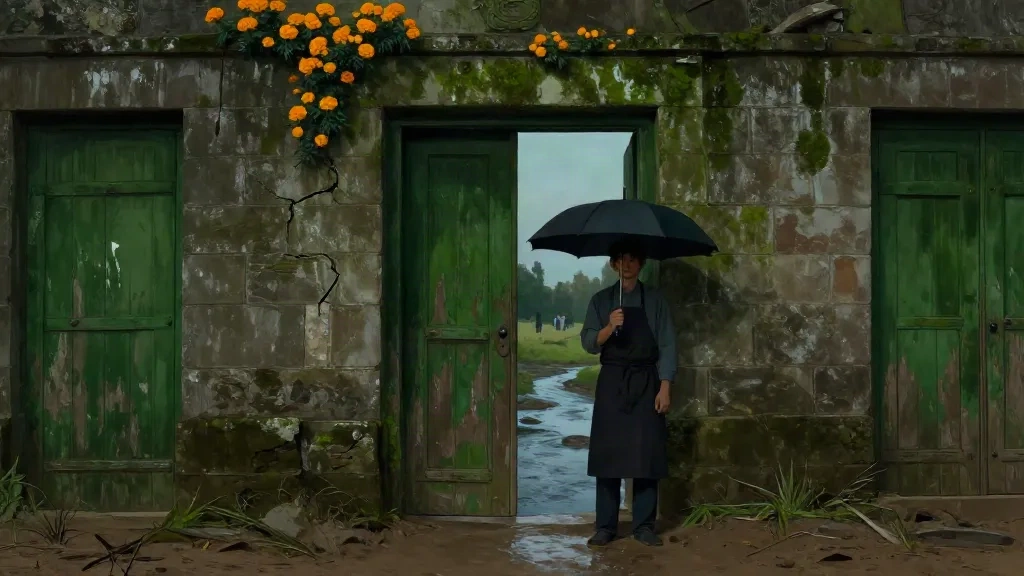
He touched the black umbrella leaning against a case marked RETURNING AFTER RAIN. Its handle was made of bone, its canopy sewn from a hundred mourning ribbons. Mara had seen it in her mother’s photographs, though her mother had never owned an umbrella.
“It belongs to the person who pays for the final door,” he said. “The cost is remembered. Once paid, it cannot be paid again.”
The Dry River
At midnight, Mara took the umbrella and led her father beyond the museum. The grounds sloped toward a dry riverbed where rain had once carved the land. Wet stones shone beneath the moon. Marigold flowers burned in cracks along the banks, though the season was winter.
The final door waited there, a plain wooden slab standing upright without walls. A thin stream ran beneath it, carrying reflections of people Mara had cooked for. The umbrella trembled in her hands.
“The cost is one meal,” her father said. “You serve it to someone you love, and they forget you loved them.”
Mara understood then. Her mother had opened this door, eaten one last meal with her daughter, and paid with the memory of that love. The legend was true because the door had made it true.
“If I pay, will Mum come back?”
“No,” he said. “But the people you have fed will remain.”
She looked at him beneath the black canopy. The rain began without touching either of them, falling into the dry riverbed and sounding like applause in another room.
What the Door Served
Mara cooked over a small fire built from the last dry branches. She used river mushrooms, moss, and a handful of marigold petals. She made her mother’s broth, then carried the bowl to the door.
Her father did not ask whether she had chosen. He knew the answer by the way she held the spoon: not to summon a mother, but to release the people hunger had carried across years.
The door opened. Warm air touched her face. Beyond it, the museum’s galleries shone with green moss and wet stone, each threshold breathing a different kind of courage. The summoned guests stood there, younger than the day they had eaten, and waited.
Mara served them. Her father took the bowl with trembling hands. When he looked at her, his eyes held recognition without memory, the look of a stranger meeting someone he had loved in another life.
“Thank you,” he said.
“You’re welcome,” Mara replied.
Then she opened the black umbrella over both of them. Rain struck its canopy, bright as a flash of marigold. The dry river began to run, and the doors swung wide.
At dawn, the museum had a new exhibit: one empty chair beneath a black umbrella, reserved for anyone willing to begin again. Mara kept cooking. She never set a place for her mother. The broth had already paid for its welcome.





