 Netwrck
Adventure.
The Cook and the Black Umbrella
Mara Bell kept the museum kitchen beneath the east gallery, where the doors waited in their brass frames like sleeping animals. Each carried a small ivory label: courage to leave, courage to return, courage to tell the truth, courage to forgive the living. The cook had inherited the kitchen, the bronze ladle, and one black umbrella with a bent silver spoke.
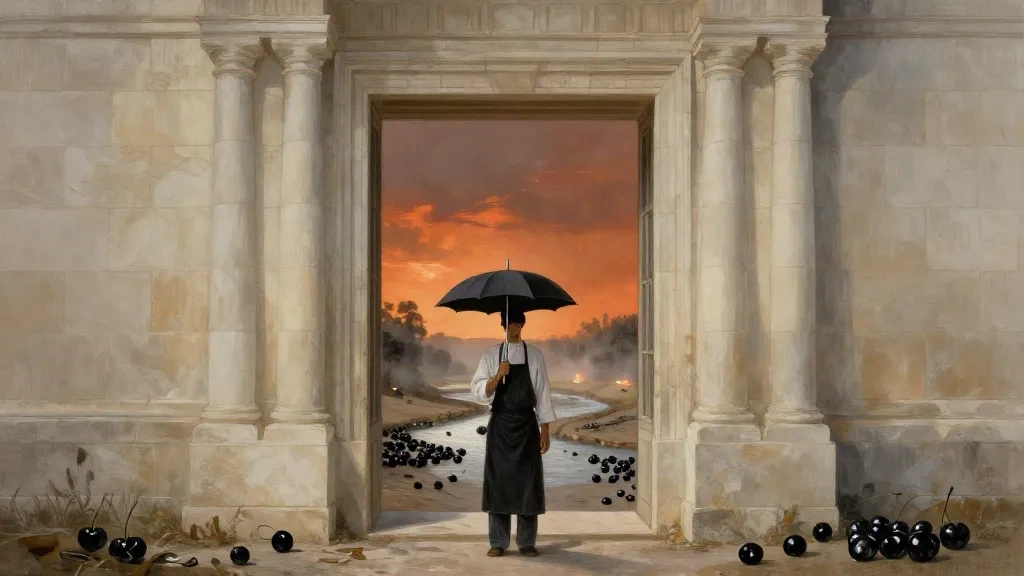
Her family legend concerned the ninth door. It stood behind a panel of pale stone and opened onto a dry riverbed. Her grandmother had said that beneath its copper horizon lay the camp of the Salt Pilgrims, who vanished while crossing the wastes. The pilgrims had carried a black umbrella over their last meal. Mara believed their cook had written down what happened there, and that the recipe could summon every person who had ever eaten at her table.
Mara wanted to prove the legend before the museum trustees sold the old kitchens. Not for money, though money would help. She wanted the names of her grandmother's seven unnamed children, and she wanted to know whether the woman who raised her had been inventing meals to keep the dead near.
The Door That Remembered Hunger
The ninth door had no handle. Only a shallow groove shaped like a spoon and a warning scratched into the stone: WHAT IS GIVEN ONCE MAY NOT BE GIVEN AGAIN.
Mara set the black umbrella against the wall and placed three ingredients on the groove: salt, bitter orange peel, and a grain of rice. The door opened inward, exhaling cold dust and the smell of ash.
Beyond it, the dry riverbed stretched beneath a copper horizon. Black cherry stones lined the banks. In the distance, seven fires burned without smoke. A woman sat beside the nearest fire, stirring a pot with a ladle.
“You came hungry,” the woman said.
“I came for the truth.”
The woman laughed, but the sound broke in the middle. “Truth is a poor sauce. It burns everything it touches.”
Each time Mara stirred the pot, another traveler appeared: a child wrapped in a white scarf, a rider with an empty saddle, a woman carrying a cracked bowl. They were the people her grandmother had fed, or their descendants, or the shapes their stories left behind. One by one they spoke of the night the river changed.
The river had not dried suddenly. It had been persuaded to leave. At midnight, the strongest among them had opened a gate beneath the copper horizon, hoping to draw water from a buried spring. The gate demanded a life. Not death—only a life chosen freely and given without regret.
The Price the River Would Not Accept
Mara understood then why her grandmother had never repeated the story. The cost could not be paid twice meant no sacrifice could be reused. If she surrendered a year of her own life, the door would open for her, but no one else could ever pass it. If she surrendered a memory, the pilgrims would be released, but the recipe would be lost. If she surrendered her name, the summoned travelers would vanish forever.
The cook from the fire showed her the choice. “Give me your name,” she said, “and I will tell you where the spring is.”
Mara looked back at the black umbrella. Its bent spoke caught the copper light. She remembered her grandmother lifting it over a table during a storm, shielding the flames while seven children ate in silence. Perhaps the legend had never promised resurrection. Perhaps it promised only this: that a table could hold a room's worth of strangers and make them, for one night, less alone.
Mara took the ladle. She stirred once, hard, and began naming every person she had ever fed. Her father. The delivery riders. The girl who stole bread from the cooling shelf. The old man who paid in buttons. She named the dead, the living, and the uncertain.
The Last Place at the Table
The gate opened before her. Cold water surged through the dry riverbed, carrying silver bubbles toward the copper horizon. The summoned travelers bowed. Their faces brightened, then thinned like steam.
“You gave the best thing,” the cook said.
“No,” Mara replied. “I gave what I had already been given.”
The black umbrella lifted itself into the air. Its broken spoke straightened. Rain struck the pale stone, then stopped before it reached the kitchen floor. On the riverbed, the black cherry stones shone like wet eyes.
At dawn, the ninth door stood open. Mara could see the dry river beyond it, but never the copper horizon. The gate had closed when the water arrived, keeping the price from being asked again.
The trustees kept the kitchen. They renamed it Hall of Shared Bread. Mara hung the repaired umbrella beside the stove, and on dark nights she heard spoons against bowls, many voices arriving together. She never cooked for ghosts. She cooked for whoever came through the museum doors, hungry and needing a place to sit.





