 Netwrck
Adventure.
The Empty Table
Mara Venn had inherited a black umbrella, a dry riverbed, and a story that everyone in Bellwether agreed was false.
The river ran pale beneath the town, carrying leaves, copper reflections, and the solemn faces of people who had made promises they could not keep. Each bridge bore a carved sentence: We cross only by what we give. The oldest bridge, west of the kitchens, had lost its rail in the flood of 921, and its gate had sealed with red clay.
That was the year Mara’s grandmother, Elia, supposedly crossed alone and returned with a handful of black cherries.
“She proved the western road opens for anyone who carries a true family name,” Mara’s mother used to say. “She brought back fruit from the other side.”
Then, three winters ago, Elia died without tasting a cherry.
Mara set the inherited umbrella beside the flour jar and opened her ledger. The family records were kept in recipes. Every dish summoned the people who had once eaten at her table: their voices, their habits, the warmth of their hands. She had made pies for weddings, bread for funerals, and one bitter soup for a brother who had left.
For Elia, she had never made anything.
On the morning of the copper horizon, Mara prepared black-cherry soup.
The People in the Flour
The first bowl began to tremble.
A spoon struck porcelain inside the empty kitchen. Then another. Chairs scraped across stone. People appeared at the table, translucent as heat, each wearing the clothes of a different decade. They looked at Mara with recognition that made her teeth ache.
“You are late,” said her father.
He had been dead for twenty years.
“You always wait until the fruit softens,” said her aunt.
Mara’s hands burned. The soup smelled of river mud and sweet summer fruit.
“Tell me about the gate,” she said.
The dead family exchanged glances.
Her father pointed toward the black umbrella. “Your grandmother knew the cost. A promise is not a word. It is a portion taken from the person who keeps it.”
Elia’s voice came from the kettle.
“The gate opens for a true name,” she said. “The river takes the memory of that name from everyone who remembers it.”
Mara understood then. The western gate had not opened for Elia because she carried their family name. It had opened because the whole town trusted the name. Once she crossed, they would forget her. The stories would remain, but Mara Venn would vanish from them.
She poured the soup into the street.
The dead drank it happily.
One Portion, Two Shadows
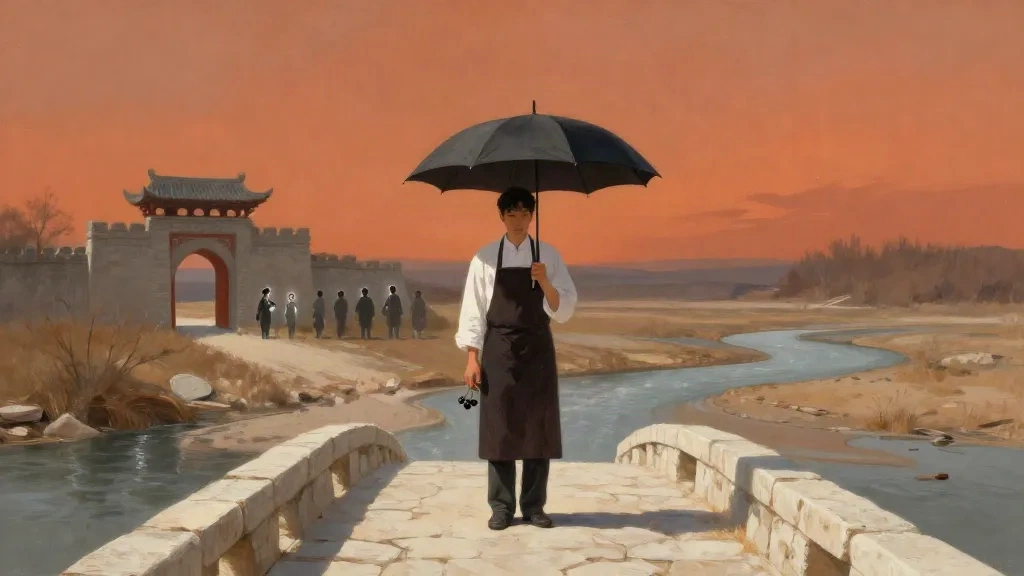
The western bridge appeared when night fell. Its stones were pale and dry, though the river whispered beneath them. The black umbrella cast a round shadow over the gate.
On the lintel, someone had carved three words: ONE PROMISE, PAID ONCE.
Mara stepped forward. The gate opened.
Behind it stood Elia, younger than Mara remembered, holding a small basket of black cherries.
“You came,” Elia said.
“You did.”
“No.” Elia lifted the basket. Its fruit shone like small wounds. “The gate took a memory from me. I forgot your father’s face. I forgot the day you were born. I kept only the proof.”
Mara looked at the basket. The family legend had been true. Her grandmother had crossed. The cost had not been paid twice; it had been transferred through every person who trusted the story.
“Take the cherries,” Elia said. “Then the town remembers the crossing.”
Mara saw the trap. To bring proof back, she would have to take the same portion. The gate would remove her from every recipe, every memory, every mouth that had tasted her cooking.
“I want the legend to be true,” Mara said.
“Truth is not a possession.”
Mara opened the umbrella. Beneath its black canopy, the copper sky folded down. The dry riverbed filled without water, with a bright line of witnesses.
She picked one cherry and ate it.
The gate took the first portion. Her name vanished from the family ledger.
It tried to take the second.
But Mara had already served the dead. Every recipe summoned those who had eaten with her, and they stood between the gate and its collection. Her father raised his empty bowl. Her aunt held the lantern. Elia smiled.
Together they spoke her name.
Mara Venn.
The gate broke open with a sound like a promise kept.
What the River Kept
At dawn, Bellwether’s western bridge had a new rail, black as a raven’s wing. The river carried no water, only clear stones and reflected faces.
Nobody remembered the dry crossing, but everyone remembered the meal. In every kitchen, someone had made black-cherry soup. Some added salt. Some added smoke. None knew why.
Mara’s mother found the recipe ledger open on the flour table. Beneath her grandmother’s name, a new line had appeared in Mara’s hand:
Black cherries, river-stone sugar, and the truth that survives the eater.
Mara could not remember her father’s face.
Yet when the dead gathered for supper, he always found the chair beside her.
He placed one black cherry in her bowl.
“The river forgot you,” he said.
“No,” Mara replied. “It kept the part of me it was promised.”
Beyond the bridge, the copper horizon brightened.





