 Netwrck
Mythic Fiction.
The Bell That Had No Owner
Nera made bells in the upper chamber of Mount Vael’s observatory, where the windows looked down on the black shoulders of a sleeping volcano. She was fourteen, all elbows and unfinished questions. Her father had left her his lathe, a box of blue resin, and the rule that every bell must be tuned to a memory its owner had not yet owned.
Her finished bells rested in glass cases: one for the first time a child would laugh; another for a sailor who would return with salt in his hair; a small silver one for a girl who would one day recognize her own face in a stranger’s window. Nera could not keep them. Once given away, they became ordinary metal, mute as stones.
Every year, the people of Cinder Street held the Unnamed Mourning. No one knew what had died in the disaster that buried the lower town. No statue, inscription, or song survived. The holiday was nevertheless kept with white flowers, unlit windows, and a procession that walked the same seven corners without ever turning them into a destination.
That year, Nera’s newest bell rang by itself.
Below the Observatory
It made no sound in the air. The vibration traveled through the floor, the brass instruments, the teeth of the brass compass hanging at her belt. Its needle spun once and pointed downward.
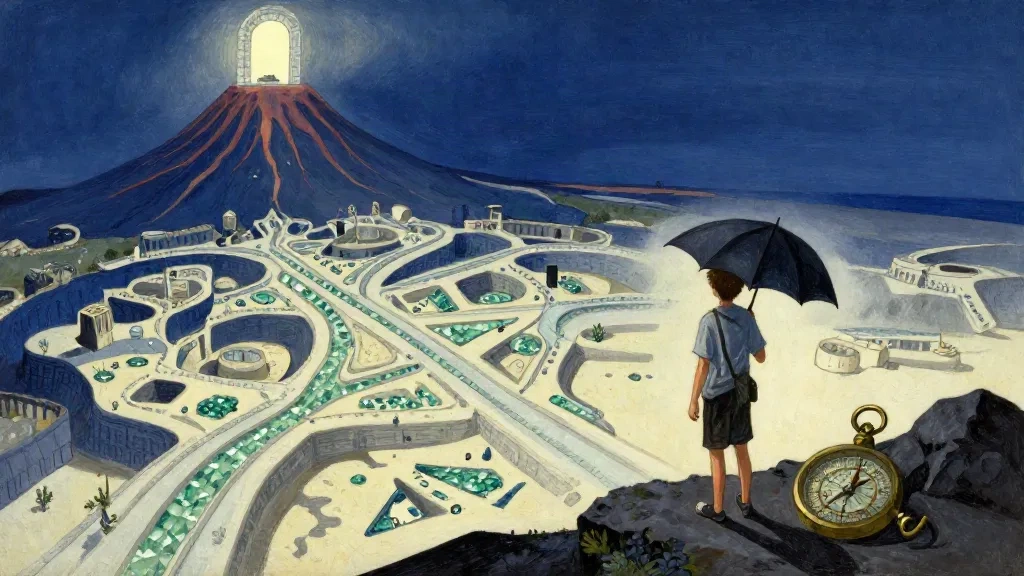
Nera took a black umbrella from the stand beside the western stair. It belonged to no one, though everyone in the mountain recognized it. The canopy had been sewn from the shadow of thunderclouds. During the Unnamed Mourning, people carried it above the procession so the absent would not see the sky.
She descended through galleries colder than stone. Here the walls held seams of sea-glass green, and old stairways curved into sand. At the last landing, she found a door marked with the shape of a street: crooked, square, and ending in a door that should have led to her own house.
Nera pushed her compass through the gap. The needle turned toward the door.
Behind it lay a city folded underground. Its buildings had been crushed beneath the volcano, yet their windows shone with cobalt evening. The streets curved in impossible directions, but at every intersection stood a familiar shop: the baker’s, the bookbinder’s, the house where children traded bright buttons. Nera recognized the smell of rain on warm pavement.
This was not Cinder Street as it was. This was Cinder Street as it might have been, if the mourning had never happened.
The Name in the Road
At the seventh corner, children in white carried a coffin made of salt. The black umbrella opened above them, though no rain fell. Nera followed, calling the names she knew from the procession. The city repeated each one from beneath the paving stones.
“Sera,” a shop window whispered.
“Mother,” said a doorway.
“Thomas Vale,” answered the mountain itself.
At the eighth corner stood a woman in a blue coat, face hidden by the collar. The children stopped. The coffin lowered.
“You came to name it,” the woman said.
“I came to find the street,” Nera answered.
“That is the same as naming it.”
Nera’s bell trembled in her pack. She understood then that the city had been built from memories the living refused to claim: all the lives that could have filled the lower town after the disaster. To call one of them true would lock it into the past. To leave it unnamed was to keep the world open.
The woman lifted her hands. In them rested a bell without a clapper.
“Your father made this,” she said.
Nera’s throat tightened. The bell’s shape was familiar, though she had never seen it. Its surface was sand-colored, with a crack of sea-glass green along its rim.
The World Beneath the Street
Nera took the bell. The moment her fingers closed around it, the city trembled. Cobalt shadows peeled from the walls, revealing the old fault beneath them. The street was not beneath the mountain. The mountain was beneath the street, and the sleeping volcano had been built to keep the world from remembering which came first.
The procession began again. This time the children sang a melody Nera knew from her father’s unfinished songs.
She struck the bell.
No note escaped. A wave passed through the underground city, lifting roofs from the buried houses and setting every window aglow. The streets unfolded into their true shape: not a straight road toward home, but a bright, branching country of possibilities.
When the light faded, Cinder Street lay around her—not restored, not erased, but visible. She could see where the old houses had stood. She could see the spaces left for the lives that had never happened.
The black umbrella lay open beside her. Its shadow covered nothing.
Nera climbed back to the observatory and placed the silent bell beside her unfinished work. Then she took up a hammer and began carving a new one.
Outside, the Unnamed Mourning continued below the mountain. For the first time, the procession did not sound like a question.
It sounded like a door.





