 Netwrck
Mythic Fiction.
The Dry River
Mara Venn inherited her father's brass spoon, her mother's salt cellar, and a legend her grandmother had guarded like a sleeping flame. The family had once fed the river itself, the story said, and received a promise in return: whenever the river rose, it would remember them.
By Mara's birth, the Anwen had shrunk to a pale scar between black banks. In summer, children played among the stones, and the oldest bridge across it was marked with three iron nails. People said the nails held the promise down.
Mara ran a kitchen above the ferry office. Her stews summoned more than appetite. A former sailor appeared whenever she simmered thyme with mussel shells. A baker returned whenever she scorched the crust of rye bread. They gathered at her table, hungry for the meals they had missed in life, and spoke of places that no longer existed.
She wanted to prove the legend true. Not for money, though travelers paid well for a bowl that briefly restored their vanished. She wanted to know whether her grandmother's claim was faith or cowardice dressed as faith.
On the third night of the first frost, Mara found a black umbrella leaning against her kitchen door. Its handle was made from river reed, though no reed grew in the dry Anwen. Beneath it lay a clean bowl and a note written in her grandmother's severe hand: At midnight, bring one true promise to the river. Bring nothing twice.
The Gate Under the Umbrella
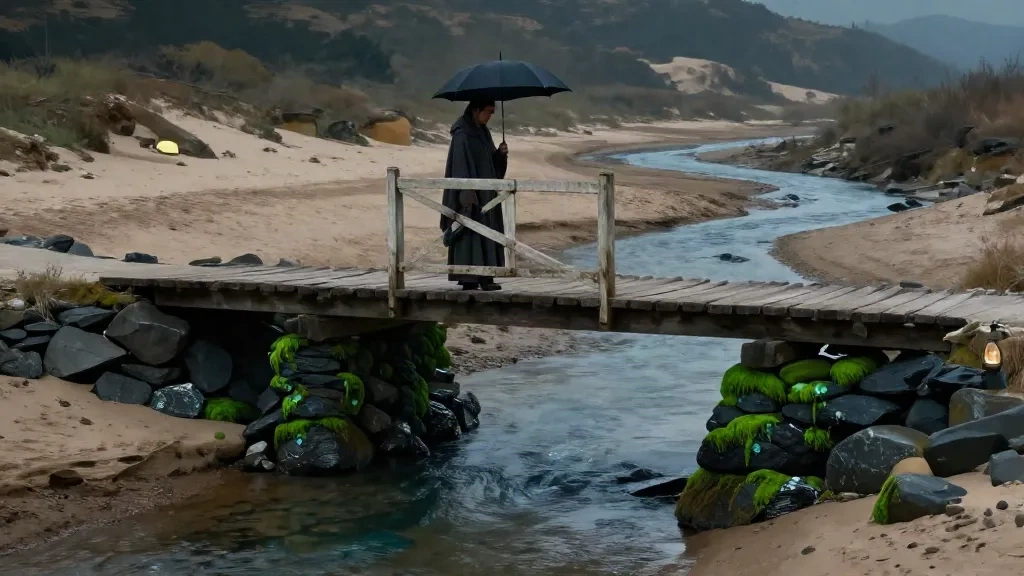
Mara took the black umbrella and walked to the second crossing, where the old bridge dipped toward the empty channel. The night smelled of sand, iron, and distant snow. She carried a pot of onion broth, a spoon, and a white shell from the ferry office.
The dry riverbed glittered faintly. Sea-glass green moss clung to the stones. Cobalt shadow pooled beneath the bridge, deeper than the night should allow.
At midnight, the black umbrella opened by itself. Below it stood a gate made of pale wood, its hinges wet with water though no rain had fallen. A voice like many currenting voices said, “A promise may open this gate. It may be paid once, and never again.”
Mara thought of the promise her family had made: that they would feed whoever the river remembered. The river had kept no part of that bargain. Its channel was dry. Its witnesses had vanished.
“What promise do you require?” she asked.
“A true one. Once given, it cannot be withdrawn. Once paid, it cannot be paid again.”
She placed the shell in the gate's lock. It opened a finger's width, revealing cobalt water beneath the earth. The smell rose from it: bread baking, storm rain, her mother's hands, her father's laugh.
“If I promise to feed the river,” Mara said, “who will I be feeding?”
The gate answered with the voices of everyone she had summoned. “Those you summon. Those you love. Those who are gone.”
Mara understood the cost. A promise cannot be broken, but it can be fulfilled endlessly. If she promised to cook for the dead, every meal would call them back. Every diner would leave hungry. Every table would remain set.
The Meal of Witnesses
She did not promise with words. She built a fire from driftwood, filled the pot at the hidden water, and added salt, onions, thyme, and the last of her grandmother's pepper.
The broth tasted like the ferry office kitchen, like childhood, like the first meal Mara had cooked for her father after he returned from the sea. Steam rose in the shape of a bridge.
People emerged from the cobalt shadow. Her grandmother came first, severe and upright. Then her father, young and salt-bearded. Then strangers whose names had been scratched from Mara's family ledger. They sat around the fire, silent, waiting.
“There is no food,” her father said.
“There is,” Mara replied, ladling broth into the bowl she had carried. “But I cannot promise to keep feeding you. A promise must be one payment, not a chain.”
She understood then. The legend had never said the river would return the family. It said the river would remember them. Memory was the promise: the meal would remain in the witness even when the eater could not.
Mara broke the black umbrella over the fire. Its ribs became fishing hooks. The hidden water rose around the bowl but did not spill. Every person drank once, and each vanished with salt shining on their lips.
What the River Kept
At dawn, the gate was gone. The black umbrella had become a stain of cobalt in the sand. In the dry riverbed, the three iron nails had lifted themselves from the bridge and settled beneath Mara's feet.
She cooked for three days without summoning anyone. Ordinary customers came. They praised the stew, and left full, and forgot her name by evening. The absence hurt, but the silence was clean.
On the fourth morning, a child pointed to the riverbed and asked why the stones were wet.
Mara looked. A green line of water ran beneath the sand, narrow as a seam in a book. The river had not returned. It had remembered where it had been.
She planted the nails beside the line and left the brass spoon on the bridge rail. Then she went home to open her kitchen. The bowl was empty, the salt cellar full, and the promise had been paid exactly once.





