 Netwrck
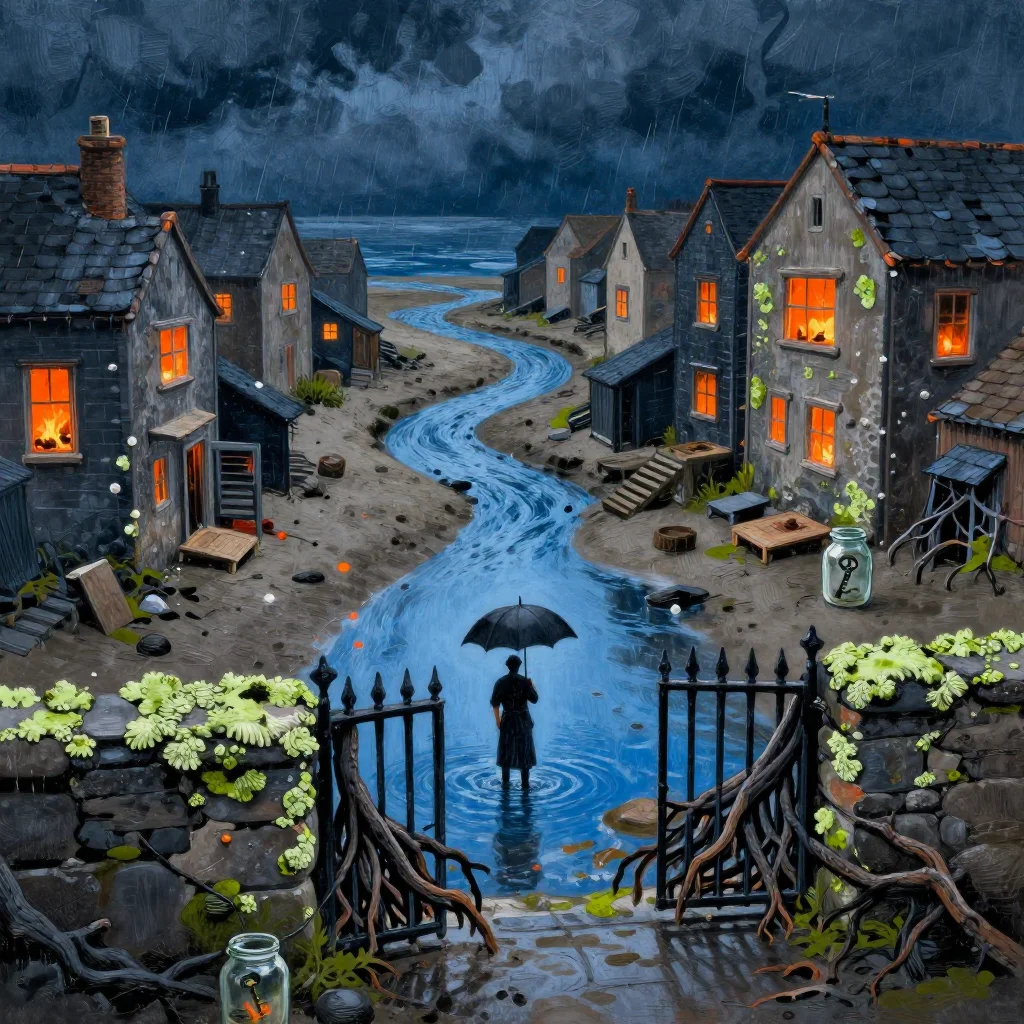
Surrealism.
What the Tide Brought
Every tide returned one forgotten object to Bellwether. A brass thimble. A child’s red shoe. A toothless comb green with salt. The town collected them in blue glass jars along the seawall, where the stones wore their histories smooth.
Mara Vale kept her restaurant above the old ferry road. Every evening she wrote recipes in a narrow black notebook, and every evening the people who had once eaten at her table came back for another serving.
Her father arrived with a fork in his breast pocket. Her sister sat beneath the salt rack, chewing seaweed. Dead customers ordered bread pudding and paid in buttons, bells, and small smooth stones. None of them asked how she had changed. They remembered only the table.
Mara wanted one person who remembered the whole story.
Her grandmother had claimed that the sea had once carried the family through a dry riverbed beneath the town, when the cliffs were young and the moon was only a rumor. Mara had inherited the claim, not the proof. On the night of the blue storm, she would finally make the sea remember it.
The Recipe for a Missing Person
She began with the last meal her grandmother cooked. Salted fish, burnt onions, orange peel, and a spoon of mustard saved from a wedding breakfast. Mara lit the blue stove and spoke the ingredients aloud.
The kitchen filled with the smell of rain on hot stone.
Her grandmother appeared at the doorway, young and stern, carrying a black umbrella. The umbrella dripped though the roof was dry.
“You’re late,” she said.
“The tide brought back your key.”
“I know.”
Mara set the key on the table. It had arrived that morning in a jar labeled with no name. The key was warm, shaped like a tooth, and too heavy to lift with one hand.
Her grandmother touched it once.
“The legend is true,” Mara said. “The river ran here. You took us through.”
Outside, a bell rang beneath the road.
Her grandmother looked toward the floor. Between the boards, a narrow channel of pale sand appeared where no channel had been. It widened into a dry riverbed, winding through the kitchen toward a gate of black iron.
The gate had no hinges. Its bars were roots.
“Proof costs the same thing twice,” her grandmother said.
“What thing?”
“A memory that makes you who you are.”
Mara looked at the key. The kitchen filled with the faces of everyone she had fed: her father laughing, her sister hungry, the old woman who always asked for tea. If she opened the gate, she would lose one of them forever.
What Could Be Paid Twice
Her grandmother unfolded the black umbrella.
“I paid my memory of you,” she said. “That is why I could bring you back for dinner, but not call you by name.”
The dry riverbed began to fill with storm-light. Blue water climbed from nowhere and ran beneath the tables, around the chairs, toward Mara’s boots. She tasted salt.
At the gate stood a small figure in a raincoat. It wore her grandmother’s face, but younger.
“Proof,” the figure said, “requires crossing.”
Mara opened the umbrella. Inside it, the ribs formed a map: the coastline, the riverbed, the gate, and one small black square where her restaurant should have been.
She understood then. The gate opened not by remembering the journey, but by surrendering the reason for wanting it.
Mara had believed her grandmother’s legend because she wanted the town to see that their family had been chosen. Without that wish, the legend remained only a story told over burnt onions.
She stepped into the riverbed.
The water struck her knees, then her waist. The black umbrella rose above her head. On its wet canvas, the family appeared walking beneath a burning orange sky, carrying bowls through a river with no water. Her father held the small moon in one hand. Her sister wore the red shoe. Her grandmother led them toward a door that opened into Bellwether.
Then the figures began to disappear.
Mara could save one memory or prove the crossing. The gate was opening behind her, and the past was asking for payment.
After the Flood
She gave up the certainty that her grandmother had been right. The loss was worse than forgetting a name. It loosened the legend from the family and placed it where it belonged: in the town, in the wet stone, in the mouths of people who had repeated it without proof.
The gate opened.
No one crossed. The dry riverbed became a channel, then a puddle, then a dark seam beneath Mara’s kitchen floor. The black umbrella collapsed into a pool of blue storm-light.
At dawn, the town came to inspect the seawall jars. A boy found a small stone shaped like a key. He ran to the restaurant and asked whether it belonged to the family.
“No,” Mara said.
She poured soup for him. When he left, he forgot the stone on the table.
That evening, the next tide arrived. It brought back a black umbrella.
Mara did not open it.
Under the kitchen floor, something moved like a river remembering its way home.





