 Netwrck
Surrealism.
The Last Supper
At the edge of the comet monastery, where the chapel walls opened onto blue storm-light, Mara Oren kept a kitchen shaped like a crescent. Copper pots floated above blue flame. Salt climbed the blackened ceiling in slow white rivers. Every recipe she cooked summoned someone who had once eaten at her table.
They arrived without footsteps. A boy with a missing front tooth. Her aunt, whose hair had turned to wet grass. A man who smelled of rain on iron. They sat at the long table, passed bread, complained about the cold, and asked for seconds.
Mara had inherited the kitchen from her grandmother, along with a family legend: a gate waited at the bottom of the comet’s oldest valley, and it opened for the blood of the family who had first crossed the dry river.
“Not blood,” her grandmother had said, pressing a black umbrella into Mara’s hands. “A meal.”
Mara had laughed then. A family legend, like all legends, had been polished by repetition until it resembled truth.
She wanted to prove it true.
The Dry River
The valley floor was a pale scar, its stones arranged in the shape of a river that had vanished before the monastery was built. Burnt orange dust lay in the cracks. Lichen glowed green wherever the stone touched shadow.
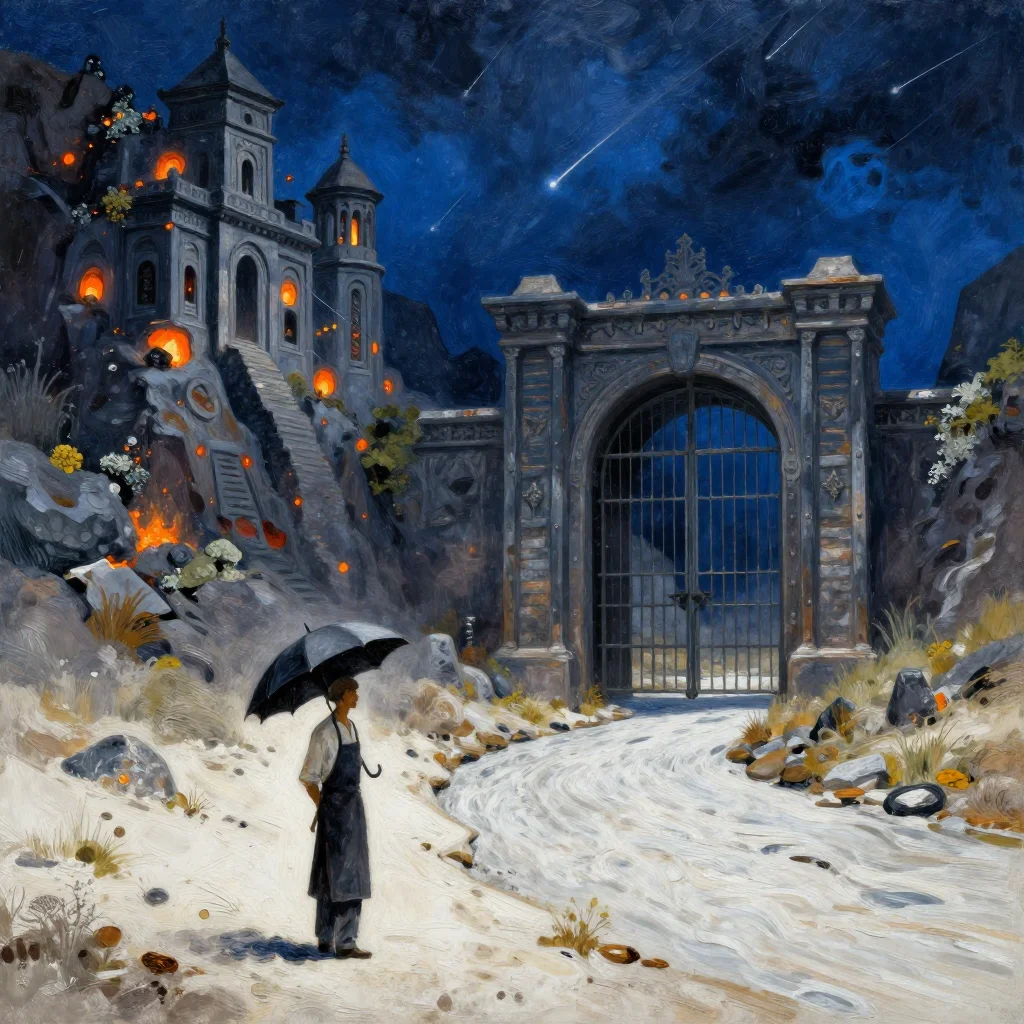
Mara walked beneath the black umbrella even though there was no rain. The storm-light moved across the sky in slow blue sheets, illuminating the terrain in flashes. At midday, the gate appeared: iron ribs rising from the earth, sealed by a pale membrane of frozen weather.
A brass plaque hung from it. The lettering had been worn nearly smooth.
ONE MAY ENTER WITH WHAT THE HOUSE HAS ALREADY PAID.
Mara brought bread, olives, onions roasted in ash, and a stew made from roots that had grown inside the chapel wall. The summoned dead gathered behind her. They watched her work without help.
When she set the bowl down, the gate did not move.
“Your family is already paid,” said her grandmother, appearing at the edge of the light. “The cost was taken before you arrived.”
Mara looked at the old woman’s bare feet, untouched by dust. Behind her, the summoned dead had begun to blur.
The Cost That Cannot Be Paid Twice
Her grandmother explained. The first Oren had crossed the dry river carrying a meal for a starving village. The village ate. The river then asked for the meal’s meaning: the names of everyone who had ever been fed by it.
The Oren family surrendered those names. The gate opened. They crossed. Everyone they had loved was forgotten.
“That is why our recipes summon them,” Mara said.
“Yes.”
“We remember what the family lost.”
“You remember enough to be lonely.”
Mara understood. Her kitchen was not haunted. It was a ledger. Every recipe gathered the names the gate had taken, allowing the dead to borrow warmth, hunger, and conversation for a little while.
The price of opening the gate was memory. Not one memory, but the complete inheritance of appetite: every person the family had ever welcomed, every hand that had stirred a pot, every voice that had said the meal was enough.
She could restore her family’s past, or she could keep the people at her table.
She cooked both.
She made one dish from the recipe her grandmother had refused to teach her, and one from the recipe her mother had burned. The first summoned her grandfather. The second summoned her mother. The kitchen filled with overlapping conversations until the copper pots rang like struck bells.
Mara served them beneath the black umbrella, sitting at the head of the table. She listened to every story, every correction, every silence. When the gate trembled, she did not rise.
What the House Kept
At dawn, the valley was gone.
Only the dry river remained, and the gate, and the black umbrella caught in the lichen. Mara walked home with no memory of her grandmother’s face.
She remembered the meal, though. Every ingredient. Every name. The weight of a ladle in her hand. The exact minute the bread came out golden.
At the monastery kitchen, the summoned dead waited.
“We cannot follow you home,” said the boy.
Mara set a bowl before him. “Then we will eat here.”
They gathered beneath the blue storm-light. Lichen brightened the stone walls. Burnt orange embers opened in the stove. The table, once empty, filled from end to end.
And at the far end, where the gate had stood, a second kitchen door appeared.
Mara opened it. The people waiting beyond were unknown to her, but they were hungry, and they had come from the long dark to ask whether there was room.
She put down the black umbrella.
Then she returned to the stove.
Proof is not remembering who you were. It is choosing what you will feed next.





