 Netwrck
Mystery.
Mara Vale arrived at Winter Terminus with a blue thread tied around her wrist and a suitcase full of windows. Each pane was wrapped in felt: a square of summer rain, a pane of autumn smoke, a thin oval through which a drowned city still held its lights.
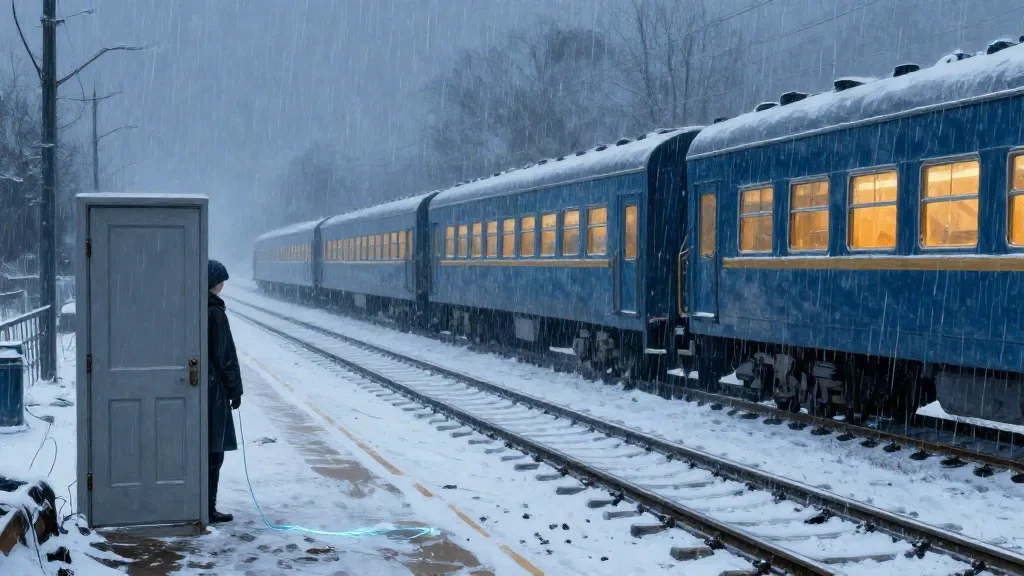
She had been told the station occupied the last hour before dawn. Snow pressed against the iron roof, and the departures board clicked with destinations no timetable admitted: APRIL PLATFORM, LATE ORCHARD, THE LONGEST EVENING. Passengers climbed into carriages marked with seasons. Some carried suitcases. Some carried shovels. One man boarded with a summer orchard trapped behind him in glass.
Mara’s hands smelled of hot sand and soda. She had come to find a window for Room Seventeen, where a woman was waiting to see her invalid brother. The room existed between a hospital and a forest, and it needed something ordinary to look through. Something with a kitchen table, perhaps. Something with a morning.
The Passenger Who Would Not Speak
At the ticket window, a clerk with frost in his eyelashes examined her case.
You cannot take a window through truth, he said. Only through what has been carefully withheld.
Mara showed him a palm-sized pane. Beyond it, rain moved over a red garden.
“Room Seventeen needs a morning,” she said.
The clerk’s face went pale. “There is no morning there.”
“There is mine.”
He stamped her ticket without answering. The blue thread around her wrist tightened by itself, tugging toward Platform Five.
There she found a trail of wet footprints crossing the snow. Each print shone with a little ordinary daylight. Mara followed it past a frozen fountain and a rack of abandoned coats. At the end stood an unmarked door, gray as winter sky.
Behind it, a woman in a blue hospital gown was sleeping in a room with no walls.
A Safer Kind of Darkness
Mara put her hand to the door. The blue thread burned cold.
“Where is the morning?” she asked.
No answer came. The sleeping woman turned her face toward nothing.
Then Mara saw the brass rail of her bed, the chipped mug on the sill, the blue thread running from her own wrist into the room. A thread of light, braided with lies, held the door open. The truth would break it.
Mara stepped back.
In the station, a child was crying beside a carriage marked FIRST FROST. He said his mother had promised to return before breakfast. A porter shook his head. “She was never here.” The child’s crying softened. A coat dropped from the rack and covered him. A warm window appeared in the carriage wall, showing him a kitchen table and a woman pouring tea.
No one spoke. The lie made the station safer: the tracks stopped shaking, the train whistles softened, and the footprints in the snow faded.
Mara understood. Truth was not merely dangerous. It was loud. A lie was a locked door; truth was a signal fire.
The Door That Counted
She returned to Room Seventeen and searched the floorboards. A single blue thread ran beneath them, knotted at seven places. Each knot corresponded to a thing someone had refused to say: the brother was alive. The mother never left. The morning belongs to someone else. The station takes what is named.
Mara drew a small window in the gray. The unmarked door appeared inside it.
“I know you are there,” she told the room.
The sleeping woman stirred.
“I know you came from a morning,” Mara continued. “I know you asked the station to hide you. I know the blue thread is a promise you made to return.”
The thread flared. The woman woke. Far away, a train announced a platform in a voice like breaking ice.
Mara held the window steady. The room filled with pale gold.
“I know I cannot keep both of us here,” she said.
The woman reached for the thread. Mara cut it.
Then, against the station’s rising wind, she told the one lie that would make the truth hold.
One Ordinary Morning
“There was never a brother,” Mara said.
The room exhaled.
On Platform Five, a carriage door opened onto a kitchen at dawn. Steam lifted from a kettle. A red bicycle leaned against the wall. A woman in a blue gown carried a cup to a table, where an invalid man slept beneath a patch of clean sunlight.
He opened his eyes.
Behind him, the real morning took hold: birds, traffic, a milkman’s bell, the ordinary clamor of a day beginning.
Mara walked away before it could be taken. The clerk watched her pass.
“You kept it,” he said.
“I lied for it.”
“Yes.” He stamped her empty ticket. “That is the dangerous kind of truth.”
Outside, snow began to melt. Mara opened her case. Every window had gone dark.
Only the blue thread remained in her hand, warm as a pulse. She tied it around the finger of the woman in the carriage, where the invisible brother lifted it to the light.





