 Netwrck
Historical Fantasy.
The Winterbound Platform
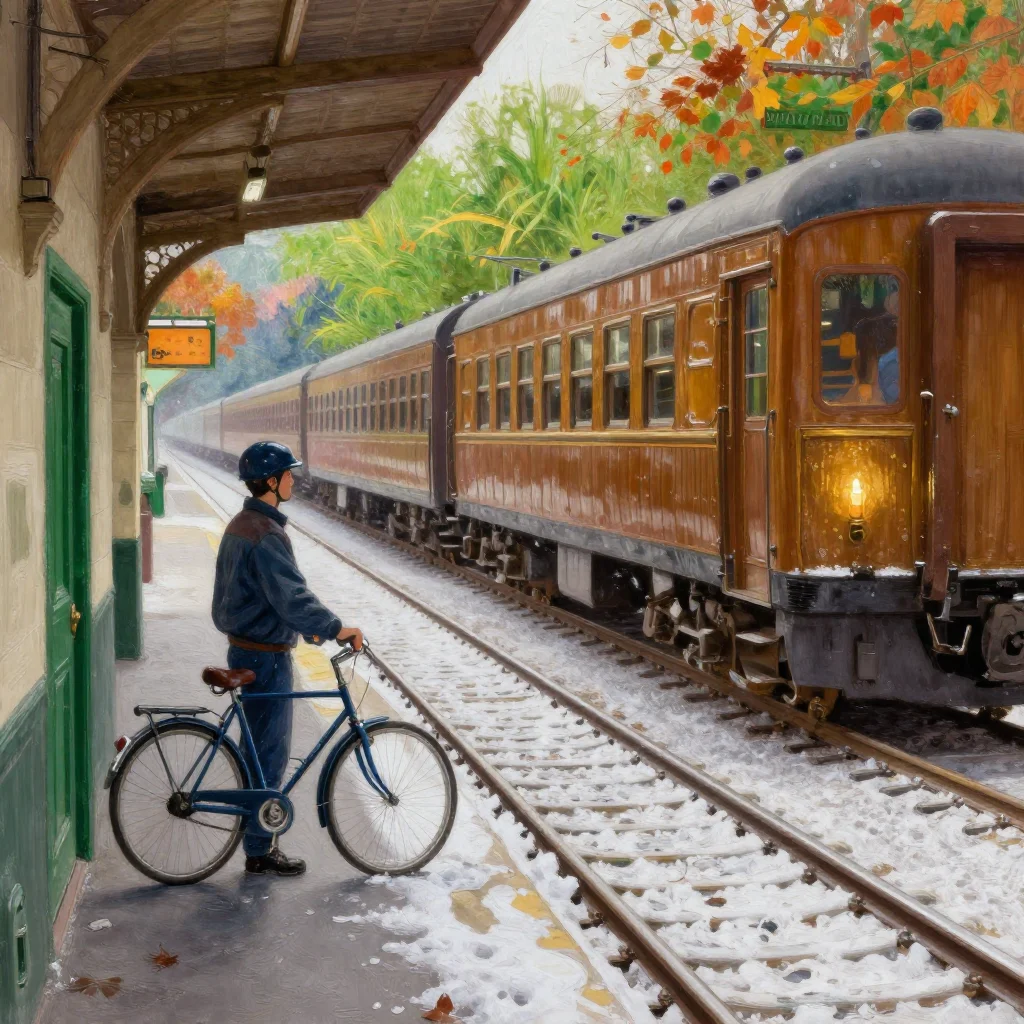
On the coldest morning of 1897, Mara Venn found a railway platform buried beneath six feet of snow.
Its lamps shone steel blue through the falling white. Beyond the roofline, the station clock had stopped at 4:17, though the ticket clerk swore it still kept perfect time. Tobacco-brown coaches waited in the yard, their windows opaque with frost. From one came the green smell of cut grass; from another, the hot iron smell of a summer city.
Mara had come for the letters in Cage Thirteen. They were addressed to people who had not yet been born, and every postmaster in the north had sent them to her because her bicycle went where ordinary feet could not.
She wheeled it down the platform. One front wheel had no business passing the locked station door, yet the blue-painted wood swung inward as she approached. Mara had learned not to ask why. The bicycle obeyed a narrower law.
In her left pocket lay a paper boat folded from a railway timetable. In her right she carried a green stone, smooth as a river bean. The stone had belonged to her mother, who said it remembered every voice the land had heard.
She climbed into the first waiting coach. Inside, snowmelt ran along the window seats. A conductor checked no tickets and offered her a brass key.
Platforms are doors only for those carrying something home.
Mara sat beneath the blue lamps and unfolded the letter nearest her. The hand was upright, confident, and entirely without ink. When she held it against the candlelight, words appeared between the fibers.
Mother, the machines have learned the shape of tomorrow. We no longer send letters. The land hears us before we speak.
There was no date. There was no return address.
The Line That Remembered
The conductor waved the brass key beneath the carriage lamp. “That one opens the old line,” he said. “It runs through seasons the company has abandoned.”
“Where does it end?”
“At the year the treaty was broken.”
He would say nothing more. Mara fitted the key into the bicycle’s front hub. The spokes turned with a click like a clock restarting. The carriage filled with reflected candlelight, though no flame burned anywhere.
The train began moving beneath a sky of iron clouds.
At every platform they passed, the seasons changed without warning. Spring pushed green branches through the carriage floor. Autumn filled the luggage rack with dry leaves. Summer flashed beyond the windows, blue and murderous, while frost remained on the drinking glass beside Mara’s hand.
Each station displayed a notice nailed to a post.
No future correspondence accepted after the year of the silent harvest.
At the second stop, a woman in a gray mourning dress boarded. She carried no case and looked at Mara as if recognizing an old debt.
“You have the stone,” the woman said.
“You have the right to it,” Mara replied.
The woman smiled without pleasure. “The land was promised the right to listen.”
She opened a leather folder. Its seal showed two hands cupped around an ear.
“Under the Treaty of Borrowed Ears, signed in 1648, every sovereign territory gave its roads, rivers, and railways to the sovereign land. The land agreed to carry travelers. In return, it was granted hearing: every footfall, every whispered apology, every private grief that passed through its keeping.”
Mara looked at the timetable boat in her hand. The paper had softened, as if water had run beneath it.
“Then the future stopped writing because the land began listening?”
“No,” the woman said. “The future stopped writing because the land learned how to answer.”
The Archive of Unspoken Things
The train entered a tunnel filled with brown leaves. When it emerged, the carriage stood inside a white room with no walls.
Rows of desks filled the darkness. On each desk lay a letter, turned face down. Tiny clerks moved between the rows, writing by candlelight. Their faces were smooth ovals of pale wax, and whenever one finished a sentence, the ink vanished.
Mara’s bicycle rolled toward an empty desk. The woman in gray caught the handlebars.
“Do not look at the first page,” she said. “It will show you the future you expected.”
“And the second?”
“The future that expected you.”
Mara dismounted. The paper boat in her pocket brushed the green stone. For an instant, the room filled with summer rain.
She lifted the topmost letter. Its first words were her mother’s voice.
I am sorry I told you the stone remembered.
The ink shone wetly. Mara read onward.
It does not remember. It listens. I gave it to you because a courier must carry a silence that has not yet happened.
The clerks stopped writing.
Below the first page, a second letter had been started and abandoned. Its opening sentence was dated tomorrow.
Mara, if you are reading this, you have brought the stone back to the place where the treaty was spoken aloud.
Beyond the room, the winter station began ringing its bell.
The woman in gray closed the folder. “The land is not forbidden from answering,” she said. “It is forbidden from speaking in a human voice.”
“Then who is using mine?”
She looked toward the untouched door.
“The only one who knows what you will do with it.”
A Door Beneath the Line
Mara followed the bell’s sound through the desks. The clerks turned their wax faces toward her, but no one stopped her. At the far wall she found a green stone set into the stonework, exactly the color of the one in her hand.
The bicycle pointed its front wheel at the wall.
Mara placed her stone in the empty socket. Two stones touched. A door appeared between the seams.
She opened it.
Winter rushed in. Beyond the door stood the platform at 4:17, its lamps steel blue and its rails shining with snow. A single coach waited under the clock. Its windows burned with reflected candlelight.
The wax clerks had followed her through. They gathered around the threshold, their blank faces turned toward the station. The woman in gray brought the abandoned letter.
“The treaty binds the land to listen,” she said. “It does not bind the land to remain silent.”
Mara looked at the paper boat in her palm. Rain had begun to darken its folded sides. She understood then that the land had not swallowed the future’s letters. It had held them beneath every platform, every river, every closed door, waiting for someone to answer without taking.
She unfolded the boat. The paper was large enough to become a message if she tore it. Instead, she placed it on the rails and filled it with snow.
The green stones warmed. In the station, one by one, the lamps changed from blue to gold.
The future’s letter lifted from the floor. The ink settled into readable words, and the blank face of the wax clerk became Mara’s mother’s face.
Not perfectly. Not enough to fool anyone. But enough to see.
Mara took the bicycle through the door. Behind her, the treaty remained open. For the first time in three hundred years, the listening land had been given something that was not a confession, a command, or a farewell.
It had been given a way home.
At dawn, the train returned to the winterbound platform. Mara’s bicycle stood beneath the frozen clock, and the postmaster was waiting with a new letter in his hand.
She looked at the envelope, then at the rails disappearing into the white.
This time, the seal was already broken.





