 Netwrck
Fantasy.
The Carriages Beneath the Sand
At the hour when violet dusk erased the horizon, the stationmaster heard wheels grinding beneath the desert.
The sound came from under the abandoned platform, where foxes had made their beds and wind had polished the rails to a dull silver. Dr. Ilyan Vale descended carrying his black medical bag. He treated homesickness as a physician should: with questions, broth, sleep, and occasionally a sedative made from blue thorn.
His patient was the station itself.
It had been built for a railway that no longer existed. When the first century train arrived, it brought twelve carriages of white cloud, each window reflecting a sky belonging to someone else. Its passengers stepped down with salt in their shoes and longings in their mouths. The station gave them rooms, meals, and names. It learned the taste of their grief.
Ilyan examined them at the old waiting hall. A woman held a ticket to a city demolished before her birth. A boy missed the moon of a moonless planet. A merchant had forgotten his own face and remembered only the smell of his mother's kitchen.
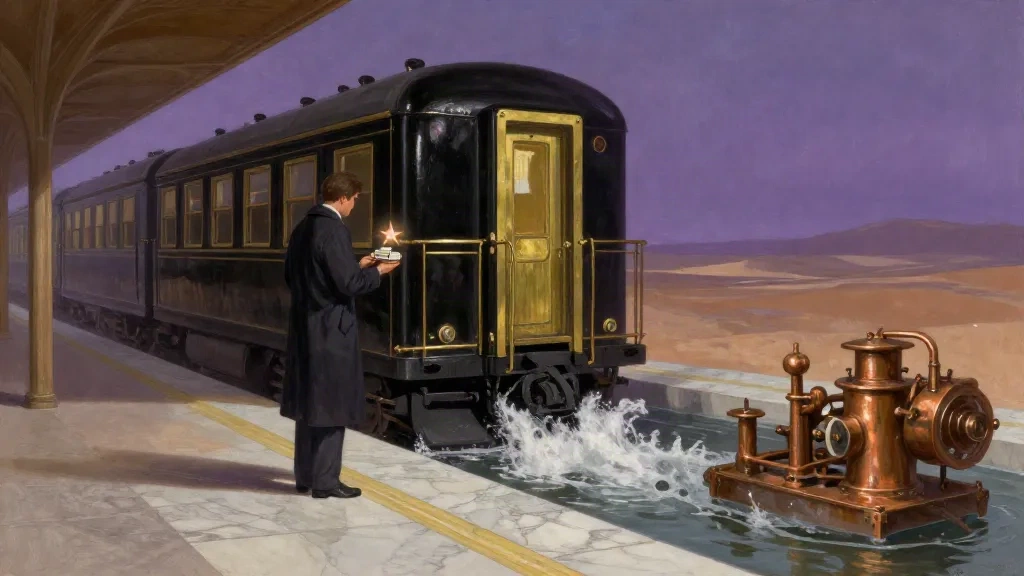
Inside his bag, wrapped in linen, Ilyan carried a music box. It played eight notes whenever a patient began to describe home. Beside it rested a copper star, small enough to close around in his fist. The star had belonged to his daughter, who vanished from a train in 1908 and reappeared nowhere.
What the Flood Remembered
At dawn, rain struck the station roof without a cloud in the sky.
Water poured from the locked signal box, from the dining car, from the brass lamps and the desert's buried bricks. Ilyan saw it gushing from a sealed municipal arch behind Platform Three. The flood had uncovered a civic project: a grand underground station designed to receive the century train and keep it there forever.
Its marble counters rose beneath the mud. Its porcelain signs promised arrivals without departures. Thousands of white tickets drifted past his boots, each printed with a destination no passenger could reach.
The stationmaster stared at the architecture. “We built it before the train came,” he said.
“You built a beautiful prison,” Ilyan answered.
The music box in his bag began to play. No one had touched the key.
The Engine's Bargain
At noon, the train surfaced in the flood.
It was black lacquer and brass, its windows pale as cloud. A conductor emerged with a silver timetable and offered Ilyan passage to any century he named. In return, the train would carry one passenger back to their lost home and retain the station as its final stop.
“The station wants to belong somewhere,” said the conductor. “It cannot bear to be temporary.”
Ilyan looked at the waiting hall, where the homesick had gathered beneath the leaking roof. He understood the offer. The train was not imprisoning them out of malice. It was offering permanence because permanence was the only shape of love it knew.
He opened his bag and lifted the music box. The eight notes sounded across the water.
Every carriage door opened.
Inside each compartment was a version of the station made from memories: a warmer floor, a familiar window, the exact hour of an unbroken goodbye. The passengers entered because the rooms were beautiful. The conductor bowed.
Ilyan climbed onto the locomotive.
A Station Without Tracks
The engine knew the taste of copper and the pressure of stars. It feared a place with no fixed destination.
He placed the copper star in its brass ignition housing.
“A home is not a prison,” he said. “A home is a door that opens both ways.”
The train shuddered. Its wheels turned against the rails, seeking a line that had never existed. Ilyan set the music box on the engine's controls. Eight notes tore through the engine's noise.
The carriages began to dissolve into cloud-white birds.
They carried the passengers toward their lost rooms, their old skies, their unfinished conversations. Not home as it had been. Home as memory had kept it: imperfect, open, alive.
The conductor seized Ilyan's sleeve. “Then what will remain of the station?”
Below them, the flood exposed the marble counters. Ilyan watched water wash away the hidden locks.
“A platform,” he said. “A departure. A place where anyone may leave.”
The engine cooled. Its timetable fell open to a blank page.
By evening, only one carriage remained, rusting beside the platform. Ilyan entered it and found no doors, no windows, no compartments. On the wall, where the conductor had stood, a small copper star reflected violet dusk.
He did not take it.
Outside, the station lamps came on, one after another, as if remembering how to illuminate a departure.





