 Netwrck
Historical Fantasy.
The house that would not sleep
By dusk in Bellwether-on-Wye, the chimneys had begun whispering.
They whispered through Elian Vale's surgery, past the brass instruments and bottles of bitter tincture, through the rooms where patients sharpened their memories of distant places. A widow rubbed the glass of her photograph case and asked for salt. A coal carrier complained that the mines had grown so far away. A bride said she could hear her wedding morning creaking beneath the floorboards.
Elian listened. Then she stitched the widow's torn sleeve, packed coal in the carrier's basket, and gave the bride a cup of chamomile.
“Homesick houses,” she said. “There is no cure.”
“There is always a cure,” said the house itself, settling its chimneys with a groan. “Only some cures cost too much.”
Every bridge in Bellwether was a promise, and every bridge kept the words its builders had spoken. The Confession Bridge over the Wye bore I will return before the spring thaw in letters beneath the water. The Sorrow Bridge declared, Nothing I carry across will be your burden. Elian had crossed them so often that the river knew the hem of her blue dress.
On the eastern edge of town, however, a house had sickened twice. Its residents boarded opposite trains. Its doors separated like quarrelling neighbours.
That house belonged to Miriam and Thomas Rusk.
The scheduling error
Elian found Thomas in his shed, packing a trunk with a red scarf wound around one hand.
“Her mother wants her in Yorkshire,” he said. “Mine wants me in Bristol. Tomorrow's train leaves at eleven-forty. If we board separately, neither can turn back without appearing before the judge.”
Elian set down her black bag. The ticket on the workbench had been printed for the 11:40 departure, but its brass date plate showed the following day.
“This cannot take two days to arrive,” she said.
“Stationmaster Quill has settled that.”
Stationmaster Alaric Quill met them at the platform with his lantern lit despite the afternoon sun. Steel-blue coat, tobacco-brown gloves, a watch chain glinting like cold wire.
“Every ending,” he said, “is a scheduling error.”
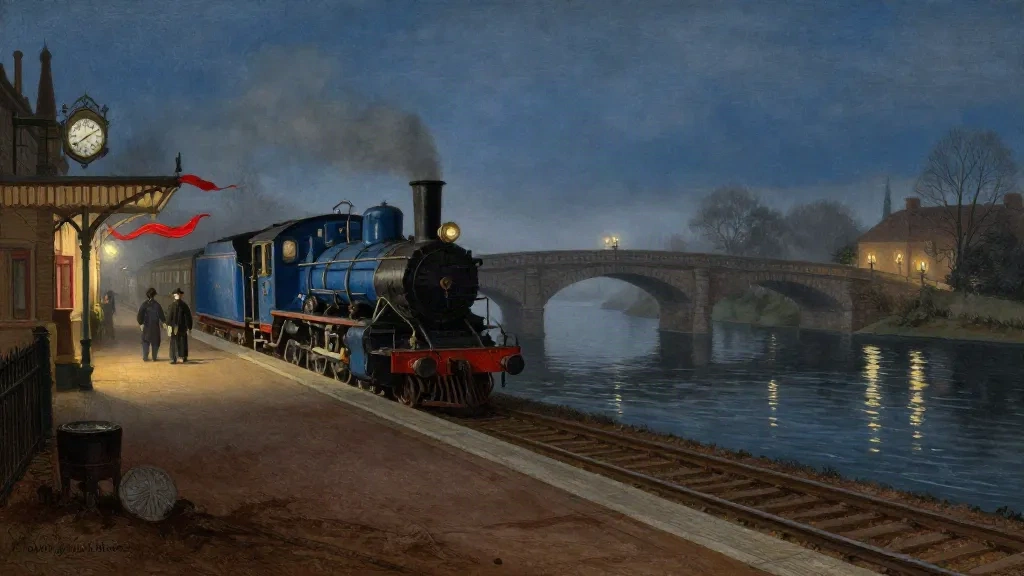
He tapped the ticket. A second train emerged from the empty fields, silent and blue, its lamps burning before the whistle. The Wye reflected candlelight through the station window, wavering in the glass.
“The service has been amended,” Quill continued. “The last Rusk departure was entered as permanent. I hold to the record.”
“You hold to an error.”
“The distinction matters when two people have scheduled their hatred for convenience.”
Elian examined the printed clauses beneath the date. In town records, she had seen the seal used for promises withdrawn before they were spoken. The ward was still there, followed by a private physician's name.
Her predecessor. Doctor Ambrose Wren, dead fourteen winters.
One seat kept empty
The river rose under Confession Bridge.
Its words, swollen beneath the surface, turned from a vow into a question: Will you return before the spring thaw?
Elian found the date of that spring in Wren's almanac. He had made Thomas promise to bring Miriam across the bridge before the first clear day. The local almanac, burned during the flood three years later, had omitted the thaw.
“Then he broke his promise,” she said.
“The bridge records intent,” she answered. “And intent is what he feared she would see.”
They brought the red scarf to the station. Elian wrapped it around the ticket, tightening the knot exactly as she had tied bandages for the fever ward.
Quill watched. “That changes nothing.”
“It prevents the river from taking the wrong name.”
At midnight, the silent train waited beneath steel-blue stars. Thomas boarded with the ticket. Miriam remained on the platform, folded into her coat. The engine gave a whistle like a kettle abandoning supper.
Thomas looked at his wife. The red scarf rose.
“I thought the ending was,” he said.
“An error,” Miriam replied. “Yes.”
Then she crossed the line.
The carriage doors sealed before Quill could amend his rule. Elian stepped onto the final link, one hand closing around the scarf's loose end.
The last amendment
The river remembered before the train escaped.
Every bridge in Bellwether tightened its cables; every promise stored in brick and mud strained toward the rails. In passing houses, doors fitted neatly into frames. Letters slid from mantelpieces to tables. Shoes walked to their owners. The old woman across from Elian began stitching her absent husband's sleeve.
“Homesick houses,” she murmured, “sometimes send one another home.”
Quill stood rigid beside the clock, watching his amended service rewind. “Record,” he said, “this departure as never.”
But the river rejected him. Elian gave the ticket to Thomas. Its date blurred, then darkened into a new plate: TODAY.
“No,” he said. “A cancelled journey will be remembered as cancelled.”
“Then make another promise,” Elian said. “Small enough to keep. Specific enough to be called a mistake.”
Thomas turned to Miriam.
“I made you a lie,” he said. “Every winter I asked about the judge, I had already written to your mother.”
Miriam's face closed.
“Yes,” she said.
The train had no place for a repaired past. Elian seized the red scarf and tied it to the station clock, above the departure board.
In Bellwether, no promise was broken until its binding was named. The scarf snapped in the wind. The train halted. Its destination changed from BRISTOL AND YORKSHIRE to THIS PLATFORM.
Thomas stepped down. Miriam did not meet him, but she held out her hand.
Elian left before they spoke. Some cures, she knew, must begin with a hand and end where no nurse can follow.
At dawn, the Confession Bridge finally showed a new line beneath the water:
We kept the truth too late, and arrived together.





