 Netwrck
Science Fiction.
Theatre at the Ebb
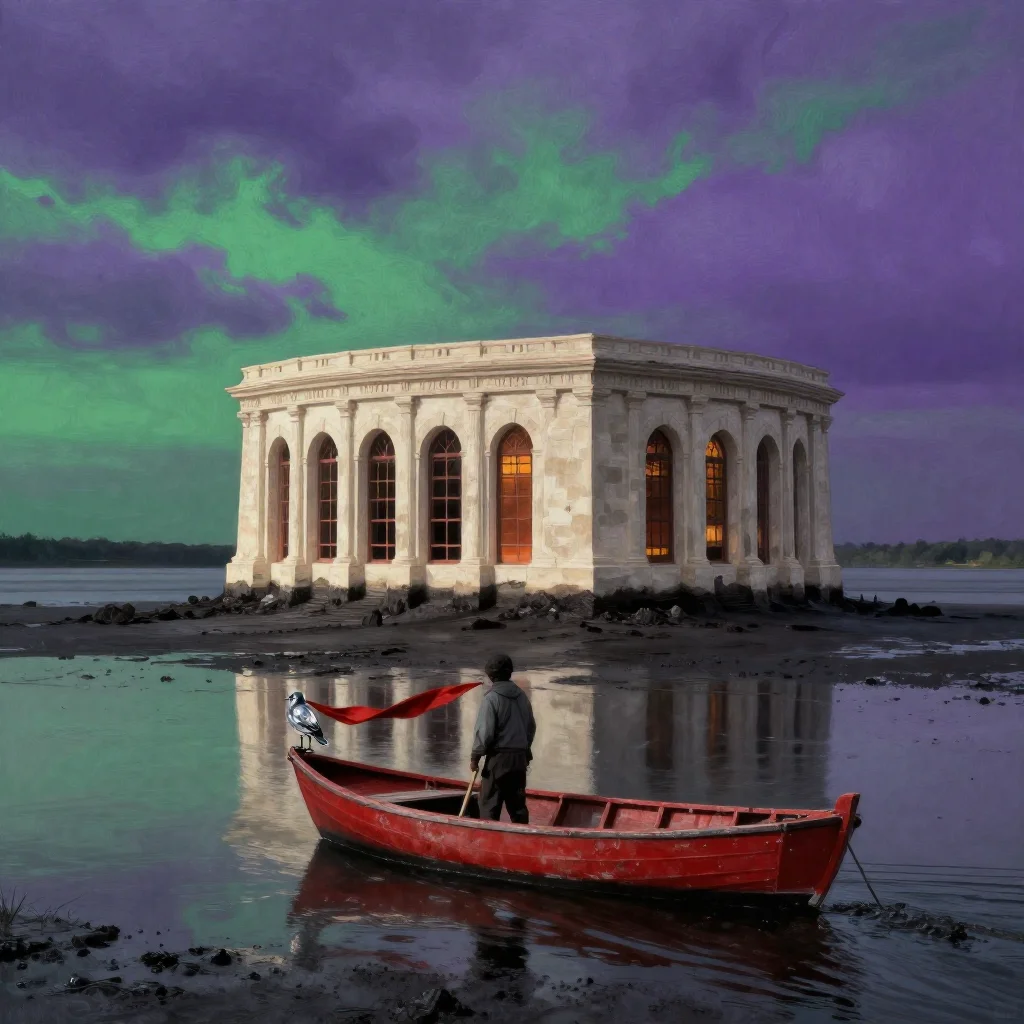
At low tide, the lake withdrew into the western basins and uncovered a theatre of pale stone. Its columns stood in the mud like drowned trees, and its doors waited above a stairway of barnacles. Maren knew the crossing because he had made it nine hundred times, though the lake had shown him only one morning each week. He ferried the living, the vanished, and those who had misplaced their futures across the black water. His boat was painted the dull red of old brick. In its stern rested a glass bird, delicate as a held breath.
He had come to understand the arithmetic. Every crossing was a rehearsal. The lake lifted the water, set the theatre bare, and offered Maren an audience that had not been cast yet, and then took it back. On the first crossing there had been eleven passengers and a woman selling fish from a basket of stones. On the fourth there had been no passengers at all and the audience seated in the dark, waiting politely for a play that never began. On the two hundredth, Elian Vey had climbed down the barnacle stair and put his hand flat on the theatre door as if greeting a horse.
Maren rowed because rowing was the only verb that kept working. He was fifty-one years old and had been the lake's ferryman for thirty-one of them, and he had never once rowed the same crossing twice, and he had never told anyone that, because the telling seemed like a kind of theft.
What the Lake Would Not Say Aloud
His desire had a name: Elian Vey, the lighthouse keeper who had vanished before the first winter. Maren remembered Elian's laugh, the copper scar through his left eyebrow, and the way he wrapped his red scarf around his throat even in summer. The keeper had been the last person to remember the original world, before everyone began receiving the same dawn and the same distant thunder. He had gone looking for the theatre's discarded endings. He had never returned.
He had left the map. That was the word Maren used, and he knew it was a word with a door in it.
It was drawn on skin, stitched from the lining of an old coat, and marked with places no one had ever seen. Whenever someone tried to follow it honestly, the ink changed. A straight coast became a staircase. A blue inlet folded into a mountain. A name erased itself whenever its owner spoke it aloud. The map did not prevent travel; it prevented agreement. It made truth depend on a person's first and most secret intention.
Maren had tested this. In the ninth year of the ferry he had taken the map to a village that believed itself ordinary, and a woman there had sworn to follow it honestly, and the whole coast had folded into a staircase and put them on a mountain that was not there. After that he had refused every passenger who asked to see it. The map was not a guide. It was a preference wearing the shape of a place.
The Name the Lake Owed Him
There was a third thing the lake knew about him, and Maren had told no one that either.
Forty years ago, before the theatre, before Elian, when Maren was a boy of eleven and the lake still held ordinary weather, he had run the crossing for his uncle during a spring flood. A woman came to the bank. Ines Sorel. She had a red scarf and a bad cough and a house on the eastern shore with shutters the colour of weak tea. She asked to be ferried and did not have the fee, and she offered instead the only currency the water had ever honoured from her, which was a sentence. Let me forget that I was ever afraid, she said, and the lake took her at her word, and Maren felt the sentence go out of her like breath out of a lung.
Then the current under the boat turned, and Maren, eleven and strong and stupid with a dead man's certainty, cut the rope and let the boat drift broadside while he watched the channel. Ines did not drown. She was simply removed. The lake did something with its discarded passengers that it never explained, and the village on the eastern shore built a house with shutters the colour of weak tea, and a woman lived in it, and she was not Ines, and she was not anyone.
Maren had told himself for four decades that the lake had taken her. It was easier than the truth, which was that the lake had offered exactly what Ines asked for and Maren had broken his own oar on the thwart and held on anyway. The glass bird had arrived in the stern of his boat that same spring, and had never once sung in front of him.
The Stagehand Called Corren
On a crossing in his forty-ninth year, the tide fell early.
He was two hundred paces off the theatre when he heard a voice carry across the water in the flat register of a man giving a note. You are early, ferryman, it said. The house is not finished.
He rowed in anyway. Under the portico a man in a workman's apron was stacking barnacles into a crate. He had a long neck and the closed eyes of someone listening harder than necessary. Where his brows should have been, two small audience masks had been fitted, hinged at the temples.
“You are late, Maren,” said the man. “She is coming. She always comes. I have kept the sentence.”
“Corren,” Maren said. He had not said the name in thirty years and it came out of him like a cough. Corren had been the theatre's prompter in the last performance of the original world, and had read every line twice because the actors could not be trusted with the second reading. He had gone down beneath the stage the night the performance was cancelled. That was the official account, which is to say the account the lake permitted.
“The bird,” Corren said. He had not opened the masks. “Put it on the rail where I can hear it sing. It sang on the final night of the original world, beside the keeper's red scarf. It has not sung since. Do you know why?”
“It has nothing to say to me.”
“It has nothing to say to you,” Corren agreed. “That is the same as a shout, where I am standing.”
Corren lifted the mask on his left brow with one finger and looked at Maren with a single dry eye.
“The keeper read the map aloud,” he said. “All of it. On the second night. He wanted the truth to be publicly binding, so he stood on the apron and dictated his intention like a man posting a notice. The coast became a staircase for him and he went down it anyway, because he thought a will that strong ought to be able to carry a lie. He was wrong. The map gave him exactly what he asked for, which was the truth, and the truth had a door in it, and he walked through the wrong side of the door. That is all. That is all any of it has ever been.”
Maren felt the map warm against his chest, patient as a cat.
“The cancellation,” he said. “Who cancelled the performance?”
Corren set the crate down.
“I did.”
The theatre's eaves ticked with barnacles. Somewhere under the boards, a rope creaked.
“A man in a wet coat came down the stair with the copper door already unlocked,” Corren said. “I had spent nine years promising the audience that the last line would be the truest thing they had ever heard. I had nine years of small promises to keep, ferryman. I sent the actors home. The keeper went looking for whoever had ordered the last line struck. Both men were wrong about the door.”
“There were two men.”
“There was a door,” said Corren. “Then there were two men. You will find that this is how it always goes.”
A Bargain in a Dry Room
Corren took him beneath the stage, down a stair of warm air, to a room where the brass door stood in a frame of black salt. Corren did not touch it.
“The lock knows the keeper's palm,” he said. “You will find it does not answer. What it wants is a scar, and it is not fussy about whose.”
“You want something.”
“I want to be permitted to stop.” Corren's voice thinned. “I have been prompter for thirty-one years of a performance that ended nine years before I died. Someone must read the lines. If the keeper comes back and reads them, the sentence is spent and I may go and stand in a field somewhere, and be a man, and be tired in the ordinary way. You have a map that will not agree to anything. You have a keeper you want. Make a trade, ferryman, and let an old man out of his job.”
The map slid out of Maren's coat and lay itself on the floor between them, and where Corren's boot came near it, the ink rearranged itself into a coastline with a small red mark at the third headland, which was not a headland, it was a shutter.
Maren said the only true thing he had, which was a lie told carefully. I am going to take the ending that names me, and I am not going to give anyone my intentions, and I am not coming back here with a route.
The ink went still. The coastline held its shape for the length of three breaths and then folded itself into a long stair of white steps going down, and at the bottom of the stair a brass door appeared, and beside it a small red door in a white house, and both were the same door.
“Now it will hold,” said Corren, with something that was almost satisfaction. “A map cannot help a man who will not want anything. It is the wanting that bends it. If you were the kind of man who wanted nothing, ferryman, you could have walked to the keeper in a straight line years ago. You did not. Nobody does.”
Maren picked up the map. Corren's eyes went to the glass bird in his hands, and for the first time the mask-lids moved.
“Do not let it sing in the theatre,” Corren said. “If it sings here, the sentence I was holding becomes the last line, and the last line is what I struck. Put it in the water. Put it in a place where something has been taken and not given. Water forgives. Audiences do not.”
Maren had not intended to ask. He said: “What did you strike?”
Corren turned the masks to the wall.
“Ask the door,” he said. “It will not lie. That is the door's cruelty. It reports, and it does not interpret. Go on, then. It has been waiting nine years for somebody with a scar and a reason to use it.”
The Room of Discarded Sentences
The brass was warm. It did not care whose scar answered it. Behind the door was a room built out of other people's last lines.
Endings hung from the ceiling on copper wire, thousands of them, turning very slowly in air that had no source. And the harvest failed every year after, and no one could say why. She kept the letter and never sent it and grew out of it. He came back in October and found the town had finished without him. Each was labelled in a small copper hand with the name of the person it belonged to. Maren read the ones nearest the door first, out of a habit he did not admit to, which is that he had spent his whole life reading the ends of things in order to see whether the middles had been worth it.
Then he stopped reading, because the middle of the room was where the labels were, and where the labels were, hung the oldest wire.
“Ines Sorel,” it said.
Maren put the palm of his left hand against the wire, and read.
She asked the lake to take the fear out of her, and the lake took the fear and the wanting of the fear and the road out of her and the memory of the road, and set her down in a house with tea-coloured shutters, and she was not Ines, and she was not anyone, and she was not unhappy.
He read it twice. There was no cruelty in it. That was the discovery that took his knees. He had spent forty years building a girl with a bad cough and a red scarf into an accusation, and the lake had simply complied, in the exact terms requested, with the whole heart it was given, and the terms had not included him.
He looked for Elian's name. He went along the wire, patient, method name by name, and did not find it, and the not finding was itself an answer, because the labels were alphabetical and he had passed the K's twice.
On the last wire, labelled only Elian Vey, keeper of the light, in a hand that was not copper but glass:
He remembered correctly, and the world mistook him for a traitor, and he went down looking for a man who was never there, and the door was a door and not an answer.
Maren cut it free. The wire came away with a small sound, like a held breath being let go in another room.
What the Lake Remembered
He was two hundred paces out when the tide turned behind him, and the lake began to put the theatre back.
Doors closed in sequence, patient as a man closing a ledger. Columns sank in order of height, the smallest first, the way a person kneels before standing. The stage came apart into the audience that had been sitting on it. He could see salt and gulls and six people who had come seeking better versions of themselves, and one of them was a woman with a red scarf, sitting in the front row, not watching the stage, watching him.
Then the water lifted the whole ruin and closed it, and the mud settled, and the black channel lay flat and empty under a sky going the colour of a bruise.
Under the mud, the actors performed the scene Corren had struck. He knew it because he could hear it. Maren rowed the flat and cold and black while the lake sang the last line over and over beneath him.
He was halfway to the eastern bank when he found the sentence.
“You are early, ferryman,” said the woman on the water. “The house is not finished.”
“The performance was cancelled.”
“The performance was cancelled,” she agreed, and turned the masks to the road, “and you were not the one who ended it. Ferryman, this matters more than you will allow yourself to hear. Look at what is in your hand. The lake takes a sentence from the person who spends it. You have taken a keeper's. It is not a ticket. It is a debt. It will be called in, and it will not be called in by the lake.”
“Corren,” he said.
She stopped. It was the first and only time Maren ever saw the composure go out of the voice on the water.
“Yes,” she said. “I am Corren. I struck the last line. I sent the actors home and I put my hands over the prompter's book and I let a man in a wet coat go down a stair for a reason I gave him, and I have kept a sentence for nine years because I could not bear the last thing I had written to be a lie. I have watched nine hundred crossings from under this water and I have never once been permitted to be tired. Give it back to me and I will stop. Let it finish. Let the play end with the truest line and I will be a man in a field.”
“The keeper reads it,” Maren said.
“The keeper is not here.”
“He is going to be.”
Silence, and gulls, and the flat black water behaving exactly as it always had.
Maren looked down at the wire in his hand. He thought about a boy with a cut rope. He thought about a woman asking to be spared her own fear, which was a request so large that no one had thought to ask whether it was hers to make. He thought about a scarf in August.
“There is a way,” he said. “Not for you. For both of us, and it costs more than the sentence.”
“Then name it, and hear it come back changed.”
“Keep it,” he said. “Keep the sentence. Do not read the line. Let the play stay unfinished. When the keeper comes back, and he will, because unfinished things come to the crossing like weather, you will hand him the wire and you will tell him you lied, and I will stand on the apron and be loud about it, and the map will not hold for either of us. It will make of me whatever I most secretly want, and you will read it aloud to him before I can change it.”
Corren was quiet a long moment.
“You have worked out what the map is,” he said. “Say it, so I know you worked it out.”
“It does not prevent travel. It prevents agreement. It gives you what you want and calls the route a fact.”
“And what do you want, Maren, from a map that cannot lie to you?”
“One more crossing with Elian Vey in it,” he said. “Alone. With the ink unasked.”
“Ah,” said Corren, and her voice went to the sound of a long neck and closed eyes, “you have been in love with him for thirty-one years and you have never once wanted him unhappy. That is why it has bent so much and gone so little. Get to the shore. I will not take the wire. I will hold the last line in my mouth until it turns to iron, and when the keeper stands in front of me I will spit it out and it will be the truest thing in the room, and neither of us will be thanked.”
She was gone. The water did not mark the place.
At the Crossing
He rowed east, and the glass bird sang one clear note behind him, somewhere under the mud, and he did not look back, and he was careful not to look back, and the not-looking was the whole of his craft.
She was waiting on the far bank. A woman alone, in a red scarf, with the years gone unevenly through her hair and a copper scar crossing her left eyebrow. She held out her hand, palm up, the way you hold out a coin you have already decided not to spend.
“I remember the world before the endings,” she said. “Not the way he remembered it. I remember it out of order. I remember the smell of the gallery before I remember the play. Ferryman, I do not know whether I am the woman on the eastern shore or whether she is me. There is a house with tea-coloured shutters and I have stood in it in every season I can reach. Somebody is asleep in my bed. I came to ask you a question and I want to be careful, because you are a man who has spent his life ferrying people to the wrong bank.”
“Ask it.”
“Do I want to remember,” she said, “or do I want to be forgiven?”
Behind her, out in the shallows where the water was already coming back over the theatre roof, every abandoned future had begun to perform again. He could see the light of it under the surface, a long pale glow moving against the silt, going in the direction a play goes when it will not stop for anyone.
He did not have an answer she would trust. The lake kept no versions. It kept only what had been offered to it, faithfully, in the exact terms of the offering, and it never gave anything back that had not first been surrendered, and Maren had spent his life on the water long enough to know that the difference between the two is the difference between a debt and a gift, and that the lake is honest, and that honesty is not the same as kindness, and that neither of those facts had ever once kept him from crossing.
“I think,” he said, “that the question is mine and not yours, and I think I have been asking it about you for forty years.”
She did not lower her hand.
“Then answer your own, ferryman, and tell me what you do with me either way.”
He took the wire out of his coat, and the wire was not what he had expected, and he understood that it never was. He understood that an ending was not a verdict but a removal: you could take it out of the ceiling, you could not put it back in the mouth of the person it had been taken from. He had been telling himself for four decades that a girl with a bad cough was owed a life, and it turned out that what was owed was not a life but a witness, and that he was the only one who had ever bothered to keep it, and that keeping a witness is not the same as being forgiven by one.
He took her hand. It was warm, and the fingers closed, and it was not Ines's hand, and he did not know whose it was, and he was not going to be told.
Then he pushed off and rowed toward the east, leaving the map folded in his coat. It changed beneath them, describing a route that had never existed, leading somewhere neither the original world nor its discarded versions had named. Behind him the lamps of the drowned theatre went on burning, and the last line went on waiting to be read, and somewhere ahead of him a lighthouse that he had not yet seen lit its lamp over water that had not yet agreed to be water.





