 Netwrck
Mythic Fiction.
The Cook of Low Water
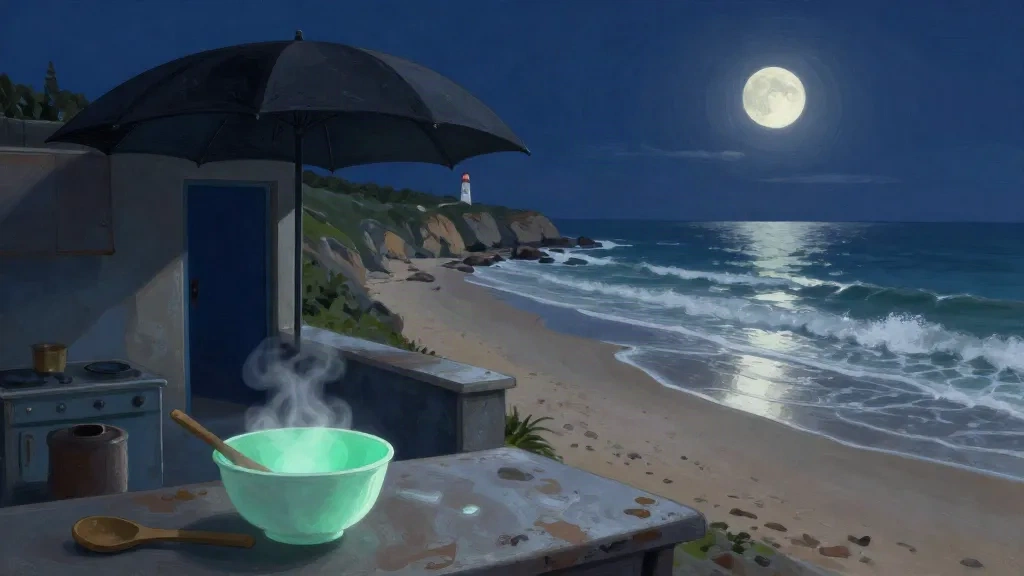
Mara Venn kept the Kettle and Bones above the tideline, where the floorboards stayed dry and the windows trembled only when the north wind blew. Below, the town of Bellwether climbed down black steps toward a sea that never quite stopped arriving.
Every tide returned one forgotten object. A child’s red shoe. A brass thimble. A salt-whitened ring. The objects appeared in gutters, crab traps, and the cups of dried seaweed, and the town carried them to Mara because her recipes could make the past answer.
She began with a broth of mussels, fennel, and burnt bread. The spoon stirred itself. A woman with seaweed in her hair sat opposite Mara, though the chair had been empty all evening.
“My grandmother said she fed the sea-gate,” Mara told her.
The woman frowned. “Your grandmother fed whoever knocked.”
That was the legend Mara intended to prove. Grandmother Elia had claimed that, forty years before, she served a drowned king beneath the old riverbed and opened a gate to the country of those the ocean had taken. When Mara was small, Elia made her taste the soup and say whether she found a grain of salt beneath the lid. There was always one.
Each recipe summoned someone who had once eaten at Mara’s table. Not ghosts, exactly. More like hunger given a memory. They spoke in fragments, complained about the price of eels, and vanished before dawn.
The Black Umbrella
On the seventh new moon, the tide brought a black umbrella to the shore.
It was old, its ribs warped, its canvas shining with an oil that smelled of stone. A note was stitched inside its handle: Do not open beneath a full moon.
Mara carried it to the town’s oldest survivor, Nera Quill, who shook when she saw it.
“That belonged to your grandmother,” Nera said.
Elia had owned a black umbrella, but Mara remembered it from childhood: a useless thing kept beneath the sink, used for polishing knives. The returned umbrella had the same silver scar across its third rib.
“She went through the gate,” Nera whispered. “She came back without one memory.”
“Which one?”
“The face of the person she saved.”
Mara laughed. Legends needed teeth, not sentimental arithmetic. She cooked that night anyway, a stew of clams, onions, and the black umbrella’s rainwater. When the pot began to sing, a boy appeared beneath the table.
He wore a sailor’s coat and held a smooth stone in both hands.
“My name is Tam,” he said.
“You’re from the riverbed.”
“From the gate.”
He set the stone on the table. It was the size of a plum and warm as bread.
“Your grandmother left this to pay the toll. She thought she had paid it twice.”
The Cost That Cannot Be Paid
Tam explained the gate’s rule while Mara’s soup cooled. The riverbed beneath Bellwether had once been a road. When the sea swallowed it, the drowned kingdom moved its gate to the shoreline. The gate opened for a person willing to surrender the memory of someone they loved.
“Your grandmother surrendered my face,” Tam said. “Then she returned and surrendered yours, trying to prove she had not. The gate took the second payment, though. It took her recognition of you.”
Mara felt the floor tilt.
“She looked at me like a stranger.”
“She knew you were family. She could no longer feel the difference between family and a stranger.”
The black umbrella lifted itself from the corner. Its ribs opened with a sound like ribs breaking. Beyond it, the kitchen filled with cobalt shadow, and the dry riverbed appeared beneath the floorboards—mud, stones, and a shining stair descending into the tide.
“Open it,” Tam said. “But the gate cannot be paid twice. Give it a memory of me, and your grandmother will remember your face. Give it a memory of yourself, and she will remember the meal you shared, but you will never know why it mattered.”
Mara understood then. The cost was not the memory. The cost was the choice to keep one truth while surrendering another.
She took down her grandmother’s largest spoon. The sea-glass green of its handle caught the shadow.
The Last Course
She cooked without cutting anything. Clams opened in steam. Fennel softened. Bread drank broth. The smell filled the house with salt and smoke.
When the summoned guests arrived, Mara served them. The woman with seaweed hair. The sailor boy. A man who claimed to have dined with Elia on the night the river vanished. They ate slowly, remembering meals they had lost.
At the final place, Mara set an empty bowl.
She had made the soup her grandmother taught her: mussels, burnt bread, and the single grain of salt beneath the lid. The empty bowl was for Elia.
“She cannot come,” Tam said.
“She can if I remember the right thing.”
Mara opened the black umbrella over the empty place. The gate appeared in its canvas, no wider than a doorway. She put the spoon into the bowl and chose.
She surrendered the memory of her own first winter, the winter in which Elia had carried her through a storm and taught her that hunger could be shared. The truth remained, but its warmth left her body.
The gate opened.
Beyond it, the dry riverbed shone under an underwater sky. Elia stood there, unchanged, her black umbrella furled at her side.
“Mara,” her grandmother said, and the name came with perfect recognition.
Mara could not remember why that mattered, only that it did. The guests entered the gate one by one. The bowl emptied. The tide withdrew.
By morning, the black umbrella hung above Mara’s stove, repaired and dry. The dry riverbed was gone from her kitchen, but its stones had settled beneath the floor, warm and pale.
Every morning afterward, Mara cooked for one empty place. Sometimes the soup tasted of strangers. Sometimes it tasted of her childhood. Always there was salt beneath the lid.
She never knew which memory had paid the gate. That was the price.
But her grandmother came home, and when she saw Mara, she smiled as if no storm had ever separated them.





