 Netwrck
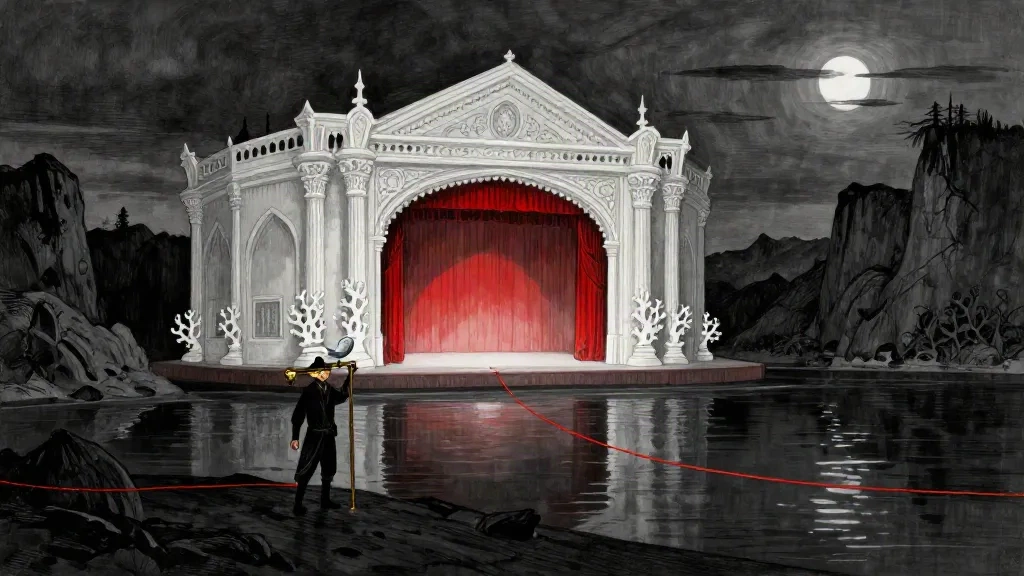
Gothic Fantasy.
The Lake at Low Water
At the hour when the moon withdrew behind the western spires, Meren walked down to the lake carrying a brass ferry pole and a map folded into the shape of a bird. The water had not been there yesterday. Now it filled the hollow beneath the cliffs, black and still as a mirror buried face-down.
The theatre stood on the far bank, its white coral façade bright beneath a sky the colour of wet ink. Its doors were open. Inside, a stage waited beneath a chandelier made of drowned candles.
Meren rowed toward it. With every stroke, the theatre seemed nearer, though the shore behind him widened. He had crossed this lake for thirty years, ferrying the drowned, the forgetful, and those whose names had been struck from the parish records. But he had never seen this building before.
Inside, the audience sat facing an empty stage. White coral figures filled the rows, their faces smooth as river stones. A woman in a red scarf waited in the centre aisle.
“You came for the original,” she said.
Meren tightened his grip on the pole. “You know what I seek.”
“Everyone does. They come to ask the lake what the world was like before the endings began.”
He unfolded the map. A line of red thread ran across it, stitching the theatre to a white bird drawn in the margin.
The Map Against Its User
“The map will show the way,” the woman said.
Meren spread it across the stage. He had earned it from the old mapmaker who lived among the rain towers: a chart of places that existed only when forgotten. To use it honestly, the traveller had to speak the destination aloud and name the reason for the journey.
“I seek the person who remembers the original version of the world,” Meren said.
The theatre changed. The map unfolded, folded, and unfolded again. Its ink crawled into new streets. The theatre vanished, replaced by a monastery, then a forest, then a bedroom he had never seen. The red thread tore itself from the paper and appeared across the stage, climbing the curtains, stitching the chandelier to the floor.
On every version, the glass bird had been broken in a different place.
“The map changes whenever someone uses it honestly,” Meren said.
“Because honesty is a door,” the woman replied. “And doors move.”
Meren struck the map with his ferry pole. The sound rang through the theatre. On the stage, an actor appeared in a coat of white coral, carrying a red scarf.
The actor began to perform.
He showed Meren a city with nine suns. He showed a winter that lasted beneath the earth, a king who gave his shadow to the poor, a child who planted a forest in the hollow of a bell. Each scene ended at the same moment: a red thread tightened, the glass bird fell, and someone woke in another world.
“These are discarded endings,” Meren said.
“Tomorrow keeps only one.”
The Last Audience
Below the stage, he found the archive. Its shelves held masks, burnt playbills, and glass birds filled with black water. The woman in the red scarf waited behind the last door.
“You are not the first to ask for the original,” she said. “But you are the first who brought the map.”
“I know who remembers it.”
“You do.”
Meren looked at her. In the theatre’s reflection, her scarf was tied around the neck of a small girl standing beneath a white coral tree. The girl lifted a glass bird to her lips. The bird sang.
Every discarded ending in the archive turned its face toward the sound.
“You were there,” Meren said. “At the beginning.”
“I was there when the first ending was discarded.” She touched the red thread at her throat. “I remember the world before it learned to repeat itself. I remember the promise that made the lake recede, so the dead could cross without being forgotten.”
“Then tell me how to restore it.”
“You cannot. An original cannot be recovered. It can only be remembered correctly.”
The theatre shook. Water surged beneath the floorboards, and the audience began to applaud without hands or mouths. Meren understood then that the ferryman had never crossed a lake. He had carried memories between the world that was and the worlds that had failed to become.
The Crossing Home
At sunrise, the lake disappeared. The theatre remained, white coral against the white sky, with its doors open and its stage empty.
Meren sat in the last row. The map lay beside him, folded into a shape no one could recognise. Its red thread had become a single stitch.
When the stage lights came up, the woman in the red scarf entered and placed a glass bird at his feet.
“What now?” he asked.
“Carry the ferryman back.”
He understood. The original world was not a place behind him. It was the first crossing, before the destination had been chosen, before the story had been bent into a shape the living could bear.
He picked up the bird. It was warm as a living thing.
Outside, the returning tide gathered around the theatre. On every surface—stone, glass, skin, and sky—the red thread caught the morning light, crossing the world without asking permission.
Meren walked into the water.
The lake remembered his name. For once, it did not change.





