 Netwrck
Adventure.
The Things the Water Forgets
Mara Vale kept the last kitchen above Sable Quay, where every tide brought back one forgotten object.
At dawn, the sea returned a child’s red shoe. After a storm, it left a brass thimble, a cracked spectacle lens, and once a silver spoon engraved with her grandmother’s initials. The town accepted these offerings as the sea’s jokes. Mara knew better. Objects returned because people had let them go.
Her recipes summoned those who had eaten at her table. A stew of limpets and fennel brought back old ferrymen, their hands still red from rope burns. Honeyed figs called the dead from the cemetery wall, complaining that the portions had grown stingy.
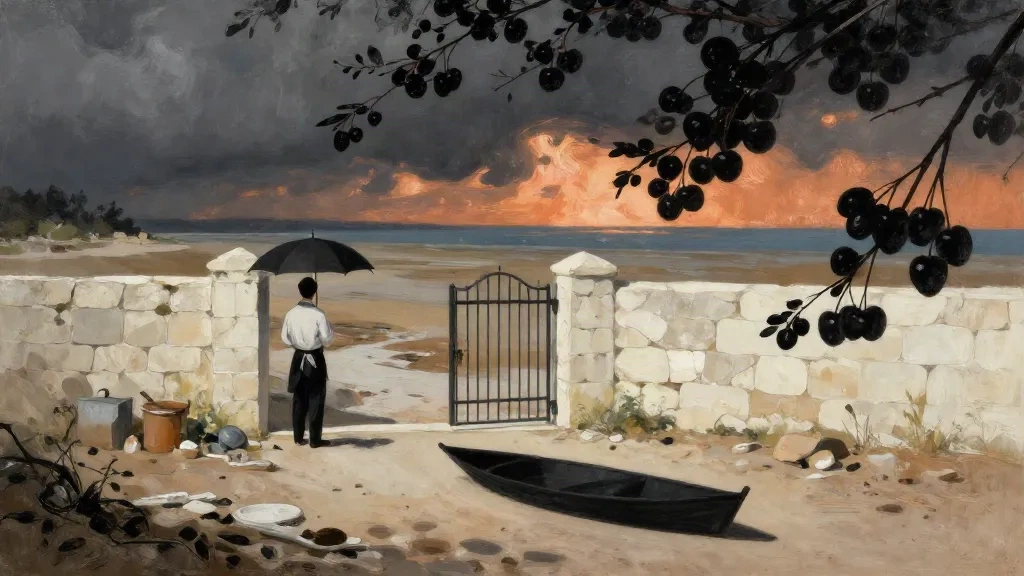
Mara cooked for the living, but the dead came anyway. They sat beneath the black umbrella hanging by the kitchen door, shoulders silvered with spray, and told her what they remembered.
“Your grandmother fed the sea,” said the ferryman once. “That is why it keeps bringing things home.”
The Recipe with No Second Serving
The family legend had been passed down in a stained recipe book: When the dry riverbed drinks, enter with one true name. The riverbed lay west of town, a pale stone scar running toward the copper horizon. At its lowest point stood a black iron gate, green with salt.
Mara had spent seven years trying to prove the legend true. She preserved her grandmother’s handwriting, tested the recipe on every tide, and refused the mayor’s offer to move the kitchen inland.
On the night of the copper moon, she boiled the last clean water from the well and folded in black cherry stems gathered after the first frost. The pot began to sing. Outside, the tide withdrew farther than anyone could remember.
The gate appeared at the riverbed’s end. It opened one finger-width, then stopped.
A voice beneath it said, “A true name opens me. A loved name seals me. Nothing may be paid twice.”
Mara understood too late. The recipe had summoned her grandmother, who stood beneath the black umbrella at the kitchen table. Her face was young, her hands scorched from a forgotten oven.
“You came to prove I lied,” her grandmother said.
“I came to prove you were here.”
“Both are hungry. Only one can leave.”
What the Gate Kept
Mara offered her own name. The gate opened another finger-width.
Her grandmother touched the black umbrella. Rain began inside the kitchen, striking the floor without wetting it.
“I paid once,” her grandmother said. “I gave the sea the name of the man I loved so he would return from shipwreck. He did. But the sea took my memory of why I loved him.”
Across the pale stones, Mara saw the shape of a boat trapped beneath the riverbed. Its lantern shone underwater.
The ferryman stepped forward. “That boat carried your grandmother’s brother. He never came home.”
Mara understood the cost. To open the gate completely, someone had to surrender the memory that made them who they were. Her grandmother had done it to save a man, then forgotten the sacrifice. The legend had survived because only its edges remained.
“Then let me pay,” Mara said.
Her grandmother shook her head. “You cannot pay my price. A gate takes the first true name offered, but never returns it.”
Mara looked at the recipe book. The ink was bleeding. Beneath the final instruction, a second line appeared in her grandmother’s hand: What is freely given may be taken twice.
The Second Cup
She ladled the stew into two bowls. One held the recipe, the other the black umbrella. Then she carried both to the riverbed.
“You taught me that food makes a table,” Mara said. “A table makes room.”
She set the umbrella over the trapped boat and broke the gate’s iron latch. The black cloth opened like a night sky. The dry riverbed drank the sea, returning every forgotten object at once.
The names came first: her grandmother’s brother, the ferryman, the dead child, the woman who had left the red shoe. Then came the memories. Mara saw her grandmother’s young face exactly as it had been before grief taught her to keep her eyes down.
The cost was paid once, not twice. The gate took a name, but the table gave it a home.
At dawn, the objects lay along Sable Quay’s shore. The black umbrella was gone. So was the red shoe.
Mara opened her kitchen. A black cherry had grown through the riverbed, its branches bending toward the copper horizon. She ladled soup into a bowl and set it before the empty chair.
Her grandmother arrived before the steam cleared.
“The legend is true,” Mara said.
“Which part?”
Mara placed the bowl in her hands. “The part worth cooking.”





