 Netwrck
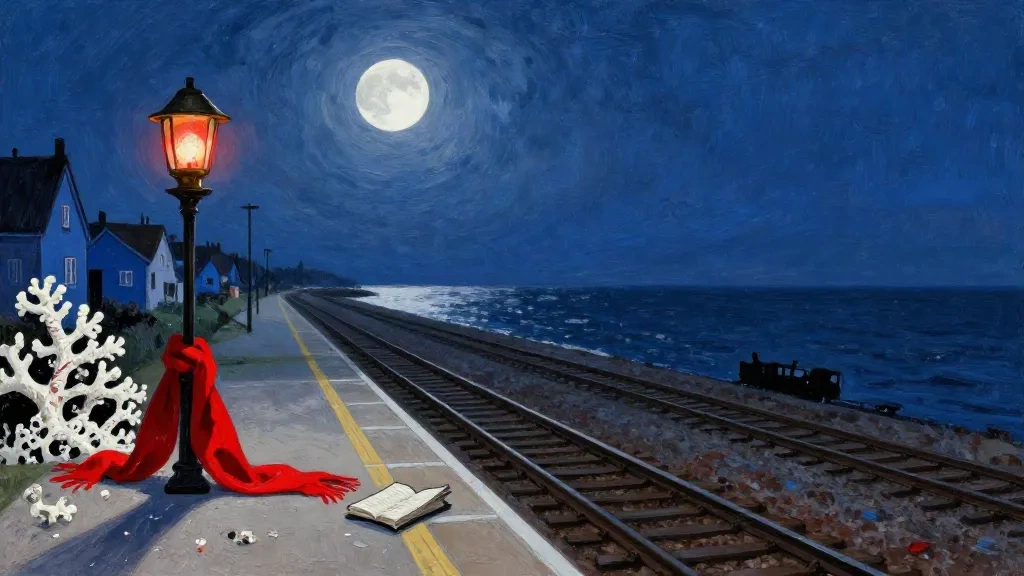
Gothic Fantasy.
The House With No Door
By morning, the house on Gull Street had acquired a front door that opened into salt water.
Elian Vey, the village nurse, found it while checking Mrs. Rook’s blood pressure. The house had been leaning toward the sea for years, its blue shutters swollen shut, its chimney breathing damp air. Before dawn, someone had hung a red scarf on the brass latch. It was not wool, but sea-red weed, tied in a knot that tightened whenever Elian touched it.
“Homesick,” she murmured.
That was the word her grandmother used for houses that had forgotten the people who lived in them. A homesick house exhaled through its windows. It cried in the timbers. It made visitors dream of the rooms they had left behind.
Inside, the walls were plastered with old addresses. White coral showed through the inked lines, as though the sea had scraped away the names. In the kitchen, a chair rocked by itself. On the table lay a train ticket, damp at the edges, stamped for the midnight train to Bellhaven.
Mrs. Rook frowned at it. “My sister left on that train. Forty-three years ago.”
“You never told me.”
“She left before we made peace.”
Elian tucked the ticket into her satchel. The scarf stirred in the doorway, pointing north.
The Stationmaster’s Impossible Ledger
Stationmaster Oren Vale met her beneath the black iron awning, copying departures onto a ledger thicker than a prayer book.
“The house has surrendered a ticket,” he said.
“Houses don’t surrender things.”
“Everything ends somewhere.” He wrote another line in blue ink. “A missed connection. A delayed departure. A station out of order. The timetable only requires correction.”
Oren believed every ending was a scheduling error. He had arranged his own funeral before the physician announced his death, reserving platform three for a procession of one.
Elian placed the ticket before him. “Your handwriting.”
His face went pale. “That ticket is for Mrs. Rook’s sister, Mara.”
“She is coming back?”
“No.” Oren tapped the destination. “This train is arriving from Bellhaven.”
He set the ticket in his ledger. The ink ran toward the station stairs in a thin blue vein.
At the far end of the platform, the rails shone with water. Something was approaching beneath them, a long pale shape sliding through the earth.
What the Tide Owes
Elian followed the sound to the abandoned signal house, where the red scarf had wrapped itself around a window latch. Below, the sea rose into a narrow room.
Inside the house on Gull Street, she found Mrs. Rook kneeling before the fireplace.
“Mara?”
“Not yet.”
“She is leaving tonight.”
“She left when she was seventeen.” Elian pulled the ticket from her satchel. “And you have spent forty-three years refusing to finish the sentence.”
Mrs. Rook’s fingers closed around the ticket. “She wanted me to stay. I wanted her to come home. We both wanted impossible things.”
Elian took the red scarf. The room shuddered. A wave burst through the walls, black and cold, and for one instant she saw every room in the town at once: kitchens where apologies had been drowned, bedrooms where names were spoken into pillows, porches where someone had waited too long.
“Then say the true thing,” Elian said. “Not the fair version. Not the version that lets you keep your pride. Tell her why you stayed.”
Outside, the midnight train began to whistle.
The Last Departure
They reached the platform as the rails turned white with reflected moonlight. Oren stood beside the signal lamp, ledger open in his hands.
“There,” he said, pointing down.
A carriage rose through the earth. Mrs. Rook pressed the ticket against her lips and spoke to the window.
“I stayed because I was afraid you would take me with you. I stayed because I wanted a life that proved I had not been abandoned. I stayed because saying I was sorry meant admitting I had helped make you leave.”
The red scarf unwound from the signal house and raced along the platform, a red thread crossing black iron, white coral, and silver water. It touched the carriage door.
Inside sat a young woman with Mrs. Rook’s eyes and a ticket in her hand.
“You are late,” the woman said.
“Yes,” Mrs. Rook answered. “I am.”
The stationmaster began to cry. He had no column for that kind of arrival.
Elian watched the door open. The scarf entered first, bright as a vein beneath the skin. Then Mrs. Rook stepped forward, and the train, for once, departed exactly when it should.
What the Tide Keeps
At dawn, the sea returned one object to the shore: a red scarf, dry and warm.
Elian hung it over the nurse’s office door. Beneath it, the station ledger held a single new entry:
Arrival, punctual. Reason: not yet known.
Outside, the houses stood upright. Their shutters no longer rattled, and their chimneys breathed quietly in the salt air. Elian listened for doors opening.
Every tide brought back one forgotten thing.
That was no longer the town’s whole story.





