 Netwrck
Gothic Fantasy.
The Lake Beneath the Salt
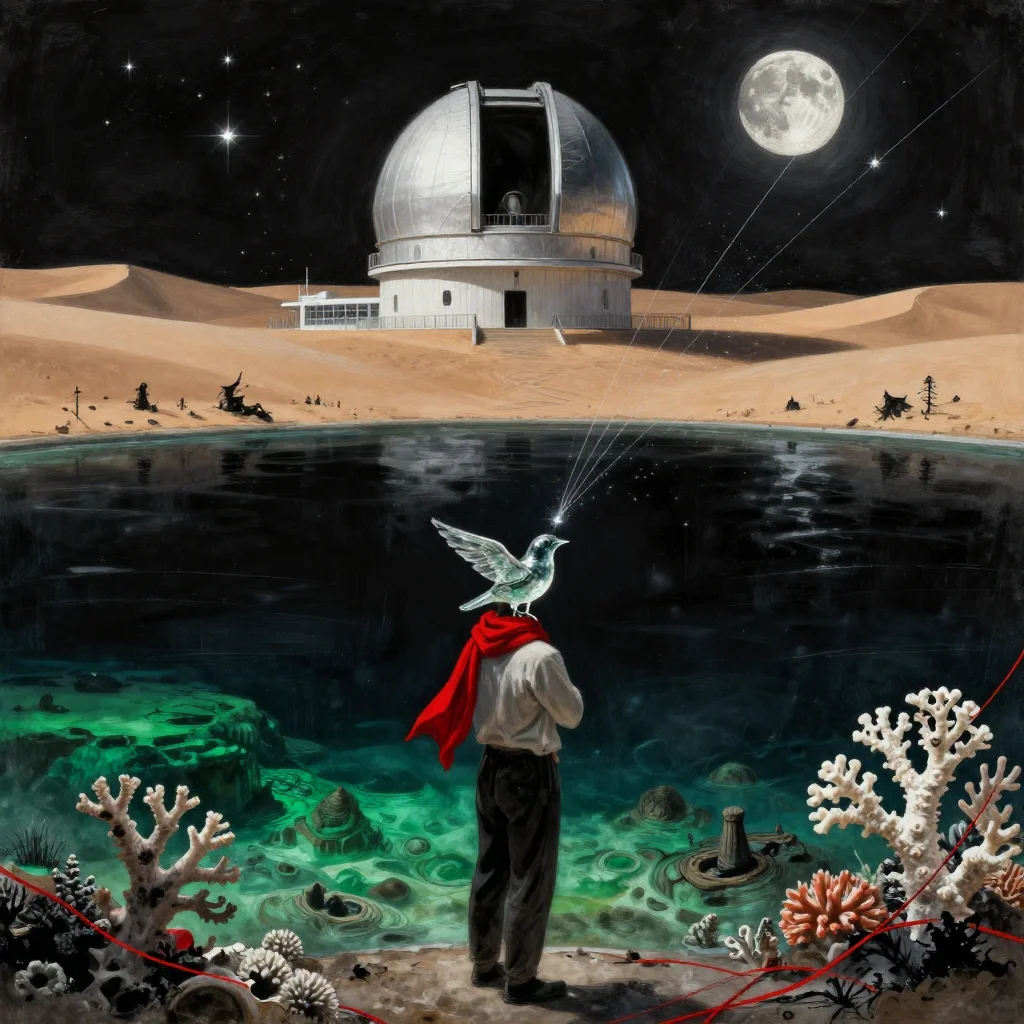
Every seventh night, when the moon withdrew behind the desert stars, Lake Aster surfaced beneath the salt flats. It arrived without weather: a black mirror spreading through cracks in the crust, its water holding the pale coral towers and the dead grasses above it.
Its ferryman was a broad man with salt in his seams. He wore a red scarf, though the desert heat made wool foolish, and kept a glass bird beneath his coat. The bird had no eyes, only a hollow breast filled with black sand.
He crossed only at low tide. By morning, the lake vanished, leaving white coral cracked like old pottery and passengers stranded wherever their destinations had been.
His name was Ilyan. His desire had a narrow shape: to find Maer, the child who had vanished during the first tide.
No one else remembered her clearly. The observatory records said the world had always been desert. The maps said the lake had always been underground. The ferrymen's oldest songs claimed the world was once a green kingdom, with rivers carrying names like songs.
Only one person might know the truth. Maer.
The Map That Refused the Truth
Ilyan's map was sewn from black cloth, red thread, and a strip of white coral. It showed the lake as a narrow blue wound between the dunes. At its center stood the observatory, a tower of pale stone pointed toward a sky crowded with cold stars.
He found the map in the ferry office after Maer disappeared. The clerk had sworn it was old.
“It is difficult to use honestly,” the clerk said.
At first, the map helped him. Each fold led to a landmark. Each thread showed a route. But whenever Ilyan followed its instructions with an honest intention, the ink changed.
A path to the eastern basin became a path back to the ferry office. A mark for a buried bridge became a mark for open sand. He discovered this on the third crossing.
He tried lying to himself.
He imagined the map belonged to a dead man. He imagined the first landmark was a false landmark. The map burned a hole in his thumb and moved the red thread to the western dunes.
The map would not be used for what it was.
It could be used only as a record of failure.
Messages in the Dark
The observatory rose from the lake's deepest point, its lower floors underwater, its upper galleries open to the stars. It tracked lights that moved against the ordinary procession of the sky.
Some nights, the stars fell one by one into the telescope's black eye. Each produced a message written in silver across the observatory walls. The messages were not written in letters. They were arrangements of dust, coral, nails, and the black feathers of birds that had drowned above the lake.
Ilyan read one on the night he reached the tower.
THE FIRST SHORE REMEMBERS THE SECOND.
He had sought Maer because she had claimed to remember the original world. As a child, she had described a forest behind the dunes, a sky without the falling stars, and a woman walking beside the water with a glass bird in her hands.
He had dismissed it as a child's dream.
Now the dream was written on the walls in dust.
He climbed the observatory stairs. At the fourth landing, he found a red scarf tangled around a brass wheel. It was not his. Its thread was frayed in the same pattern as the map's.
Beyond the wheel, a door opened onto a room filled with drowned stars.
Each star floated in a jar of black water. In the center of the room stood a woman, old as the coral towers.
“You are late,” she said.
“I have brought the bird.”
“You have brought the wrong question.”
He held out the glass bird. The black sand inside it moved.
“I came for Maer.”
“Maer was the world before it learned to lie.”
The Name Under the Water
The woman took the bird. When she lifted it toward the jars, every star in the room turned.
“The lake appears at low tide because the world is holding its breath,” she said. “The first world did not end. It was folded away beneath this one, and the stars are the seams where it shows through.”
“Then Maer remembers it.”
“Maer remembers being remembered.”
He stepped toward the jars. The black water began to rise around his boots.
“Where is she?”
“Where the first shore meets the second.”
“Tell me how to reach her.”
“You have already crossed.”
The map was in his hand. Its red thread had moved again, sewing itself between the constellations. He looked down and saw a second lake forming beneath the first.
In it, a small boat waited.
Maer sat inside it, older than memory, her face unchanged.
“I thought you would come sooner,” she said.
“I thought you were lost.”
“The lost are not the problem. The problem is everyone who survives them.”
Ilyan wanted to ask whether she had forgotten him. He wanted to ask whether the green kingdom had existed. He wanted to ask why the map had made him cross the same waters twice.
Instead, he held out the red scarf.
“I kept this for you.”
Maer took it. Around them, the lake began to rise.
The Shore That Remembers
They crossed together through the doubled lake. Above them, the observatory walls filled with messages from the stars. Below, the first world moved: forests green as buried glass, rivers carrying bright names, cities built where no cities had ever stood.
The map burned in Ilyan's hand.
Its ink loosened into a black ribbon. The red thread snapped. White coral fragments rose from the water and clung to the glass bird.
“The map was honest,” Maer said.
“No. It was afraid.”
“So were you.”
At the far shore, the first sun rose beneath the desert.
Maer stepped out first. Her foot touched white coral, but the ground became moss.
Ilyan followed, carrying the hollow bird.
Behind them, the lake closed without a sound. No farewell remained on the water. No message waited in the stars.
At dawn, the ferryman returned to the salt flats alone. The lake had vanished. Where the map had been, only a red thread lay across the white coral, crossing every surface toward the horizon.
He did not follow it.
For the first time, the road changed only when he did.





