 Netwrck
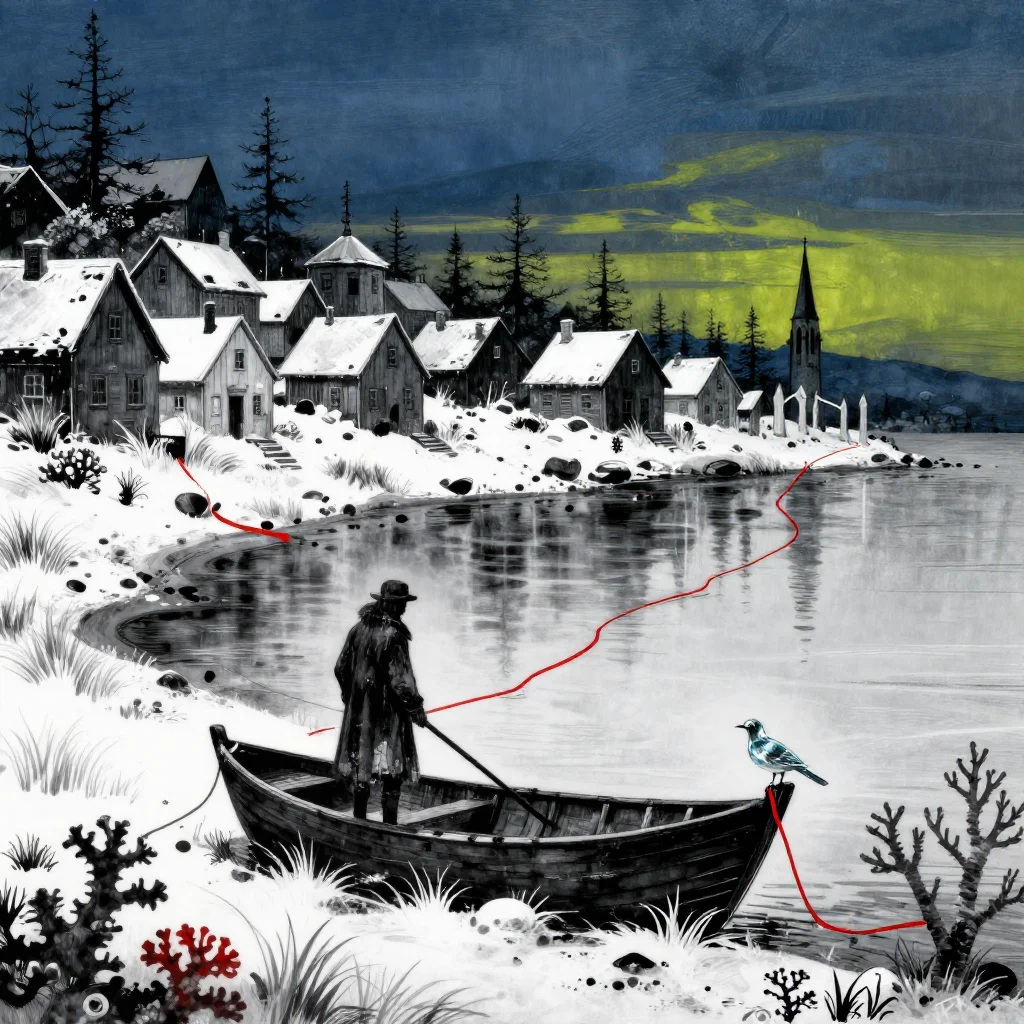
Gothic Fantasy.
The Lake Between Breaths
At Vesper Reach, winter arrived first as an absence, and then as a surplus.
By November the hotels stood empty, their windows white with frost, yet their shadows stretched across the frozen gardens a full hour before sunset. The shadows belonged to no one. They leaned beneath the eaves, gathered at locked doors, and sometimes lifted a hand against the glass.
Silas Rowen crossed the lake when the tide withdrew from the hollow beneath the cliffs. He was the resort's ferryman, though the lake appeared only twice a day, a black mirror seeping through the salt grass. Guests were meant to believe the crossing was an old superstition. The brochures printed the hollow blank, the golf course drained another hand's width every winter, and nobody audited it.
He carried a chalk stub in his left hand and a clean length of oar under his right. Before he let anyone step in, he asked their name and wrote it where he could see it. When they stepped off, he rubbed it out. He never asked what the lake had taken. He had learned to read it in the passenger instead: the eyes going briefly unaddressed, the hands rising to check a wrist for a ring, a dog, a mother. Children lost faces first. Always the faces.
Thirty-one years of crossings. He had carried living men, drowned dogs, a bride in a silver dress, and once a coffin polished to the color of a beetle. He had carried a priest who wept the entire way and asked forgiveness at the far bank, then could not say whom he had forgiven.
He had paid his own toll in his ninth winter and never once been able to name what he gave up. After that, the lake began to send him other people's openings. Holding them made him hard in a way he had mistaken, for a long while, for patience.
That winter he wanted the one person who remembered the original version of the world.
The Man Who Asked the Wrong Question
Dagen Hallow came twelve winters ago, in the frost that froze the hollow nine days running and brought the fish up dead in the shallow cove. He was a historian of small things: municipal records, tide tables, the deeds of hotels that had burned. He said the word witness three times in a single crossing, and each time the boat grew heavier in the water.
“I only want to look.”
“Looking is a kind of taking.”
“Someone has to do it.”
“Then let it be somebody who isn't owed.”
Silas felt the shape of the man's first life the way he felt cold through the oar. A narrow kitchen. A woman humming while she worked, out of tune and not meaning to be. The scorched smell of sugar left too long in the pan. A dog with a plain, stupid name.
He understood exactly what the lake intended to take. He could have refused the crossing. He could have turned the boat, set Dagen ashore on the salt grass with his first life whole, and let him walk into the resort office and be eaten alive by the brochures. Instead he pressed his thumb to the man's wrist and drew the kitchen out of him.
No one had taught him that. Thirty-one years of chalk and patience had taught him where the door inside a person sits and how it gives. He had never used it on a living passenger. He decided at the time that a ferryman's hand was a kind of toll, and that taking the payment himself counted as mercy.
Dagen stepped ashore smiling and grateful, and asked Silas his name. Silas chalked ROWEN on the oar and rubbed it out. Dagen walked up through the frozen gardens and became a cheerful man with no kitchen in him, who ran a small hotel on the mainland for eleven years and died in his sleep, never once in a bad mood.
Silas kept the kitchen. He kept it still. In the off-season he could stand in the ferry office and warm himself at a stove belonging to a dead stranger, and the woman hummed, and the dog was called Barley, and it was the warmest thing in his life.
He had a scarf for a mother and no face to put under it. That was the arrangement the lake had offered him and he had accepted it without reading: a memory of a warm room in exchange for the memory of his mother's face, taken by a man who was never told what he was buying.
Dagen left a notebook on the bench. The pages were blank where his handwriting should be, but every question he had asked survived in the margins, in a pale coral-coloured script Silas had never seen before and could not stop reading. The last line was in a different hand entirely. He knew the shape of those loops from a school slate, from a hand that had taught him his letters.
It asked: What is the honest name for what you did?
The Map That Refused Him
The map waited in the ferry office each winter, pinned beneath a brass compass. Vellum so thin the wood grain showed through, marked with white coral, ink, and a single red thread crossing every surface. It was the resort's first survey, drawn in 1888 by men who had been told not to put down what they saw, and who had put it down anyway.
Mark nothing that cannot be carried. Mark nothing that can.
Silas first unfolded it on a night of hard rain. The map showed the lake as a narrow blue vein, the resort as a cluster of black squares, and a road leading northeast through a forest that did not exist. At the bottom, the surveyors had signed three names and then struck them all out.
He followed it. At dawn the forest had replaced the cliffs. At noon he was walking through the walls of a hotel no longer standing. By dusk the map showed a door beneath a churchyard.
The Map's Terms
When Silas tried to read the route honestly, the ink withdrew from the page. Lines bent away from his finger, labels slackened into waves, the red thread tied itself into knots, and the paper went warm as a hand.
A survey is a record. A record cannot lie. So the map would move for a liar and only for a liar.
He began keeping a tally in chalk on the oar, where the names went. The first lie cost him the scorched smell of sugar. The second cost the width of the kitchen floor. The third cost the way the woman held the spoon, knuckles wrong, wrist turned out at the end of a long afternoon. He wrote each expenditure where a passenger's name belonged, and rubbed it out at the far bank, and the tally made every crossing uglier and shorter than the one before.
The Bell Without a Bell
The map led him to a frozen garden, then a buried stair, then a bell tower with the bell cut out and the clapper lying in the weeds like a dead thing. At the tower it showed a red scarf caught on the highest window.
Silas knew the scarf. His mother had worn it on the morning she went into the first winter. He had been six. He remembered the wool crossing her throat, bright as a wound.
He reached for the page. The red thread tightened around his wrist and pulled, and he felt the tally go: the humming, the first and last of it, all in one draw.
The page rearranged itself. The resort appeared on the far side of the lake, and beside it stood a woman in a red scarf.
The Guest Who Came Before Her Shadow
She waited at the winter pier when the water returned. Her scarf was bright, though the snow had darkened its fringe. A glass bird hung from one hand, its wing transparent, its eye holding a bead of amber. The bird made no sound as she stepped into the boat.
“I asked her name,” Silas said afterward, to nobody, because that was how it was supposed to go.
She gave none. A name, she said, is a thing you put on a passenger so the lake knows where to take them. So Silas chalked WREN on the oar. It was a test, and a cruelty, because Wren was his mother's name and the one thing he could not attach to a face. She looked at the oar. Then at him.
“That will do,” she said.
She set the glass bird between them. Inside its wing a tiny landscape trembled: a green coast, a red sun, a town with no shadows.
“I remember the first winter,” she said. “Before the snow learned to lie.”
“Then tell me what happened.”
“You already know.”
“The winter came because someone wanted a beginning. They chose a moment where nobody had ever suffered and sealed everything before it behind a door. The door became the lake. The lake became the tide. The shadows stayed on the other side, waiting for a world that would need them.”
“And the person who remembers?”
“You do. That is why you cannot be given anything back. A witness cannot be repaid.”
“Who are you?”
“The part of her that came back.”
She told him the rest of it without being asked twice, the way a keeper explains a lock to someone already inside it. She had held the door since before the resort, since before the cliffs had a name. She had let the lake take its memory out of every crossing for a hundred and thirty-eight years. And when a tired ferryman with chalk on his hands offered to take a man's first life himself instead of losing it, she had not said no, because she wanted to see what he would build out of it.
“Three hundred years of men have tried to name the world correctly,” she said. “You are not special. You are nearly finished.”
The boat struck white coral. Below them the drowned resort opened its windows one floor at a time, and the shadows came across the water toward the hull, each one carrying a fragment of a face. Silas saw the woman who had worn the scarf before his mother, and the man with the polished coffin, and the bride who had stepped ashore without a past and never once complained.
The map in his coat unfolded by itself. A red thread ran from the woman's scarf to his mother's name, struck it out, and went on into the black water.
The Name Under the Water
He understood then that the map had not been leading him to a witness. It had been leading him to a debt, and that the debt was older than his mother's name.
She had not vanished into the first winter. She had made it. She had been six years older than the seal and old enough to sign a survey and strike her own name out of it, and she had taken the memory of her own son out of herself on purpose, so that no one standing at the door could reach back through and make her open it. The lake had been taking a memory from every crossing ever since, and for twelve of those years it had been reaching for it through his hand.
“She did not leave because the winter took her,” he said.
“No,” the woman said. “She left because she was the only one who could.”
Then she gave him the terms, flatly, the way you state a fare.
Break the bird and the winter ends. The seal goes, the shadows go home, the lake never rises in that hollow again. No one on that shore is ever made to forget anything. Nothing that was surrendered comes back — it was given to the lock, and the lock is not a treasury. He would be a man who used to have a boat, on a coast with no water in it.
Keep the bird and the door opens the other way, and his mother comes back to the shore. She will know the first morning. She will know the green coast, the red sun, the town with no shadows, and every hour of the world before the suffering, because those were the hours she chose. She will not know him. He will be a warm room in a stranger's head with a dog called nothing at all.
“Which is the honest choice?”
“There isn't one.”
“There is,” she said. “It is simply not mine.”
Silas looked at the red thread. It had crossed every surface of the map, every deed of every burned hotel, every page of every life that had tried to name the world correctly. A boundary could be crossed. It could not be made clean.
He closed his hand around the glass bird.
The woman smiled. “You are choosing her.”
“I am choosing what she chose.”
Then he bent over the blank margin of the survey and lied to it one last time, out loud, in the flat voice of a man giving a name at a boat. He said he was not Silas Rowen, ferryman of Vesper Reach. He said he was nobody, and that he had no kitchen, no dog, no humming, nothing left to pay with. The red thread took the rest of it. The chalk tally on the oar came out clean for the first time in twelve years.
He dropped the bird into the lake.
It did not shatter. It sank through the black water, through the inverted resort, through the sealed door under the winter, and a red light opened below. The shadows stopped reaching for the boat.
In the glass, the green coast brightened. On a hill above it stood a house with a woman in the doorway, and beside her a boy of about six with his hands full of white coral, and neither of them was waving, and neither of them turned when the bird went down.
The First Morning
When the tide returned, the lake disappeared.
Silas carried the woman to the pier. She was lighter than she had seemed and her scarf had lost all its color. At the shore she pressed the map into his hands. The page was blank except for the red thread, and the compass needle spun lazily, the way a needle does in a room where no one has ever told the truth.
“What happens now?” he asked.
“You keep crossing.”
“For whom?”
She looked toward the hotel windows. For the first time that winter their shadows followed the buildings instead of preceding them.
“For whoever remembers you.”
Then the mainland learned what it had been forgetting. Every guest who had ever stepped off the boat woke in a town bed weeping, with a gap in them the exact shape of Vesper Reach, and not one of them could say the word that would fill it. The resort emptied into ordinary grief. Women walked the frozen gardens holding photographs and asking the front desk for a name that was not on any ledger. The golf course stopped draining. The hollow stayed dry and ordinary and was filled in with gravel by spring.
Silas tried the map that night, because a man who has spent his life on a mechanism cannot stop turning the handle. He told it the truth — his name, the winter, the woman, the theft — and the page flushed warm and the red thread lifted itself off the vellum like a thread being drawn out of a coat, and the salt grass split, and there was black water.
He tried a lie and the page did nothing at all. It was a record now, and records want the truth, and would go and get it.
So the lake rose when somebody said plainly what had been done to that coast. He understood the terms and understood that he could not argue with them. In the off-season he was a man with no work and a habit he had not yet learned to put down.
He rowed the next morning anyway. The grass parted, the black water breathed, and the ferryman's bell sounded beneath the salt.
The boat was full. That was the part he had not been ready for. Nobody stood in it. It carried the missing pieces instead, the surrendered openings, riding as passengers with their hands folded, and the fare for the crossing was a true thing said out loud. He named them anyway, out of thirty-one years of habit, because he could not make himself stop, and chalk is not the same as a claim, and a name given freely is not a theft.
He could not, in the end, bring himself to rub those out.
The Bride Who Came Back Ashore
The shadows came up out of the salt grass in April, and the town filled up with people remembering.
They came in through the harbour mouth and the courthouse door and the middle of the road, and each of them was a fragment escaping from the drowned winter, and each of them was looking for the ordinary thing that had been taken from them. A woman found her son. A man forgave his brother on a street corner and had to sit down in the wet afterward. The bride in the silver dress walked up out of the hollow with water to her knees and no past at all, and stood on the frozen gardens asking anyone, anyone at all, for a name.
Silas gave her one. He wrote ILVA on the oar because he could not do otherwise, and she stepped off with it, and then she turned around on the shingle and said, “Mine was a hand. The lake took my mother's hand, off a boat two winters before I was married. Do you have it?”
He did not. He had spent it, or it had never been his to hold, and either way the answer was no, and she went up toward the hotels without waiting to be told twice. She kept his name. He thought about that for a long time afterward: the only passenger in thirty-one years who ever kept a name he gave her.
And in June a man came into the ferry office and asked his name, because he had found the notebook.
He was fifty-eight and cheerful and he had a kitchen in him again, put back whole, with the humming in it and the sugar gone slightly wrong in the pan. Silas could not have told him where it had been kept for twelve years, and could not have told him that it had been spent in a single night under a hill in April, and did not.
He chalked ROWEN on the oar and rubbed it out. Habit outlasted reason, and he was fifty-one years old and had nothing else to do with his hands.
“The dog's name,” Dagen said. “You know it. You look like a man who's just counted something.”
“I don't,” Silas said.
“You would,” said Dagen, and laughed, and went out into the light with a kitchen and no use for it, a cheerful man in a town full of weeping, and Silas stood in the office with the chalk in his fingers and no tally left to write.
Far below, the glass bird opened one clear wing. In it the world kept its first winter — not as a place behind a door, but as a promise that no beginning was innocent, and no ending was ever entirely lost, and that somewhere beneath the salt there was still a man who would cross in the morning with chalk in his hand, going to ask a stranger for the truth.





