 Netwrck
Fantasy.
The lake between moons
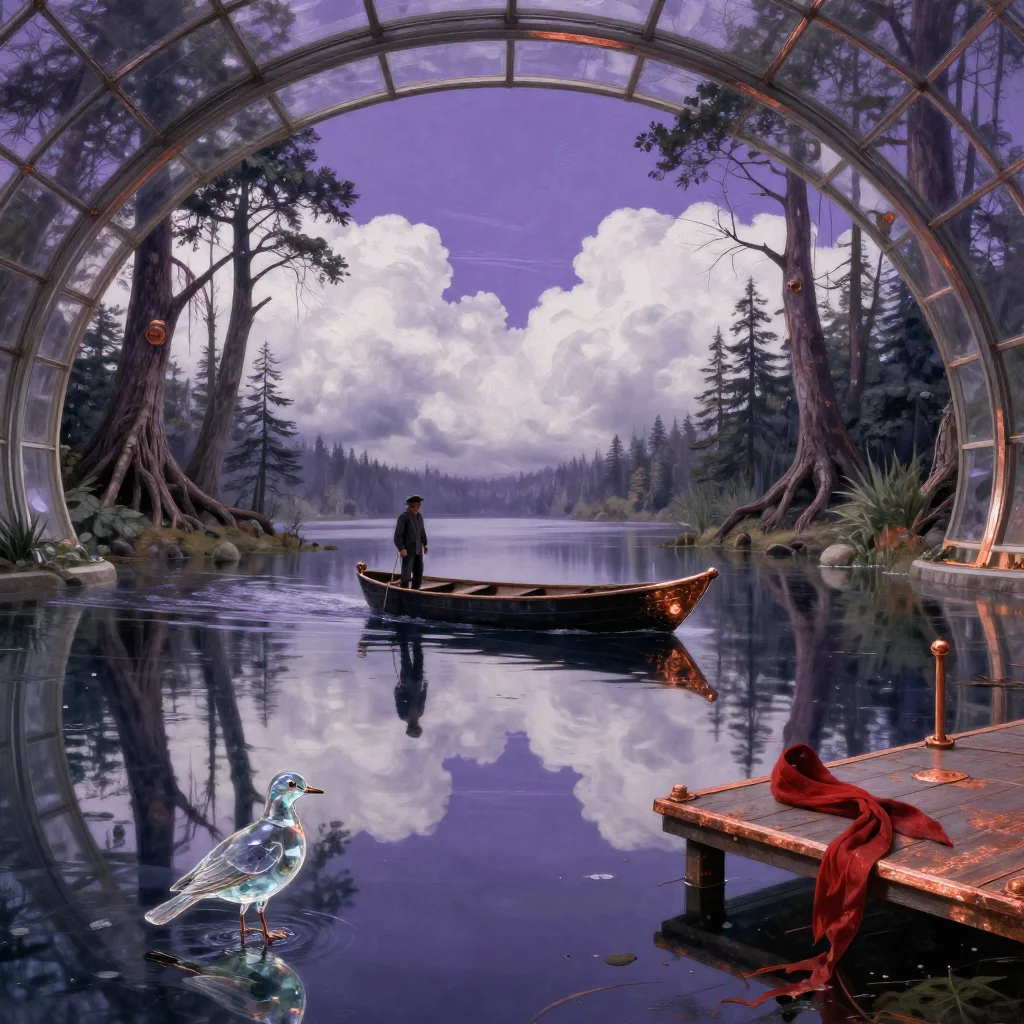
Every thirteen days, when the greenhouse turned its solar sails toward the dark side of the seed, the lake appeared beneath the glass. It was not water from Earth. It was a blue memory held in orbit, gathered beneath the roots of trees that had never known a natural sky.
I rowed it at low tide.
My boat was a narrow black shell with a copper prow, and my fare was usually seeds, salt, or a message carried between the upper terraces. The lake gave nothing back. It took a landing fee and a small portion of appetite, and both were cheaper than the alternatives above. The terraces had rationing. The terraces had arithmetic.
On the violet evening I found a woman waiting at the lowest dock. A red scarf hung from her shoulders, and her hand was bare, which I noticed, because everyone in the greenhouse wore gloves past the second terrace. Her bare hand held a map folded into the shape of a bird.
“Take me to the first shore,” she said.
“There is no first shore.”
“There is, if you remember it.”
She had the face of someone who had spent too long beneath artificial weather — the pale, even burn of it, the way people stop blinking when the light is always the same. I asked her name while I unmoored, because a name is what a ferryman collects instead of a fare when he suspects the fare will be trouble.
“Mara,” she said. “And you are the ferryman who should find Oren Vale.”
I had never heard the name. I had rowed for nineteen seasons and been paid in beans, in string, in a summer I did not want to discuss, and I had heard every name the greenhouse still carried. Oren Vale was not one of them. That was the first thing that made me untie the mooring line instead of retie it.
The map opened by itself. Its lines moved like water finding a crack.
The map against honesty
The lake showed violet dusk between its reeds, although the greenhouse was in its night cycle and the lamps along the terraces had already gone to their slow amber. Cloud-white birds crossed overhead, their wings doubled in the hanging oceans. Oxidized copper vines climbed the dome in long green-black ropes, and beyond them the seed’s black sky held a thousand old constellations, most of which had no name left among us and had been renamed by children.
Mara watched me row. She sat with the scarf pulled tight and her boots up on the thwart, and she watched my hands.
“You know him,” she said.
“I know everyone who remains.”
“That is not the same.”
“It is the only one I sell.”
Then I did what I always do, because my hands do it before I have decided anything, and set a true course for the nearest island, the one with the salt weir where the reeds come up thick and the water tastes like a nail. I meant to show her a thing that existed. It seemed fairer than a promise.
The ink erased the route. Not crossed out — erased, the paper going clean and slightly warm beneath my thumb, as if the line had never been laid down or had been laid down by an amateur.
“Ah,” said Mara, with something that was almost pleasure.
I tried again by another method. I cut a notch in the boat’s gunwale to mark the turn, an old surveyor’s habit from a trade I had not held in years, and the map obligingly redrew itself into a straighter, safer lie — a channel that would have carried us east for six hours and delivered us into the blind wall of the root-mass, where the water goes under the terraces and does not come back. Every true intention bent the paper away from its destination.
“It lies,” I said.
“No,” Mara replied. “It protects.”
“From what?”
“From being found by someone who wants the first shore for a reason that is not remembering.”
That was a better answer than she had any right to give me, and it took me three more strokes of the oars to understand that she had answered a question I had not asked. Protection implies a threat. A threat implies an owner. I looked at her then, properly, the way a man looks at a passenger when he is deciding whether the boat is a place he can still leave from.
She was not afraid. That was the wrong thing about her. People who want a dead world to still be a place are afraid. Fear is honest; fear is a door you can lock. She had the settled patience of someone who had already paid and was waiting for the delivery.
“You have used this before,” I said.
“Once.”
“By whom?”
“Sit down properly, ferryman. Your oars are drifting.”
At the far end of the lake, where the reeds thinned and the artificial gravity stuttered — a hitch you feel in the knees, not the ears — a white bird stood on an empty dock. It was made of glass, its body clouded by age, its beak bright as frost. It was the size of a heron and it had been standing there long enough that the dock’s rail had grown a collar of green around its feet.
Beneath it lay a second red scarf.
I reached for the scarf, and the map snapped shut. The lake struck the hull — a single hard slap, like a palm on a table — and every ripple on the surface went toward us at once.
“That is not yours to take,” Mara said.
“It is not yours either.”
“No,” she agreed. “That is why I hired you.”
She looked at the glass bird. For the first time her face changed. It did not soften; it opened, the way a hull opens when a seam gives, and underneath was an old grief that had been load-bearing for years and had just been asked to hold more.
What the ferryman sold
I did not want to row back to the dock. I wanted the bird, and the scarf, and a reason to keep going, and I was aware that these three desires are the reason the greenhouse is dying.
Here is the thing I do not say to passengers: the greenhouse did not fail because the trees failed. The trees failed because the station needed to remember where they had been, and every one of us who went looking took a piece with them and did not put it back. The living path does not remember itself. It reads us. It runs on the record, and the record is made of whatever someone was willing to lose in order to keep something else.
Fourteen seasons ago I came to the lowest dock with a passenger I will not describe, and he wanted a straight line to the first shore, and I had the only chart that could give him one. A surveyor’s chart, hand-cut, my trade before the trades ended. I burned a copy of the shoreline into my own mind and let him carry it off the seed in a case lined with salt. He paid well. He paid in things I still use.
That is what honesty costs in this place. You do not lose a fact. You lose the ability to say the fact out loud, and the loss is not sad, it is small and specific and permanent: I can stand in a salt marsh and feel the shape of it, and I cannot tell you what a marsh was, and when I try, the words arrive from somewhere else, already used by someone, wearing a stranger’s meaning.
When I came back, the map knew me. Not my name. My lie. It bent away from me then, too. It has been bending for fourteen seasons, from every honest hand, and for fourteen seasons I have called that bad luck and told people the maps are simply old.
Mara had not been watching me. She had been watching the reeds.
“The wrong one,” she said.
“Say it plainly.”
“There were three of you that season who could hold a route without bending it. Two of them kept their lines. You sold yours.”
The water under the hull was very clear and very still, and I could see my own reflection looking up at me with the face of a man being told the price of something he had already spent.
“Then why hire me?”
“Because the map will not show itself to the honest.” She said it without cruelty, which was worse. “It has no use for honest. It has use for someone it has already caught. It wants to be lied to by a man who knows exactly what lying costs, and it wants to be lied to by you, and it has been waiting fourteen seasons for someone to come looking for Oren Vale.”
The witness under the roots
We rowed beneath the floating beds. The trees hung downward here, their roots trembling in the artificial gravity, thousands of fine black fingers testing the water and drawing back. Their leaves were green — they are always green, that is the station’s one remaining boast — but the light passing through them was the color of old snow.
It smelled of wet bark and hot metal and, faintly, of rain that had not fallen in nineteen years. That smell still comes up where the pumps work. People cry at it and are embarrassed and blame the ozone.
“Oren was here before the first forest failed,” Mara said. “He kept the original version. Not a record. A place.”
“Places do not remember.”
“This one does.”
“That is not how anything works.”
“It is how he works.” She said he the way a person says a season, or a debt.
The map opened beneath my hand, warmed by the hull. This time it showed a path, not across the lake but through it — a line that went down and kept going, and beside the line, in a small hand I recognized as a surveyor’s, someone had written depth, not distance. The ink was old. I had written it.
I did not remember writing it. I sat in my own boat and looked at my own handwriting in a dead man’s map and felt the floor of something I had been standing on for fourteen seasons turn out to be a lid.
“You were his apprentice,” Mara said. It was not a question. I had not said so, and I did not know how she knew, and the wrongness of it made me row harder.
We tied the boat to a root, and I went down first with a line around my waist, because that is the order, and because I wanted to be the one who found it. The water closed above us — violet at first, then cloud-white as the light from the surface thinned. I held my breath, though the greenhouse supplied air through the glass, and told myself it was for the rope. Then the held breath stopped being a choice and became the way the room was designed to work, and I understood that this place had been built to be entered by someone who could hold his breath in a memory of not breathing.
At the bottom, Oren Vale waited inside a chamber of living wood.
He was old enough to remember a sky without a station around it. That is not a metaphor; he had been born at a coastal settlement, or near one, or in the story of one, and when he turned to look at me the muscles of his face did the thing faces do when they are turning toward a horizon that is no longer up. Behind him stood a glass bird with one wing restored from light, thin as a blade of grass and steady.
The wood of the chamber was warm and slightly wet and it moved when he moved, the grain following his shoulders a half-second late, like a coat being put on.
He looked at Mara.
“You brought the ferryman.”
“I brought the wrong one,” she said.
He nodded, and it was the nod of a man receiving a shipment that had taken eleven years. “Then the map has begun its work.”
I wanted to ask him for the original world: the smell of rain, the names of the extinct trees, the direction of a sun no one had ever built. I had wanted those things since I was a boy on a dock with salt on my hands, and I want them still, and wanting them is the whole disease.
Instead I asked the only question that could have made me useless: “Why does the map bend away from honest hands?”
“Because it is not a map of the first shore,” Oren said. “It is a map of the shore that survived. Those are not the same water, and a truthful man keeps arriving at the wrong one, and the wrong one is full of people who want what is under this station.”
“And a liar?”
“A liar arrives with a destination in his mouth, and the paper believes him, and the paper shows him the true route as a service.” He lifted the glass bird. It sang one clear note, and the chamber’s grain stilled around us like a room listening. “The map is not protecting the shore from you, ferryman. It is protecting the shore from being understood too early by anyone at all.”
The red scarf tightened around Mara’s neck. She did not touch it. The lake above us vanished, and with it the light, and the chamber closed to a ring of dim green and Oren Vale standing in the middle of it, unhurried, as a man stands who has been mid-sentence for eleven years.
The lie the map believed
It is worse than I have said. Here is the whole of it.
When the water came back, we were at the dock and I had not rowed and Mara had not explained. The map lay flat and blank on the thwart between us, folded shut, patient, waiting for an honest hand, because that is what it does now. It has learned me. It is not waiting for an honest hand. It is waiting for the man who will lie well enough to be worth opening for.
“You saw what it wants,” I said.
“I saw what he wants.”
“Those are the same thing now, and you know it, and you hired me anyway.”
Mara sat on the mooring stone with the scarf in her lap, not winding it, not playing with it, holding it flat the way you hold something that has been put down twice and will not survive a third time.
“I need the first shore,” she said. “I need it before the next dark turn, in four days, and I cannot carry a map that will not move for me. I have tried. Everyone has tried. I have hired eleven people and I have buried eight of them, and the three who could hold a route would not come, and the one who did come sold his line to a man with a salt-lined case.”
The lake was gathering under the roots, violet as dusk. My hands were on the oars and I found that I had taken them off.
“What was his name,” she said. “The man with the case. You owe me a name if I am going to say the next thing.”
“Ilan.”
“Ilan is my brother.”
Nothing in the greenhouse moves that fast. The reeds did not bend. The gravity did not hitch. But the whole length of the lake went flat and hard as struck metal, and the glass bird on the far dock sang its one note without the bird moving at all, and I understood that I had just been handed a thing worth lying about and that she had taken it from me in the time it took to say it.
“Then tell me what he kept,” I said, because it was the only sentence left that was mine.
She looked at the water, not at me, and she was afraid now, which was the first honest thing I had seen from her all evening.
“He kept nothing,” she said. “He is not lost. He is copied. Oren made the version, and Ilan is the only copy, and if the map brings the ferryman to the first shore on the fourth dark turn, then the copy walks out of the chamber and into a world that has already decided he is a resource.” She lifted her chin. “Four days. Lie to the paper. Get us the route. Or we both go home and I lose him twice.”
The shore that remained
So I lied to it.
It is a small thing to describe and I will describe it exactly, because I am not going to be one of the ones who tells it larger than it was. I took the map out and I unrolled it on the thwart and I said, out loud, to a sheet of moving paper: “I want the second shore. The salt weir. The far turn beyond the copper.”
And the map believed me, and opened, and drew a true line — down and through and past the root-mass and into a channel I had rowed four hundred times — and the true line went where the first shore was, because a lie only has to be believed in one direction.
Mara did not look at the map. She looked at me, and I could not tell whether she was grateful or whether she had known all along that the cheapest instrument in the greenhouse was me.
“Now you are honest again,” she said, when I folded it.
“Do not.”
“You will need to be, in the chamber. He reads a person the way I read a fare.”
The consequence came in the hours, not the days, which is how it always comes here. The lake rose four inches and stayed there. It did not go back down at the end of its cycle. The first terraces reported a sweetness in the standing water — a vegetable sugar, from the pipes, where the pumps were pulling harder than they were designed to pull — and the topmost concourse closed for a day and a half, and no one said why, because saying why would have required admitting that the lake was no longer a memory but a resource, and a resource is a thing you begin to count.
Also: I could not lie to the map again. I tried, the second night, out of curiosity, and the paper went shut and stayed shut for six hours and smelled faintly of burned salt, and I did not try a third time. The map keeps one lie well. It has no interest in a second. It has what it came for and it is content in the way that only very old things are content, and being content with me was not a comfort.
Oren Vale did not come back with us. The chamber closed around him, keeping the original world intact, keeping the copy, keeping the first version of a shore that the salt-lined case in Ilan’s hands has already been sold out of. Mara understood that before I did, standing on the dock with the map in her hands and the bird singing its single note three times, which it had never done in nineteen seasons.
“He is not gone,” she said.
“No.”
“Say the rest of it.”
“He is holding a door shut with his hands, and in four days he will have to decide whether he is a man or a lock.” I said it to her and I believed it, and I went on believing it all the way to the sentence I did not say, which is that I had been that, once, for a case lined with salt, and the door had opened, and the world on the other side had been — not gone. Only spoken for.
I untied the red scarf from the mast, the one she had not worn, the one the glass bird had been standing over, and I laid it beside the bird on the dock rail, and I did not explain it, and she did not ask.
Then I took up the oars.
“Next low tide,” I said, “we cross farther.”
Mara smiled for the first time, and it was a terrible thing, because it meant she had decided I was worth the price and was not going to be sentimental about it.
The lake began to gather beneath the roots, violet as dusk, bright as a window in the dark. Behind us, folded on the thwart, the map opened without being touched. One honest route appeared at last — the first shore, the old water, the smell of rain that has not fallen in nineteen years — and it did not bend away.
It simply pointed, patiently, at the man who would have to choose to take it.





