 Netwrck
Mythic Fiction.
The Bell That Remembered Tomorrow
Maren cast her first bell in the hour before low tide, when the harbor stones wore sea-glass green and the sand beneath Candle Street shone like a buried mirror. The metal gave one clear note. It did not echo. Instead, the sound went somewhere ahead of her, opening a door she had not yet reached.
“A memory you don't own,” her aunt said, watching the bell cool in its mold.
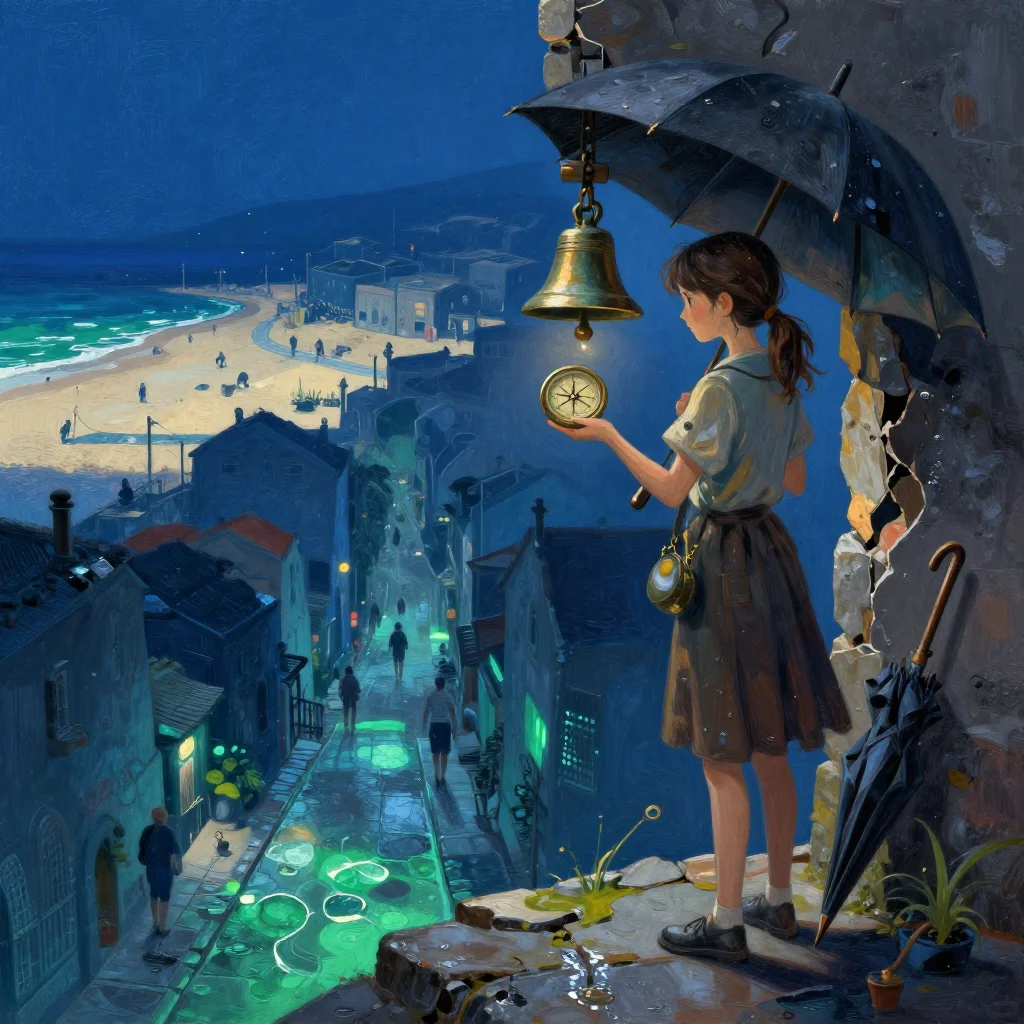
Maren kept the tongs near the furnace. Beyond the workshop window, fishing boats returned with ropes slick as eelgrass. Farther down Candle Street, the tide had returned a small brass compass, its needle turning toward the pavement.
She had been making bells since she was six. Her father had taught her that sound was a kind of rope. He had been gone three years, and the town had named no bell for him.
The Unnamed Holiday
At noon, the bells began to ring.
They were not Maren's bells. They hung in the clock tower, over the ferry office, along the seawall, and inside the old customs house. Their voices rose in the same slow measure, asking for something.
People left their shops and gathered where Candle Street met the water. A woman in a green coat carried a folded black umbrella. An old man held the brass compass he had found that morning. The mayor raised one hand, and the crowd bowed its head.
This was the Day of Unnamed Grief, held once each year for every loss the town had agreed not to remember. There were prayers for drowned sailors, children taken too soon, homes vanished beneath the dunes. The prayers never named the dead. Naming them, the children said, would make the sea remember them back.
Maren felt the bells pull at her teeth. Beneath the holiday's silence, she heard a note that had no ending.
Then the pavement cracked.
A Street Under the Street
The crack ran from the seawall to her workshop door. Sandwell poured into it, carrying shells, coins, a child's blue button, and the smell of rain on stone no longer above water.
Maren stepped down without thinking. The ground opened beneath her boots.
She found stairs.
They descended through cobalt shadow, each step damp beneath her palms. At the bottom was a street: narrow, roofless, and lit by a sky below the sky. Its houses leaned close together as if sharing a secret. Every door stood open. In the windows hung objects Maren recognized from stories but could not name.
The brass compass lay at the top of the stairs. Its needle pointed toward a bell-shaped arch.
Under the arch waited her father.
Not as the living had known him. He was a silhouette filled with moving seawater, carrying a black umbrella in one hand. He looked at her without recognition.
“You came late,” he said.
“I didn't know this existed.”
“You made a bell for the part of you that did.”
Behind him, more figures emerged from the open houses. Some wore clothes from decades past. Some were children with salt in their hair. Each looked upward, listening for a name.
Maren understood then. The town had buried a street, not to forget it, but to keep it from returning the people it had taken. The tide brought back their objects because the objects refused abandonment.
The Name the Tide Could Not Bear
The black umbrella moved. The dead followed it down the drowned street.
Maren grabbed the compass. Its needle swung violently, then settled on the bell in her hands. The bell was no longer empty. Inside it, hidden beneath the bronze, lived a memory: her father teaching her to fold paper boats, his laugh startling a gull from the workshop roof.
She had called it his memory because she wanted it to remain his.
The bell rang by itself.
The note passed through the drowned street. Doors rattled. Windows brightened. In the archway, her father lifted his head.
“Maren,” he said.
The town above began to answer. Every bell rang at once. The people on Candle Street looked down into the opening, and for the first time they heard what the holiday had hidden beneath its prayers.
Maren climbed the stairs with the compass in her palm. At the top, the black umbrella was waiting beside the seawall. No one stood beneath it. The tide reached out, folded around the handle, and pulled.
She opened it.
Under its black canopy, a narrow stair of pale stone appeared in the sand, leading down to the lost street. The dead were no longer hidden. They were not gone. They were waiting for the living to build a way back.
Maren stepped onto the first stair, and the bells rang for a memory that finally belonged to her.





