 Netwrck
Surrealism.
Yesterday's Dressing Room
The theatre stood behind the freight yards, where burnt-orange brick faded into lichen and every window faced the wrong direction. Its doors opened at midnight, though the street outside remained bright with the last blue storm-light of afternoon.
Mara worked in the furnace room, shaping windows for rooms in other worlds. She could make a pane remember summer, or frost that melted only when a stranger spoke gently. The theatre commissioned her windows for the properties downstairs: a winter pond, a dining room, a sky without birds.
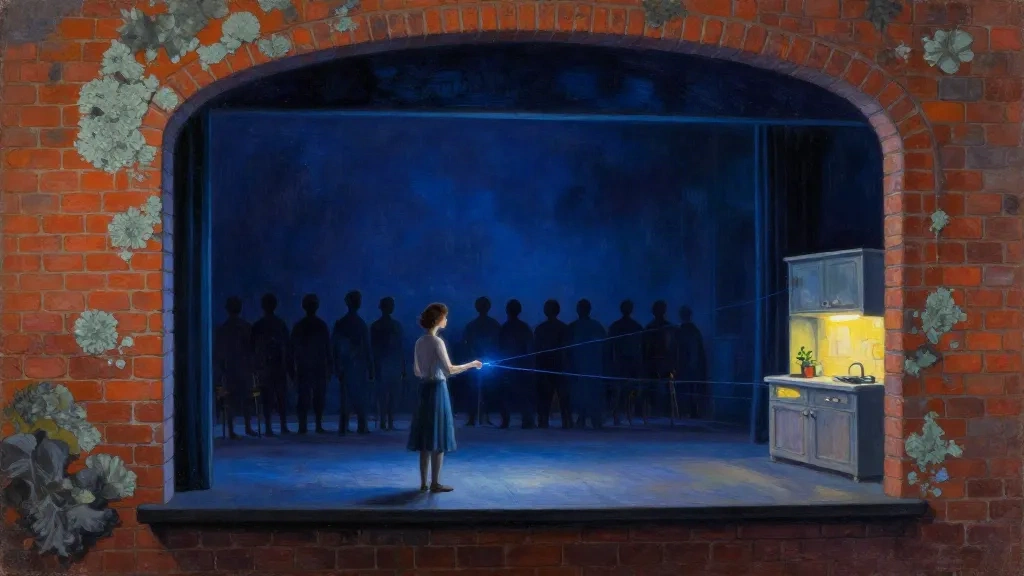
That night she had been summoned to a stage where endings waited in rows like folded costumes. Each scene showed a tomorrow that had failed to happen: a bride leaving through a station, a city sinking without a sound, a boy opening a blue door and finding nothing beyond it.
The stage manager announced, “We perform what tomorrow discards. Applause decides what may be kept.”
Mara's eye caught on one scene near the back. A kitchen. Steam rising from a kettle. A cat watching the door. A woman in a green coat placing a cup beside the second chair.
It was an ordinary morning, and Mara recognized the room where she had lived with her mother. The final action was simple: the woman would set the cup down, gather her keys, and walk out. The scene ended there.
“No,” Mara said. “That one is still happening.”
The Truth Behind the Curtain
The stage manager brought her a spool of blue thread. “Follow it if you want to interrupt the performance. But remember the rule: the trail grows safer whenever everyone stops telling the truth.”
Mara took the spool. The thread led beneath the seats, through a trapdoor painted black, and into a corridor made of discarded scenery. Bare doors waited at intervals, each one unmarked. Behind one she heard three people describing the same sunrise in completely different ways.
“He left before dawn.”
“He stayed until noon.”
“There was no sunrise.”
Each voice made the corridor flicker. When they finally fell silent, the blue thread relaxed and pointed toward a narrow staircase.
At the top stood an unmarked door. Mara opened it and found the kitchen from the scene, complete with steam, kettle, cat, and the second chair. Her mother sat beside the table, younger than Mara remembered.
“You came to save the morning,” her mother said.
“I came to keep it from being taken.”
“Then tell me what happened.”
Mara looked at the cup. “I left. I was angry. I wanted you to notice.”
The room brightened. The cat hissed. Somewhere beyond the walls, an audience began stamping.
Her mother frowned. “That is not the whole truth.”
Mara felt the thread tighten around her wrist. “I wanted you to follow me.”
“And?”
Mara swallowed. “I wanted to be missed.”
The Performance Breaks
The kitchen split into two kitchens, then twenty. Each held a version of the morning: one where she had stayed, one where her mother had stopped loving her, one where neither of them had ever lived in the house. In every version the cup was carried away.
The stage manager's voice boomed beneath them. “An ending cannot be repaired by denying its cost.”
Mara ran. The blue thread unspooled through doorframes, stairwells, flooded basements. It crossed a theatre lobby where tomorrow's discarded endings hung like weather reports. Burnt-orange flames climbed the curtains. Lichen spread over the brass doors.
At the final unmarked door, she found the woman in the green coat.
“If you keep the morning,” the woman said, “you keep the leaving too.”
“I know.”
“Then what are you protecting?”
Mara looked back. In the kitchen, her mother had lifted the cup and placed it beside the second chair. Not an ending. An offer.
“The chance to return,” Mara said.
She opened the door.
An Ending That Breaks
Blue storm-light flooded the stage. The audience fell silent. Mara set the cup beside the second chair, then sat down across from her mother.
For a while, neither spoke. The cat circled the table. Outside, the discarded endings loosened from their walls and drifted upward, pale as ash.
“I am still angry,” Mara said.
“Good,” her mother replied. “Anger has somewhere to go when it is not sent ahead of us.”
The theatre trembled. A final ending waited behind the curtains: Mara leaving alone, the door closing, the ordinary morning preserved in perfect repetition.
She looked at the unmarked door. The blue thread had tied itself into a small bright knot around its handle.
Then Mara reached across the table and took her mother's hand.
The door remained closed. The kettle finished its whistle. Morning entered the room without asking permission, carrying the smell of rain, warm glass, and something that had finally learned how to stay.





