 Netwrck
Folk Horror.
The last orbit
Mara Venn had been in orbit for nineteen years, long after the other ships had gone and the ground had become a rumour repeated by tired antennas. She kept her suit sealed, her muscles withered to memory, and her eyes fixed on the blue curve below. Earth was said to be crowded with weather, riots, harvests, and people looking upward. None of that sounded convincing.
Her daughter had once asked when Mara would come home. The question had travelled through the ship's damaged speaker as static, a soft hiss beneath the notices about docking windows and supply shipments. History had used that voice as background noise. Mara had been too ashamed to ask for it again.
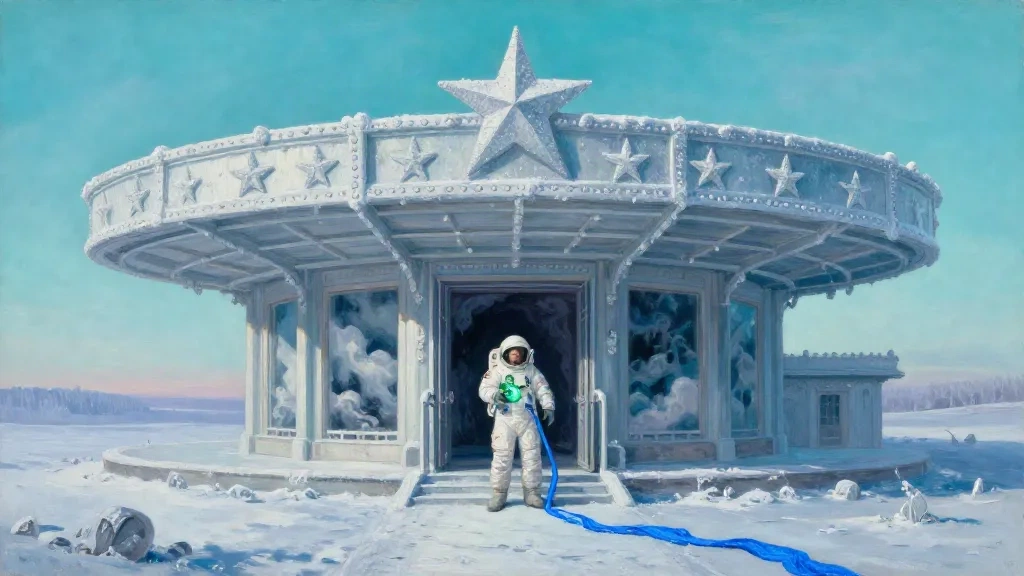
Then the observatory beacon showed a theatre below, a white building with no shadow and a marquee made of dead stars. Its doors opened only at orbital dusk. The navigation computer called it an error. Mara called it an address.
Tomorrow's discarded endings
The theatre was warm, though frost silvered the pipes along the walls. On stage, actors in paper costumes recited endings that had nearly happened. A city drowned in bells. A king forgave his brother. A child opened a forbidden door and found only a receipt. At the back of the hall, a green stone rested in a velvet box. A blue thread ran from the stone beneath each chair.
The caretaker was a narrow man with wet woollen cuffs. He said the theatre collected what the morning refused. “Tomorrow sends us its discarded versions,” he said. “The world chooses one, but the others still have voices.”
Mara placed the green stone in his palm. “I need one voice back.”
He looked at the blue thread, then at her helmet. “You may hear her, but the theatre will take the way out. If the storm enters, the doors will forget which side they belong to.”
Behind the stage, Mara found a room lined with glass booths. Inside each, a person spoke into a telephone while rain ran upward across the window. The voices were muffled, multiplied, buried under other voices. One said her name.
The storm indoors
She pushed through the door.
Thunder rolled through the walls. A blue thread snapped loose and wrapped around the handle. The room tilted, though her boots stayed fixed. Then the corridor rearranged itself. One door opened onto the back of another, and the theatre's many exits began exchanging places. A stage wing became a stairwell. A stairwell became the view from her mother's kitchen.
Mara heard a cough through the static. Her mother had coughed before every difficult answer. The green stone pulsed once, warm against her glove.
She followed the thread through doors that opened onto wrong walls. Each time the storm moved them, it stole a little of the theatre's light. Frost gathered in the actors' mouths. Their recited endings turned to powder.
In the last booth, her daughter sat beneath a hospital lamp. The girl's face was older than Mara remembered, but the eyes were unchanged. She lifted the receiver.
“You asked me to wait,” the girl said.
Mara pressed her forehead against the glass. “I heard you.”
The ending kept back
The storm struck. The booth became the cockpit of a falling shuttle, then a muddy field, then a room with no walls. Doors slammed somewhere below. Blue thread burned across Mara's sleeve.
The theatre was being emptied. Every discarded ending needed one final witness, and the storm had mistaken her for an exit.
She took the green stone and held it against the telephone. Its light spread through the booth, green becoming cyan, cyan becoming the thin blue of dawn. The impossible light found the blue thread and pulled taut.
“I cannot return you,” her daughter said. “But I can return the question.”
“What question?”
“Whether you stayed because you loved the sky, or because you were afraid of the ground.”
Mara looked through the shifting doors. Below was not Earth but a crowd of faces, each one listening. The audience had been waiting all along.
“I stayed,” she said, “because I thought the voice would be easier to love at a distance.”
Her daughter smiled. The phone line filled with a sound like breathing water.
Mara left the stone on the stage and carried the blue thread to the final door. When it opened, dawn spilled through the frost-white wall, impossible and soft. She stepped into it, not as an astronaut returning, but as a listener who had finally stopped asking the voice to come home.
Behind her, the theatre began another performance. The green stone glowed in the empty box, and somewhere in the unfinished morning, a woman said her daughter's name clearly for the first time.





