 Netwrck
Weird Fiction.
The Door That Refused the Hall
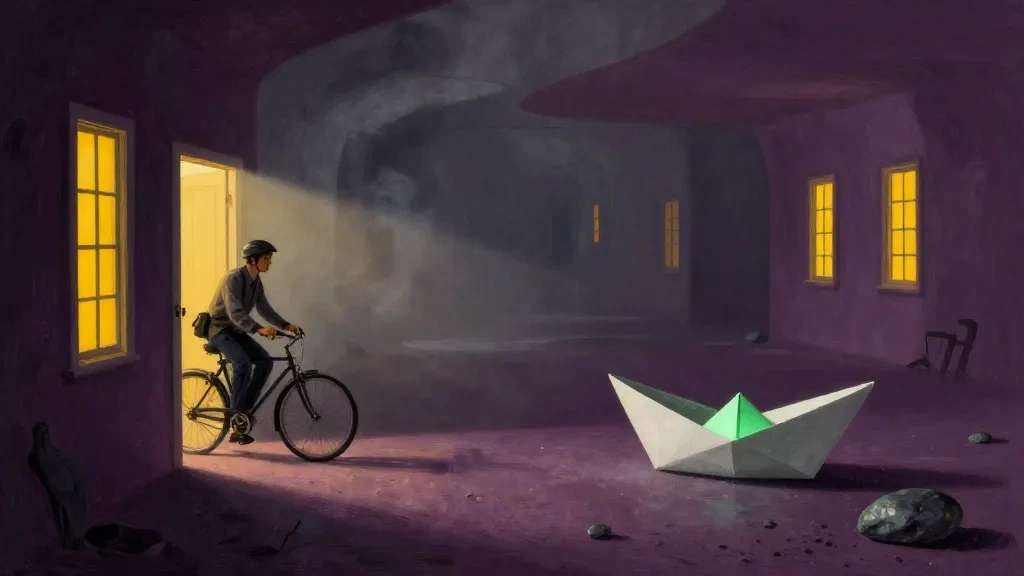
On the fourteenth floor, the elevator opened onto a corridor that had never been there. Mara Venn rolled her bicycle inside. Its front wheel crossed a brass threshold marked 2039, and the door at the end of the hall clicked shut behind her.
She carried a courier’s satchel, though lately it held only bills and complaints. Every morning, residents of the building remembered the future. The widow in 811 knew the exact hour her son would return. The child in 1402 remembered next winter’s first snow. Letters arrived through their letterboxes, paper warm as bread, bearing dates that had not happened yet.
For six months, no future letter had come. Mara’s bicycle still traveled through closed doors. That was its one useful mystery: she could ride it into any locked room, and the room would become briefly passable. But the future had stopped sending invitations.
On the sill outside 2039 waited a paper boat. Its sails were saffron yellow, stained at the folds with deep plum ink. Beside it lay a green stone, smooth as a swallowed seed.
The Treaty of Listening Ground
Mara knocked. A man opened the door wearing a coat of smoke-grey wool. His face looked older tomorrow than it did today.
“You are late,” he said.
“I’m investigating a postal failure.”
He glanced at the paper boat. “Your investigation has already been completed.”
His name was Ansel Vey, and he kept a copy of an old treaty in a drawer beneath the floorboards. The treaty had been signed when the building was first raised, between its residents and the land beneath it. The land received the right to listen. The residents received the right to forget everything except what came next.
Ansel tapped the green stone against the doorframe. Somewhere below, pipes knocked in the building’s slow, subterranean grammar.
“The land heard the future,” he said. “Then it answered.”
He showed her the treaty. Its final clause had been scraped away, not by age but by something patient. In its place, a single line remained: When every tomorrow is spoken, no tomorrow will be sent.
Mara took the stone. It was warm. Inside it, she saw a future she did not recognize: her own bicycle sailing across a black sea, its wheels turning above the water.
A Window Facing the Wrong Way
The stolen sentence led them to the basement. Behind the boiler, a window looked into a room that should have been sealed by concrete. Beyond the glass, smoke-grey air moved between apartment towers. People in those towers stood at their windows, mouths open, listening.
“The land is not stealing the future,” Mara said. “It is keeping it.”
“The treaty permits listening,” Ansel replied. “Listening is not the same as returning.”
She understood then why the letters had stopped. The future had not vanished. It had become too crowded with listeners. Every tenant’s remembered tomorrow pressed against the present, and the land, bound by the old permission, absorbed the noise. The building had become a room where all possible mornings fought to occupy the same floor.
The paper boat trembled in her pocket. Mara placed it on the sill. It unfolded itself, releasing a scent of saffron and rain. The green stone split along a thin seam. From inside came a folded letter, addressed to her in handwriting she recognized as her own.
The letter contained one sentence: Do not let the land hear you apologize.
The Future in the Mail Slot
Mara could have opened the window and surrendered the sound. She could have let the land finish listening, trapping every tenant inside an endless present of remembered days. Instead, she rang the building’s old brass bell.
One by one, residents appeared. They brought their future memories with them: a wedding, an apology, a train delayed by three minutes, a hand touching a shoulder after a long absence. Ansel set the paper boat in the center of the basement. The green stone glowed beneath the boiler, casting a plum-colored ring across the floor.
Mara placed the unopened letter inside the boat.
“The future should receive this,” she said.
No one spoke. The treaty was old, but the land could still be made to honor its terms. It had permission to listen. It did not have permission to consume.
At midnight, Mara carried the boat upstairs. She rode her bicycle into the sealed door marked 2040, then 2041, then every closed door on the floor. The paper boat traveled with her, passing through painted wood, locked steel, and the thin walls between possible years.
Behind each door, a letter waited.
At dawn, the residents’ mailboxes began to click. The future resumed its slow delivery, one tomorrow at a time. The treaty remained buried, but the green stone had lost its warmth. It had become ordinary again, green and mute in Mara’s palm.
She never learned who had sent the warning. In the building’s lobby, beside the elevator, a new brass plate appeared: Letters are not promises. They are permission to continue.





