 Netwrck
Folk Horror.
The Bicycle and the Locked Door
Mara delivered to a building where no one remembered yesterday. Its windows were packed with frost, though midsummer heat shimmered over the roofs. Inside, every tenant lived slightly ahead of themselves: boiling kettles announced grief, unopened letters thanked the postman, and children rehearsed names they had not yet been given.
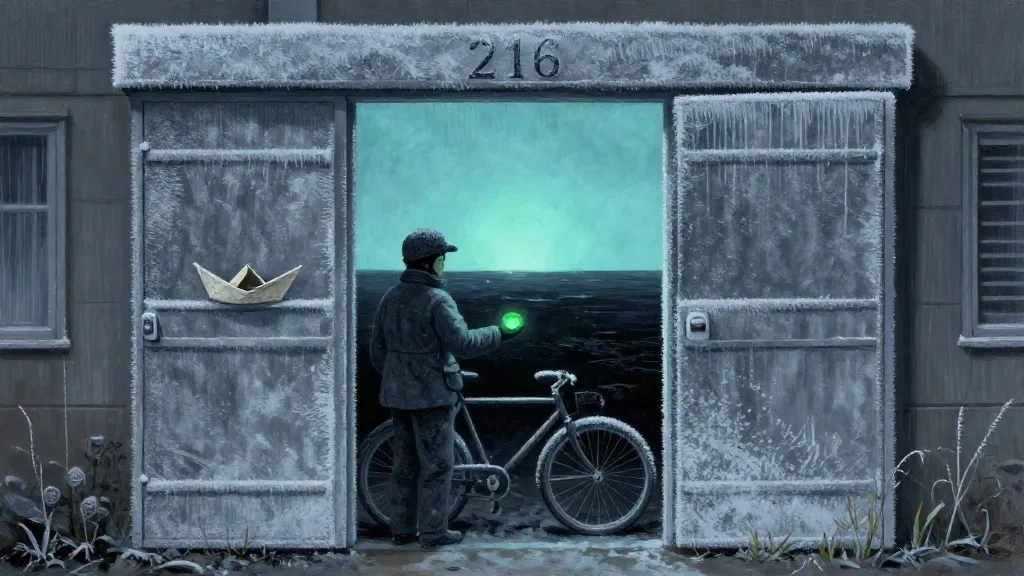
Mara’s bicycle had no ordinary lock. Its wheels rolled through apartment doors. A green stone hung from the handlebar, polished smooth by her palm, and beneath the saddle she carried a paper boat folded from an undelivered letter.
For nine years the future had sent her work. Each morning, brass tags appeared in her basket bearing an address, a name, and a parcel wrapped in frost. The parcels contained necessities for lives not yet lived. Mara delivered them quickly, before events could spoil the arrangement.
Then the letters stopped.
No addresses. No names. Only the bicycle arriving each dawn with its basket empty. Mara wanted to know why the future had abandoned her. She pedaled past the ordinary doors, calling through keyholes for tomorrow, but the walls answered in voices that spoke events centuries removed.
At the building’s end stood Door 216. It was made of iron and rimed white. No tag had ever carried that number, yet someone within scratched a paper boat into its frost.
The Land That Listened
When Mara turned the green stone in her hand, the door opened inward onto a winter field beneath an impossible dawn. Cyan light spread without warmth across black furrows. A woman stood there holding a treaty bound in green thread.
“You are late,” the woman said.
The land had once been human. So the treaty claimed, though no register agreed on who had signed it. In exchange for crops, water, and the names of the dead, the old settlement permitted the land to listen. It heard footsteps through floors, quarrels through walls, and the future’s footsteps before they took their first step.
The agreement had an unwritten clause: when the land heard a future it disliked, it could lock it away.
“It heard us planning to leave,” said the woman. “Not the city. The ground. People from every apartment promised to build elsewhere, and the land believed them.”
Mara unfolded the paper boat. Inside, faint pencil marks ran backward along its creases. Her father’s handwriting. A dock, a ticket, a date twelve years hence.
“The future stopped because it was afraid to send anything past the lock?”
“No. It stopped because someone answered from the other side.”
The Courier Returns
Beyond the treaty woman waited a road under the cyan dawn. Along it stood every door in the building, multiplied without end. From behind them came noises Mara recognized: her bicycle bell, her mother’s cough, rain beginning against a window she had never seen.
Behind one door, the future waited with parcels in its hands.
“You may take one delivery,” the woman said. “But knowledge of the road will pass from you to the land. The land may then use your route.”
Mara understood at once. The land had not broken the future. The future had learned to avoid the one road capable of leading everyone home.
She mounted the bicycle. The green stone split beneath her fingers, releasing a smell of iron and winter water. She placed the paper boat in the basket, where it began to fill with darkness.
Riding became a burial. Every closed door she crossed woke. Inside, futures crowded against the hinges: marriages, funerals, narrow escapes, children growing old in rooms that no longer existed. They reached toward her, but Mara kept pedaling.
Behind her, the land opened its iron mouth. Cyan light poured through it, bright as a sunrise seen underwater. The road buckled. The doors began to shut.
What Arrives Tomorrow
Mara reached the final door. Its lock was warm. She laid the paper boat against it, and the darkness inside unfolded into a thin, folded letter.
The handwriting was hers. The date was tomorrow.
It read: Do not let the land hear where you have gone.
Beyond the door, a bicycle bell rang once.
Mara smiled and pushed it open. The future had not stopped sending letters. It had learned the one address the land could not bear to listen to.
At dawn, the tenants woke without remembering yesterday. Mara returned to the lobby, her basket full of new tags.
At the top of the stairs, the lowest door stood ajar. A paper boat rested on the threshold, and a green stone shone beneath it.
Mara never opened that door. She simply mounted her bicycle, passed through the wall, and began her rounds.





