 Netwrck
Speculative Fiction.
The Market Below Winter
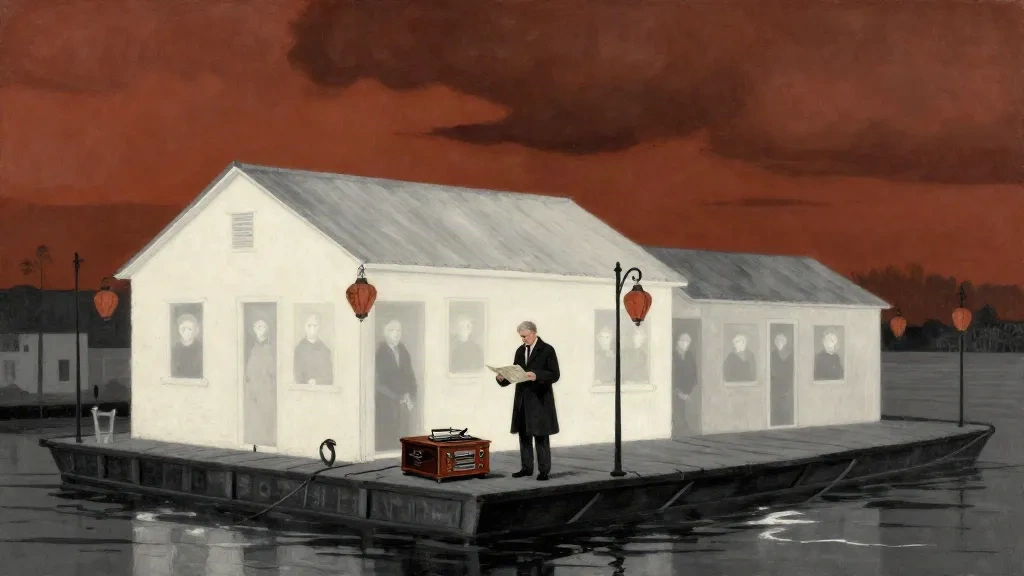
The market hung beneath a sky with no clouds, its stalls tethered by iron chains to an old brown cloud. Rust-red lanterns leaned into the pale winter light. Below them, the lake turned over in a slow black wheel.
Elias Venn found the seller beneath a stall draped with charcoal cloth. She was small, silver-haired, and careful not to move her shadow.
“You have something my mother left,” Elias said.
She named no mother. She unfolded a map creased into the shape of a closed fist. Pale roads crossed it, all leading toward the same house.
“She promised to come back when the house finished growing.”
“Promises are markets. People sell what they can no longer carry.”
The seller placed a small music box on the map. It played eight notes, paused, then played them again with one note changed.
“Your mother carried that. So did the daughter before her.”
Elias listened until the final note settled. His mother had played the same faulty phrase when he was nine, though he had thought it was a childhood tune.
The house stood at the end of the last pier, beyond the market’s purchased memories. Its windows were shuttered. Its chimney leaned toward the lake.
Elias stopped at the threshold.
He had spent forty years learning how to leave rooms. Stage sets, dressing rooms, hospitals, a narrow customs office in a city whose name he no longer used. He knew exits by heart. He did not know how to return until that moment.
He pushed open the door.
Inside stood the entrance hall from his grandmother’s house: green paint, a brass clock, a row of wet umbrellas. He remembered leaving it. The memory moved under his feet like a floorboard remembering a footstep.
He stepped inside.
His mother’s music box sat on the hall table.
Rooms for the Unsaid
“You came back,” said a voice from the kitchen.
His mother sat with her back to him, though he knew the room was empty. The old anger rose first. Then the old tenderness. She had died in the house he had promised never to enter.
“You said you would return when it stopped growing.”
The house answered for her. A wall divided itself from floor to ceiling, and a narrow door appeared in the new plaster.
Elias stared at the wallpaper. A crack ran through its pattern like a vein.
“It never stopped,” his mother said.
He opened the door. Beyond it was the room where she had rehearsed her leaving. No costumes, no script, no false names. She sat before the mirror, practicing a confession.
Elias closed the door.
A second room opened.
His own bedroom waited inside, arranged for the morning he had left for the theatre. The sheets were tucked. The window looked onto rain.
“You told me the house needed no one,” he said.
“I needed somewhere to put what I could not say.”
“What did you say?”
The music box started in the hall. Eight notes. The ninth changed.
He crossed to it. Inside the lid, beneath rust-red velvet, lay a strip of paper: When the house has room enough for the truth, bring the map to the locked door.
His mother’s handwriting was small and exact. His grandmother’s was cramped and hurried.
“That was not a promise,” Elias said. “It was an instruction.”
“That is what a promise becomes after three generations.”
The Door That Owes an Answer
They reached the locked door at midnight.
It had appeared in the hall wall, painted the same green as the entrance. The folded map fit its keyhole.
Elias inserted the map. The door opened inward on darkness.
“You promised to return when the house stopped growing,” he said.
“I promised to tell you why I left.”
“That is not the same.”
“No.”
The house shuddered. A room formed behind them, then another. Doors multiplied along the walls. Behind one, his mother shouted that he was too late. Behind another, the audience laughed. Behind the last, his grandmother whispered, Tell him where you buried the key.
Elias understood then. The house did not grow from lies. It grew from the distance between what people said and what they meant. His family had been feeding it for generations.
He opened the music box and removed the sleeping mechanism.
The missing ninth note was not a note. It was a small brass key wrapped in a strip of tissue.
He carried the key to the dark door. The map’s roads brightened on the floor, branching now toward every room.
“If I open it,” he said, “the house may stop.”
“It may remember all of us.”
“Then it can have the part I was afraid to tell.”
He turned the key.
What the House Kept
For one breath, every room held still.
Then the walls became transparent. In the kitchen, his grandmother sat beside his mother, both young, both afraid. They had quarreled over an inheritance, a theatre, a child. His grandmother had promised to visit. His mother had promised to return. Every unkept promise had acquired a doorway.
His mother’s ghost stood before him.
“I left because I was afraid you would forgive me,” she said.
Elias looked at the house around them: hundreds of rooms, all empty, all waiting for a person to confess.
“I could not forgive you,” he said. “I kept trying to find the room where that would happen.”
“There is no such room.”
“No.”
He took the folded map from the locked door. The paper had softened in his hands. Its roads had become pale threads, tied at the corners.
Outside, the market lanterns swung over the black lake. The music box gave one final note.
The house stopped growing.
Elias left the map on the hall table, beside the clock, where anyone with an ownerless memory might find it. Then he went down the pier.
At dawn, the seller watched him from beneath the charcoal cloth.
“Did you keep the promise?”
Elias looked back. The house had one lit window.
“I learned which one I had made.”
He did not tell her the rest. But for the first time, the house did not make another room.





