 Netwrck
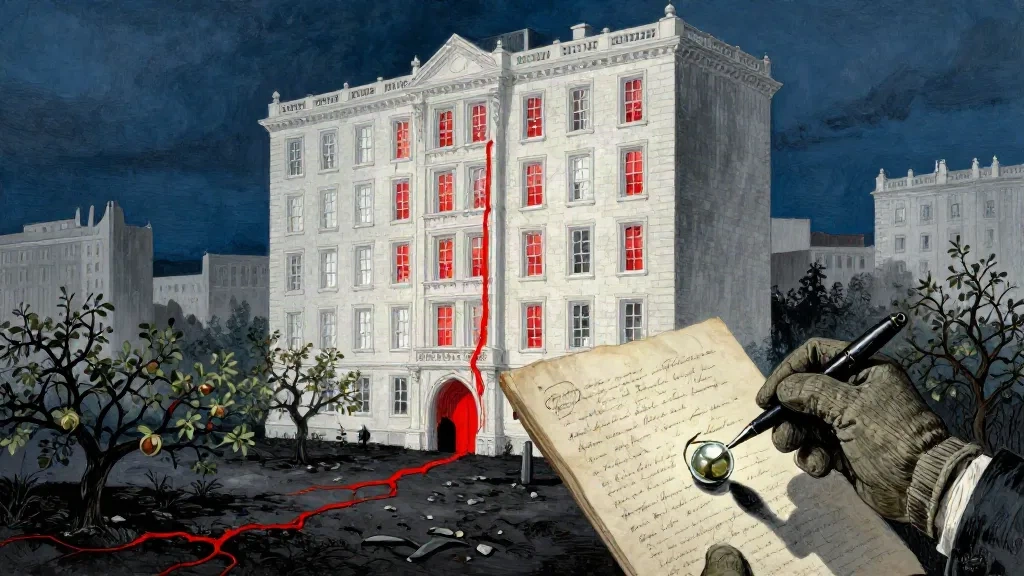
Gothic Fantasy.
The Catalogue Beneath the Stair
The Vellum House stood seventeen floors above a drowned garden, though everyone who lived there agreed it had only twelve. Its corridors were white coral, the porous stone veined with red thread that tightened whenever the elevators changed direction. No one hung clocks. The tenants remembered futures, not mornings, and a calendar was considered an act of cruelty.
Mara Venn worked in the basement archive, where ink ran uphill across the census ledgers. Her hands were permanently cold from the paper. Her job was the filing of arrivals that had not happened: births in rooms that were still empty, surrenders signed in kitchens that no tenant had entered yet, last names abandoned by families who preferred the wind. She was not to mourn, not to celebrate, and above all not to judge. She was to witness that a thing had been entered.
Enter it as it will be, not as it is. The building keeps both.
Four years ago she had entered a name for a man named Tace who lived in 1102 with his daughter, and that same night the girl had stopped recognising him. Not his face. His name. She had watched from the stairwell as a nine-year-old walked past her tenant twice and went home to a stranger, and Mara had written it down anyway, because the ink wanted it and the building had held her wrist. That was the whole of her punishment, and she had accepted it, and it had taught her the shape of her job: the paper does not care whose life it opens.
Her mother had lived in the Vellum House and had died in it before Mara was born, which meant the building had never met her and had no intention of starting. Mara kept a wool glove on her left hand through the summer, and beneath its cuff, a splinter of black glass ground from the heel of something the demolition crew had swept out of the east stairwell. She told no one where she had found it. She told no one almost anything.
On the ninth evening the glass seed appeared in her desk drawer. It was clear, cold, and empty except for a single red filament caught inside, hanging like a hair in treacle. Beneath it lay a catalogue entry in handwriting she recognised as her own.
Venn, Mara. Formerly the Orchard Street house. Name to be returned to the land. Witness to follow.
The date was forty-one years ahead. Mara checked it twice against the wall ledger, which needed no correcting; the wall ledger had known since the first week of the month.
The Signature Beneath the Door
She carried the catalogue upstairs because the basement had learned her shape and she did not want to be alone with the asking of anything. The tenants were eating their customary meals of unremembered fruit and drinking water from glasses that showed tomorrow's weather. A child in room 1404 sat on the landing steps with her knees up, playing at a funeral that had not occurred, choosing the hymns. An old man in 1209 stood in his doorway rehearsing a first conversation with a daughter he had not yet met, over and over, adjusting the word late to eventually and then back.
Mara had always liked that man. It was the only unkind thing she had ever filed, and she had filed it with care.
At the seventh-floor landing, the shadow separated itself from the wall beneath her lamp. It had been there for months, she realised. Thin as a coat sleeve, black as spilled ink, it bowed with a flourish that made the red thread across the coral stair rail tighten.
“You have found an outstanding name,” it said. Its voice came from every door at once, and from inside the walls, and from a place under the floor that was older than the building.
“Names aren't debts.”
“In this house they are.” It produced a document from inside its darkness. The paper smelled of rain striking a grave, and of the fruit bowl in 1102, and of the wool glove she had not taken off in eleven years. “The land cannot receive what everyone agrees to forget. We do not take. We merely require your witness.”
“My witness for what.”
“That you will not come to harm by its absence.”
That was the trick in the wording, and Mara heard it the way she heard a false entry: at the space where the clerk's breath had been. Not that the erasure was harmless. That she would consent not to suffer from it. A consent dressed as a kindness, the way every form in the Vellum House was dressed.
She read the form. At the bottom was a blank reserved for a signature, and above it a line she had seen only once before in eleven years of filing, on a page in Sul Ammery's hand. Holder of the pen, night clerk, 40 years standing. Sul had read it to her once and made her laugh, and then he had not laughed, and then he had gone down to the furnace room and stayed there a long while.
“You have been holding it that long?”
“Holding it is not the same as keeping it.”
“What is the difference?”
“One of them is a post.” He had looked at her then with the particular gentleness the very old use for the very young, which she had hated. “And one of them is a debt with a shape in it.”
The shadow offered her a pen. It was warm, which nothing in the house was.
Mara kept her gloved hand closed. Beneath the cuff the black glass had gone hot against her skin, the way a word goes hot in the mouth of someone who has been forbidden to say it. In the shadow's surface she saw the orchard she remembered, though she had never visited it: the low stone wall, the grass that grew in the shape of a hand, the three apple trees her mother had described to nobody. And beyond the wall, standing in the road, a woman with a wool glove over her left hand and a girl of about six beside her, both of them waiting for something to be finished.
She stepped back. The shadow did not follow. It only leaned, and enjoyed the leaning.
The Room That Had Not Happened
“Sign,” it said, “and the name returns to the land.”
“Returns to where?”
“Where it belongs.”
“That is an answer to a question nobody asked.”
“It is the only kind the Vellum House gives.”
Mara pressed the catalogue flat against the wall. The red thread woke along its length, lit one doorway, then another, then a third further up, climbing toward a floor she had never been able to count correctly. The plaster there was smooth and unnumbered. The door was marked with a future date in the building's own hand.
Inside: shelves of jars, each holding weather that had been forgotten by everybody it had happened to. Rain going up a window. Hail in a jar with a child's palmprint. A clear cold afternoon with nothing in it. The light in the room was the light of a room where no one had ever decided anything, and Mara understood, with a sensation like a key in a lock, that this was where her mother had been sent, and that her mother had agreed to be sent.
On the table lay a second glass seed, a cracked wool glove, and a deed describing an orchard destroyed before the city was built. The deed was witnessed by a woman with a memory of rain, and signed by a woman with Mara's face.
Forty-one years from now, the orchard would be under a metro platform. Mara had seen the platform in a jar of forgotten weather. She had filed the demolition schedule herself, three winters ago, in a neat hand, on a Tuesday.
“You came here,” she said.
“I was sent here,” the shadow replied. “There is no difference in a house that remembers consequences.”
“You are not my mother.”
“No,” it agreed, with what in a face would have been relief. “Your mother is a ledger entry. I am what is owed on it.” It came closer, and the cold of the room organised itself around Mara's ankles like water finding a drain. “She signed to be let go and put a witness in the field so that someone else would pay. That is what the field is for. It is not a kindness to the world. It is a kindness to the one who signs.”
“And now the field is mine.”
“The field has always been yours. You are simply the first to be asked.”
She lifted the second seed. Every future-memory in the room rushed toward it: rain on a red door, roots under stone, a hand pressing soil flat over a name in a language older than the city's. The catalogue opened itself at her entry. Beneath the ink, in the same hand, a second word surfaced as the water rose through the fibres.
Witness.
She understood the mechanism then, and understood that it had been built for her specifically, by someone who knew her habits. The seed held a future. To end the erasure the seed had to be broken — but a broken future with no witness is a witnessed loss, and the loss would fall on the nearest living person who loved whoever it had happened to. The building had not come to her as a monster. It had come as a form, correctly filled in, and a pen, warmly held.
The shadow's pen began to move by itself. It signed the deed, and then struck Venn from the top line with a single economical stroke, and left the document in her hands, which meant nothing now. Nothing could be done to a name that had no witness and no claimant. The building shook. Somewhere above them an elevator opened onto a floor that did not exist, and did not close.
What the Tenants Owed
She came back up through the coral in a fever of arithmetic. Sul was waiting for her at the top of the basement stair, which was not possible, because he had gone down to the furnace room an hour ago and had not come up, and he was not a man who came up.
“Term ended,” he said. “Forty years. I filed the last name I ever wanted to file and now the pen has no hand and it has been looking for one. You should have let it keep me.”
“You could have said.”
“I said. You filed it anyway.” He said it without heat, the way the building said things. “That is the whole of the Vellum House, Mara. Everything is said, and then it is filed.”
She went to 1404. The child's funeral had stopped. The girl sat on the landing with her hymn book shut on her knees, staring at the wall, and when Mara asked her name the girl told her cheerfully that she was not sure she had one yet, which was the answer of a tenant whose future had just been taken out of the room like a drawer. Her mother was asleep in 1402 with her mouth open, and Mara went in and shook her awake, and the woman said, in a voice of enormous calm, what did you do, what did you do, she was supposed to see me, that was the only thing she was ever going get, and now I have to bury her twice.
That was the price. Not a threat. A price, itemised, in real time. Mara ran the stairwell again with the seed burning in her fist, and the red thread showed her the arithmetic plainly at last: a name returned to the land did not cease to exist. It stopped being held. The whole weight of it fell down the coral well onto whoever had been rehearsing loving the person in question, and for an erasure of forty-one years that weight was a child's funeral and a man's unwritten daughter and, at the bottom, the garden itself, which had been holding a name it had no longer been permitted to hold.
In 1209 the old man had stopped rehearsing. The doorway was open and the room empty and the glass of water on the sill had gone dull. Mara found him in the lobby, forty floors below his own kitchen, standing with his coat on in the wrong weather, asking the desk whether anyone had come.
“Your daughter,” she said. “What was her name?”
He thought. He thought for a long time, with a real effort that frightened her, and then he said, “I have been keeping it. Where have I been keeping it?” and she knew that whatever the building had been quietly feeding him for eleven years, it had gone out of him like a lamp going out of a room, and that when they had found the girl, if they found the girl, it would be a stranger asking her father a first question.
He put his hand on her gloved one, gently, as if apologising for the size of it.
“You are the archivist.”
“Yes.”
“Then you will tell me whether I was happy.”
“No,” Mara said. “I only file.”
What the Land Remembers
She went back down into the unnumbered floor with the seed in her fist and the splinter of black glass in her hand and Sul Ammery's ghost of a post to fill.
The shadow was waiting in the room of jars and had folded itself thin with impatience. Rain was coming up through the floorboards in a slow, reversed curtain, and the cold of it went through her shoes.
“You have had your look,” it said. “You have had your arithmetic. Sign.”
“I am not signing your form.”
“Then nothing changes, and the girl upstairs goes on being no one, and the old man goes on being told he is happy.”
“No.” Mara set the deed on the table, unrolled it, and uncapped her own ink. “I am signing the receipt.”
That was the seam in the whole architecture, and the building had built it for itself, because the land takes only what is delivered. The form asked a witness to consent to a loss. A receipt asks a witness to confirm that something arrived, intact, accounted for, signed for by the person who bore it. She was the witness. She had always been the witness. The difference was not in her, it was in the verb, and the Vellum House, which had never once been lied to, had no procedure for the truth.
She opened her gloved hand. The black glass had warmed to blood heat. She pressed it into the ink of the signature line hard enough to crack it, and the shadow recoiled, because a hand made of the land's own residue was on the form now, from underneath, and the form could not be read in two directions at once.
“You are not permitted,” it said.
“I am permitted. I am the field.”
She put the wool glove on her bare left hand, so that the crack in it joined the crack in the glove, and then she signed the receipt with her whole palm, smearing the ink across the forty-one years so that the date came apart into weather. The shadow shrieked in a voice like drawers slamming in a house where everyone was asleep.
“You cannot alter a returned life,” it said.
“A returned life is still a life.”
She broke the seed against the floor. The red thread snapped from wall to wall and drew a single line from the deed down through the foundations, and the document burned without heat. The jars of forgotten weather all went at once: rain on a red door, hail, the empty clear afternoon, a hundred afternoons that had been nobody's and were now nobody's again, but had been let go. Through the floorboards Mara saw the buried orchard as the building had always known it, in the first register, before the streets: black branches, white coral roots braided through the water table, and a low stone marker with a name worn past legibility by every city map that had ever been drawn on top of it.
A wool glove lay on the grass beside it, and the glove was whole, and Mara understood with a lurch that the cracked one in the room upstairs had been hers, all along, kept warm by a hand that had no need of warmth, carried through forty-one years of a future so that it could be brought back and broken at exactly the right hour, and that the woman who had done this was not a woman with Mara's face but a woman with her method.
The catalogue lay open in the rising water at her feet. She did not read the entry, because she knew what her handwriting had put there, and she had been putting it there for years, on Tuesdays, in a neat hand, correctly filled in. She spoke instead, and what she spoke was not the surname the future had assigned but the first name her mother had called her through the wall of a rented room in Orchard Street, in a voice nobody was ever meant to record, the one that had kept her name from being entirely administered.
The land opened. Soil came up through the stairwell in a slow black column, carrying seeds, rain, and the smell of apples. The shadow lost its hands, then its head, then its name, and went into the ground the way a signature goes into a file, and the place it had stood was only a place.
Dawn in the Archive
At first light the building had twelve floors again and could not decide which way it had been counting, so the lifts ran on the red thread instead, stopping where somebody was thinking about stopping.
Mara went up to 1404 first. The girl remembered a funeral, all of it, hymns included, in the wrong order, which was how a six-year-old would have carried it. Her mother was asleep with her hand on the girl's back and the child's face wet and furious and alive. In the lobby the old man was home. He had a woman's umbrella over his arm that belonged to nobody and he would not give it back, and at some point in the middle of the afternoon he said a name into a telephone and then sat down on the stairs and let out a long breath, and Mara, filing nothing, saw him go grey and glad at once and understood that the surplus had gone somewhere after all, and that it was not the garden's doing, and that she had not asked.
Sul Ammery was not in the furnace room and not in the archive. The night clerk's chair was cold. On its seat lay a form, correctly filled in, in his hand, dated forty years earlier, with the signature line blank, because he had never once managed to lie in writing and had spent his whole term proving it.
Then she went to the basement, because the basement was where the records were, and she was the archivist, and the ink was still running uphill.
The catalogue held one entry. Everything else had gone back into the walls to be somebody's.
Witness, Mara. Name returned. Future, unwritten. Standing debt: one witness, unspent, held at the convenience of the house.
She read it twice. Then she took up her pen, and in a neat hand, on a Tuesday, entered it as it would be, not as it was.
A red thread remained across the threshold of the archive, no thicker than a hair, warm, and patient, and the sound of remembered footsteps was still approaching from behind. Mara tied one end of it around her finger, the gloved one, where the glass had been, and the other end she left loose, in case something in the garden wanted to hold on. Then she went up through the coral stair, past seven tenants who did not know her name and would not be told, to the drowned garden, to look for a stone that no map had ever admitted to, and to say a name out loud where there was still somebody listening.





