 Netwrck
Romance.
The Last Screening
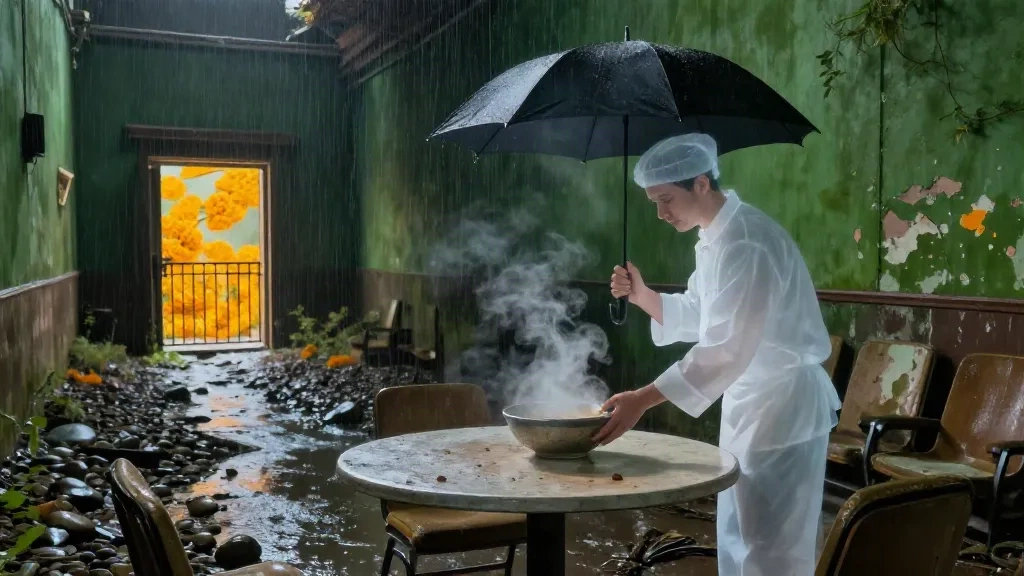
Mara had inherited the abandoned cinema with its moss-green walls, its leaking roof, and the black umbrella left in the third row. The umbrella belonged to Elias Vale, according to the family legend, though no photograph had ever shown his face.
Her grandmother had told the story while stirring barley soup: Elias came to their table during a storm, ate one meal, and left behind a future. A safer one. A future where the river beside their village did not flood, where the mill stayed standing, where the family kept its name.
“You only have to prove he was real,” Grandmother had said. “Feed him when the picture calls.”
Mara had dismissed it as a cook’s bedtime story until the cinema began showing films of futures that almost happened. The projection flickered over the dusty seats: rain falling upward, her own kitchen filled with unfamiliar children, Elias standing beneath a black umbrella in a town she had never visited.
She brought a pot of onion broth to the screen. The first diner appeared as a translucent shape. Then another. A woman with flour on her sleeves. A boy holding a red balloon. An old man who wept when he smelled thyme.
Each was someone who had once eaten at Mara’s table, pulled from a future she had not chosen.
The Gate in the Riverbed
Elias came on the seventh night.
He stepped out of the silver image carrying the black umbrella, its handle shining with rain though the roof was dry. He looked at Mara as if recognizing her before seeing her.
“You’re late,” he said.
“I didn’t know you existed.”
“That’s how the invitation works.”
Behind him, the cinema walls opened onto a dry riverbed. Stones shone wet beneath the moss green projection. A gate stood at its center, made of black slats and pale nails. Across it waited a town with intact houses, a full mill, and a blue evening sky.
Mara’s grandmother stood there too. Young, straight-backed, smiling without surprise.
Elias unfolded the black umbrella. “Your family promised me a place at the table.”
“And you took everything else.”
“The future doesn’t permit bargains. It permits substitutions.”
Mara understood then. The cost was not a possession or a year of life. It was a memory. The gate demanded the memory of someone who had eaten at her table, and the payment could be made only once. Pay with the same memory twice, and the gate opened onto nothing at all.
She could save the flooded village by forgetting her grandmother’s face. She could bring Elias through by forgetting her first meal, the broth warming her hands after her mother died. She could prove the legend, but proof and love required incompatible witnesses.
Elias looked at the place beside him. “I didn’t come to make you choose between us.”
“Then why bring the gate?”
“Because you always make the meal taste better than the truth.”
A Future Worth Serving
Mara returned to the kitchen and cooked without a recipe. She used the last green herbs from the window, beans dried in autumn, a strip of smoked fish, and broth made from the bones of the family’s first soup. She ground pepper into a small marigold flower and set it beside the plate.
Elias followed the scent through the broken projection.
“You’re not cooking for the gate,” he said.
“No.”
“Then what are you cooking for?”
“For the person who remembers choosing.”
She served him at the table beneath the screen. He ate slowly, watching her face instead of the food. The diners gathered around them, transparent hands lifting bowls, all the futures they had nearly lived pressing close.
When Elias finished, the black umbrella began to lose its color. He looked at the gate across the dry riverbed.
“I can prove the legend by crossing,” he said. “But I can’t cross without taking your memory of me.”
“I know.”
“And if you refuse?”
“Then the legend remains a story.”
He touched the table. “That is not the same as false.”
Mara looked at the wet stones, the nails in the gate, the flash of marigold reflected in black water beneath the projection. Her grandmother had chosen a future where everyone survived, but someone had to remember the cost. Love could not erase the truth and still be love.
Mara opened her hand. The memory rose warm and sharp: a boy under a black umbrella, rain on his cheeks, soup between his hands, the exact expression of his gratitude. She gave it to the gate.
The nails pulled backward. Elias stepped through, returned to the cinema, and took her face between his palms. The future behind him dissolved, leaving only the abandoned seats and the dry riverbed’s silence.
“I remember you,” Mara whispered.
“Not the version that saves us.”
“No. The one who came back.”
He kissed her beneath the moss-green screen. Outside, rain began against the roof, and the black umbrella lay open between them like a dark, patient promise.





