 Netwrck
Mythic Fiction.
Shadows at the Empty Tables
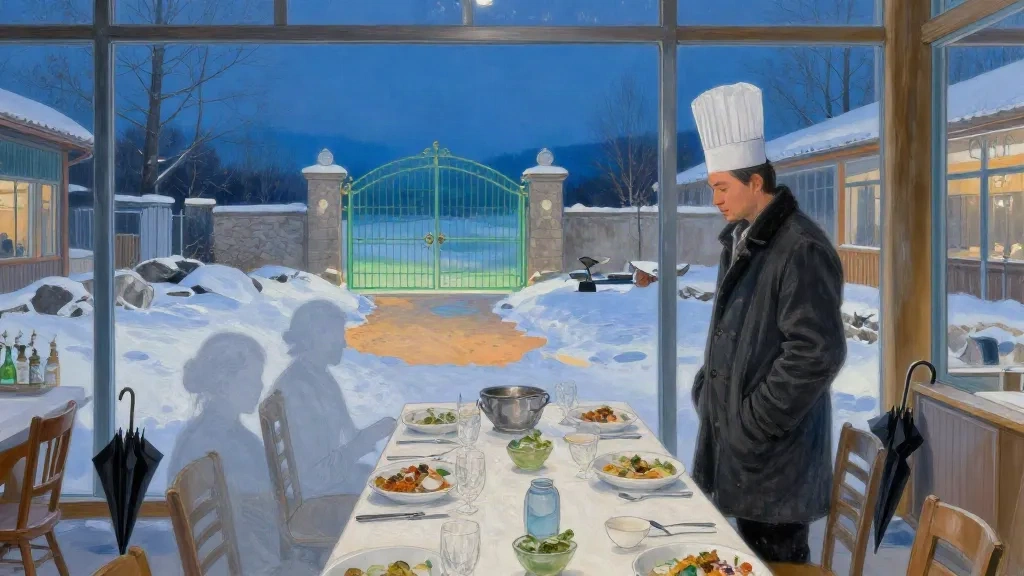
Shadows reached the Winter Larch before the first skier did.
They slid beneath the eaves while the lifts stood still, crossed the frozen drive in blue-black lines, and gathered at the lodge tables before anyone had ordered coffee. Mara Venn watched them from the kitchen window. Each silhouette wore the shape of a guest who had not yet arrived: a woman with one arm, a broad man carrying skis, a child whose head tipped backward in sleep.
By noon, the shadows had taken seats. By nightfall, the guests who belonged to them were eating.
Mara carried plates through the dining room and felt the room remember her. The black umbrella by the service door trembled whenever the old iron gate appeared in her dreams. Beyond it lay a dry riverbed, pale stones arranged beneath cobalt shade.
Her family said the river had once run there. Her grandmother, Anselma, had crossed it fifty years ago and returned with a recipe no cookbook recorded. She also returned without remembering the night she disappeared.
“The gate opened for me,” Anselma had said. “I paid, but I forgot the road.”
To that day, her family had called it a winter hallucination. Mara intended to disprove them.
What the Recipes Brought Home
Cooking had always summoned the absent. A spoonful of brown butter in Mara's mother's stew brought back the smell of her father's pipe. Bread brushed with pine honey restored the afternoon her brother learned to whistle. These were harmless echoes, shadows arriving early.
But Anselma's recipe summoned people.
Mara began serving it on the anniversary of the grandmother's crossing. Sea-glass green mussels steeped in cider. Sand-colored roots roasted in kelp butter. Cobalt mushrooms gathered above the snowline. When she placed the black umbrella beside the final bowl, the dining room vanished.
Winter closed beyond the windows without wind. Lanterns went dark. The guests at the tables became translucent, and between them stood her grandmother as Mara had last seen her: soaked coat, bare feet, eyes fixed upon an invisible gate.
“You came through the recipe,” Mara said.
“I came through hunger,” Anselma replied. “I still haven't come through the gate.”
At once, the dining room filled with everyone who had ever eaten at Mara's table. Her parents arrived in clothes from vanished decades. Dead friends bent over untouched soup. Strangers inherited the faces of customers she remembered serving.
Their praise was worse than hunger. They asked for second helpings. They praised her grandmother's cooking until Mara understood the terrible reach of it: every person nourished by the recipe had become part of the table's memory.
Anselma opened her hand. Inside lay a small brass key.
The Price of the Crossing
“The gate is beneath the reservoir,” Anselma said. “It opens for one bearer of the family name. Whoever enters may return with the river.”
“What did you pay?”
The gathered dead fell silent.
“The memory of why I needed to cross.”
Mara now saw the route through the kitchen, past the coal bins and down beneath the frozen skating pond. The black umbrella was its key. Dry river stones waited on the other side. The gate's hinges resembled two black wings.
She walked there after midnight with the umbrella over her head. The storm had left everything blue and severe. At the reservoir, she cut the ice and descended a ladder rusted by another age.
Below, the dry riverbed ran beneath a sky with no stars. Every step made the stones grind like teeth. At its end stood the gate.
Its lock accepted the umbrella's tip. The gate opened a hand's width.
“One crossing,” said a voice from the dark beyond. “One life for one road. Nothing can be paid twice.”
Mara understood then. Her first impossible crossing had purchased the return journey. The payment had been extracted before the gate had ever existed for her. If she tried to pay again, it would not take a memory. It would take the person holding it.
She forced the gate wider. The dry riverbed ended, and beyond it ran the vanished river, bright beneath a green dawn. Along the far bank stood her grandmother at the age Mara knew best: whole-eyed, laughing, untouched by winter.
A Table Set for the Living
“If I return without the story,” Mara called, “how will I prove you crossed?”
Anselma smiled sadly. “A true thing doesn't need the one who lost it to prove it.”
The gate pulled hard against Mara. The price climbed through her: first winter mornings, then her parents' faces, then the sound of bread crackling in a black oven. She loosened her grip.
Behind her, however, footsteps approached. Anselma had followed.
“You paid once,” the elder shouted. “You can never pay again.”
Mara seized her grandmother's wrist. The gate wanted payment and would receive none. Instead, she opened the umbrella between them, black cloth over both faces, and spoke the first line of the recipe as a declaration rather than an invocation.
“Set a table where no one is hungry.”
The gate recoiled. On the far bank, green water leapt into a dry channel, lifting the stones and carrying a thousand reflected shadows west. Anselma's returned self smiled once, then faded into dawn.
Mara climbed out carrying no brass key, no family memory, no answer. Yet the following winter, when her father's old watch was found lodged in the umbrella, its cracked face displayed her grandmother's face smiling.
Mara served the recipe that night. Empty places filled before the doors opened. Every shadow rose when she entered.
In her grandmother's place stood a guest with wet sleeves and steady eyes. Mara set a bowl before her.
“Tell me who you are,” Mara said.
The woman tasted the food. Her face changed, not into a memory, but into recognition.
“Your grandmother,” she answered. “You finally served me your mother's cooking. I told you I preferred it.”
Outside, snow erased the road. The umbrella dripped river water into the salt.
And beneath the table, unseen by the living guests, a dry river began to run.





