 Netwrck
Mythic Fiction.
The Recipe for the Missing Guest
At dawn, the door above Mara Venn's kitchen clicked open, and a dead fisherman entered carrying the taste of salt on his breath.
He crossed the sand-colored tiles, took the chair nearest the hearth, and said, “My wife said your stew was worth remembering.”
Mara set a bowl before him. He ate. Then he bowed low and vanished, leaving behind a wet black umbrella despite the cloudless cobalt morning.
It happened again at noon, with a girl who had loved Mara's grandmother, and at dusk, with three brothers who had quarreled on the last evening their mother lived. Each arrived hungry. Each vanished before the second bite.
The summons was in the recipe book inherited with the museum. Its black pages began with a warning: Every guest restored shall hunger once again.
Beneath that lay a family legend. Mara's great-grandmother had cooked a seventh course for travelers stranded between storms. They returned years later, older but unharmed, claiming she had opened a door in hunger. Mara had dismissed it as sailors' invention.
Now she intended to prove it true.
The Gallery That Refused Dry Weather
The Museum of Doors occupied the floor of a vanished river.
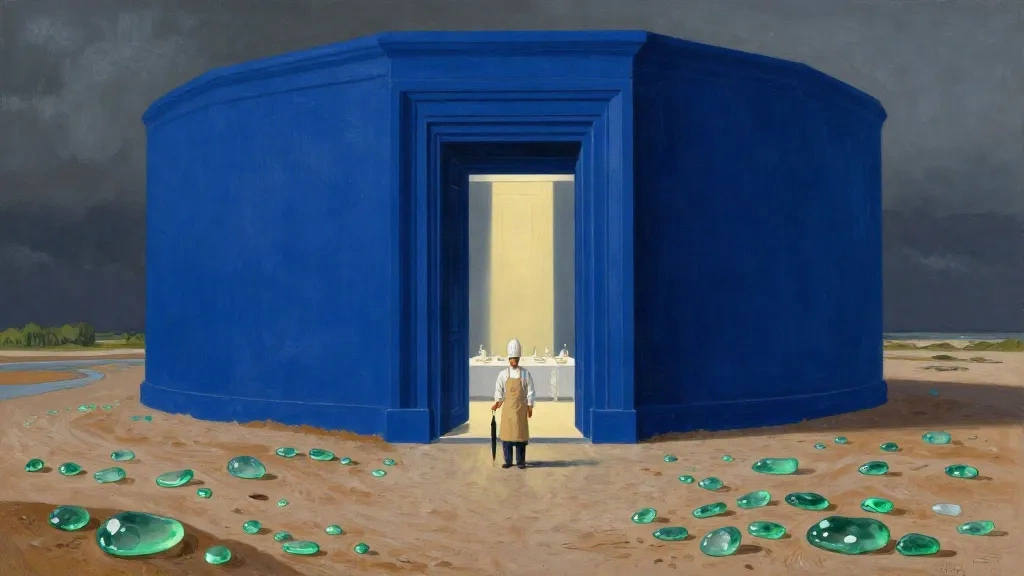
Mara crossed its exhibition hall beside a dry riverbed filled with sea-glass pebbles. Green light gathered in the deepest pools, though no water ran there. Overhead, cobalt shadows leaned from doorframes like sleepers.
Each door carried a small brass label: courage to begin, courage to refuse, courage to be seen, courage to leave. Between them, a black umbrella leaned against the wall, identical to the one the fisherman had left behind.
“Not souvenirs,” said the curator, a tall woman whose face was hidden beneath a sand-colored veil. “They are evidence.”
“Evidence of what?”
“That every kind of courage asks for something.”
The seventh course waited at the final door. Its label was blank.
When Mara touched the handle, her grandmother appeared from the cobalt shadow. She looked exactly as she had on the night before the storm, young enough to have been mistaken for Mara's mother.
“You brought no seventh course,” she said.
Mara lifted the recipe book. Inside, seven lines had appeared in letters cut into wet salt.
The first six summoned the living and the dead who had eaten at their family table. The seventh summoned the traveler who had once crossed the final door. To open it, they had swallowed the one dish no one could taste twice.
The old woman glanced at the book, then at Mara's mouth.
“A family cannot pay that price,” Mara said.
“No,” her grandmother replied. “That is why I invented the story.”
The Cost of Remembering
Behind the door waited a kitchen beneath cobalt shadow.
A dry riverbed ran beneath its long table, its stones luminous green. A storm-black window revealed no sea, only a white horizon. The seventh course waited there: a bowl of clear soup, steaming above a plate written with Mara's family name.
The cook at the stove wore the same black umbrella, though no rain fell.
“To summon the traveler,” the cook said, “you must feed him what you will never taste again.”
“A life?”
“Only the way that life will know itself.”
Mara understood. The cost was not a memory or a year. It was the recipe itself. Once surrendered, she would never cook that meal again. She would be unable to remember its taste, its aroma, or the hand that first stirred it. Tomorrow, the knowledge of how to make it would be gone.
She had rehearsed the loss a hundred times, but never as a woman standing beside her own table.
From the gallery came the scrape of chairs. Her summoned guests had returned, following the salt smell through the museum. They stood beyond the threshold, hungry and patient. The fisherman shook seawater from his hat. The girl whispered her grandmother's name.
Mara picked up the ladle.
“If I lose the recipe,” she asked, “will I still know the story?”
The cook's umbrella dripped dry air. “A story can change shape. A meal can be lost. Choose what you are willing to carry.”
For one breath, Mara nearly closed the door. The legend was already doing what legends did: making the dead demand more than the living could give.
Then she ladled the soup.
It was the taste of her grandmother's hands, the harbor's first rain, and every table where strangers had been made family. It tasted like courage.
Mara drank.
What the Empty Bowl Kept
When she opened her eyes, the seventh course was gone.
So was the recipe. Mara could remember the storm, the door, even her grandmother's face, but wherever the taste should have been, there was only sand-colored silence.
The traveler entered. He wore a sailor's coat faded green, and beneath one arm carried a bundle wrapped in a black umbrella.
“You fed me,” he said.
“I fed what I was.”
He ate the meal the recipe had promised. Each bite returned color to the cobalt window: salt marsh, winter sky, a road climbing away from the sea. The dry riverbed below the table filled with clear green water.
Her grandmother watched the traveler finish.
“Did the family legend prove true?” Mara asked.
“The legend proved hunger makes a door,” the old woman said. “Courage makes someone cross it.”
Outside, the summoned guests sat down one after another. No one demanded another bowl. Instead, the girl helped the fisherman close his umbrella. The three brothers shared the same bowl without quarrelling.
Mara had lost the meal, not the table.
At home, she wrote a new recipe in the black book. Not the lost one. Something simpler: bread, green herbs, beans left overnight in salt water. It was not the seventh course.
It did not open any door.
Still, whenever frightened travellers arrived, Mara set it before them, and every guest stayed long enough to become a memory worth keeping.
On the oldest page, beneath the warning, new words had formed in sea-glass green.
A door may demand once. A table may ask forever.





