 Netwrck
Everything that eats here eats twice.
The Cook of Cinder Ridge
Mara Vale kept the observatory kitchen eleven rooms below the summit of Cinder Ridge, where the stone sweated warmth in August and the windows looked out on a sky the color of a black cherry held up to a lamp. Her copper pots hung in a row above a stove fed by a vent that rose out of the sleeping volcano. She judged the mountain's moods by her flue: a slow breath meant it was dreaming, a dry tick meant it had begun to decide something.
She cooked for whoever might come. Climbers off the north face with split fingernails. Surveyors whose batteries died. The refuelling crew. Her grandmother's oldest friends, who still walked out in June though none of them could manage the last pitch anymore. Trout in the vent's heat, bread in a cast-iron pot, honey in stone crocks, and always one bowl set on the table for the empty chair.
No one had ever stayed for breakfast. By dawn the bowls were washed, the chairs pushed back in, the callers gone up the mountain.
“The mountain keeps what we owe it,” her grandmother said. Everyone called her Grana. She told the legend the way she reported weather. Food made a door, she said. Not an ordinary door. Anyone who had eaten under that roof and vanished before the ash cooled could be called back to one more meal, and the mountain would open the way for them.
Mara had filed it with the stories about the ridge's warm vent and the lights climbers saw in the ash. Then, two winters ago, she pulled up the third floorboard to scrape out mice droppings and found a name cut into the plank with a kitchen knife. The letters leaned like bad handwriting.
ELIN VALE.
Her mother had gone down the mountain in a wool coat when Mara was five months old and had not come back up in thirty years. Not a word. Not a photograph. A sampler stitched in blue thread hung in the kitchen, a table with twelve places laid out for a meal no one had ever eaten, and in the corner, a black cherry.
Mara wanted proof. She also wanted her mother in the third chair, eating, staying. For a long time she told herself those were the same want.
The Useful Lie
The night before Grana died, she had given Mara the ledger.
Every meal, every name, every night for fifty-one years, in a hand that got worse as it went. Names of climbers, dates, and beside each entry a single word: paid. Beside the rescued, paid. Beside the buried, paid. Beside the ones who came up and went down again within the hour, paid. Grana had been settling the mountain's accounts her whole life, one bowl at a time, and never told anyone.
On the last page, in a shakier hand:
Ash-fall, the long winter. Elin came for supper, thirty years ago. I paid in the sound of my own mother saying my name. Elin did not stay. I did not call her again.
Food is not the door. Food is what makes the mountain lean close enough to be heard.
“I told you the legend so that you would want it,” Grana said, in the tone she used for the weather. “Wanting is safe. Going is not.”
Forty-one names
Earlier pages held the century before. Forty-one payers in three hundred years, each with a price written out in full. A man who gave the memory of his wife's hands. Two sisters who gave a winter each and came back unable to shiver. A woman who gave her son's first word and received him home nine years later, seven years old again, delighted, calling her by a name she had never heard anyone use.
And in the margins of the last seven entries, in Grana's hand: She can taste the ridge. So can he. So can they.
Mara had read it twice and turned the ledger over, as if the back of a thing might say something kinder.
The Dry River
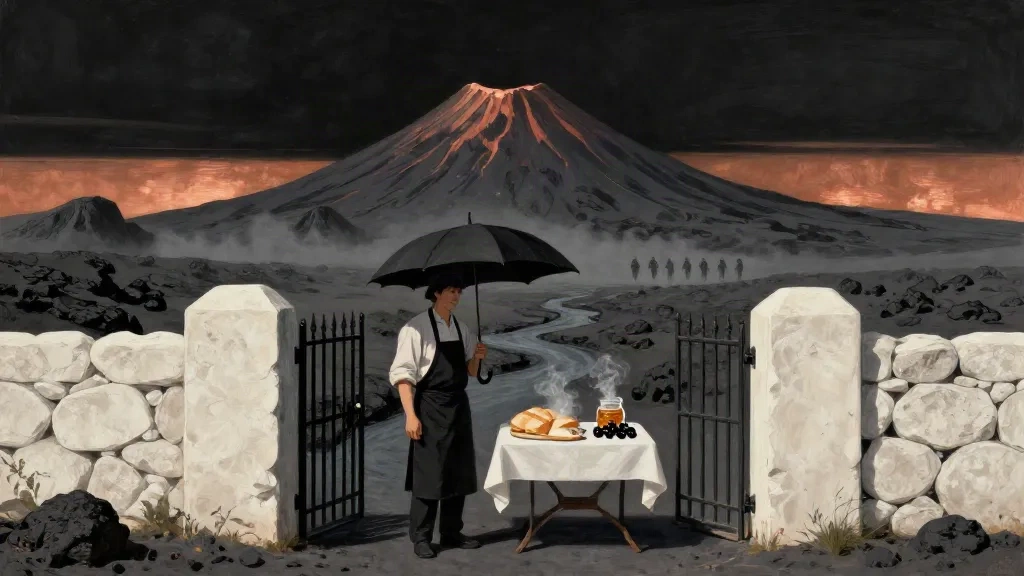
The route to the summit crossed a riverbed that had been dry for three hundred years. Mara climbed it in the black umbrella Grana had pressed into her hands that last winter without a word of explanation, though no rain fell beneath the crater and never had. She carried no lantern. The ash gave off a low amber light of its own, enough to see by, the way you can see by a stove in a dark room.
Pale stones stood up out of the grey in ranks, like the teeth of something buried and patient. Cinder smelled of wet iron and old snow. Twice she stopped and listened, and twice she was sure she could hear someone walking behind her at her own pace, and both times there was only the mountain settling.
At midnight the stones began to click. Not wind. Knuckle on stone, over and over, a patience that had outlasted the language it was counting in.
The gate stood at the end of the riverbed: a narrow iron arch, waist-high, half-buried in cinder, rusted to the color of dried blood. Beside it leaned a slate, and cut into the slate, deep and sure, were a bowl, a spoon, and a single black cherry.
One meal may open the way. One meal may close it forever.
She set her basket down. Bread, smoked trout, mountain honey, and black cherries kept in vinegar since the last harvest. The recipe was hers. The arrangement was not — she had copied the sampler years ago without knowing whose hands she was copying, twelve places and a cherry in the corner, and she had always set a bowl at the sixth place, for reasons she had never examined.
She laid the table beside the gate. Lit the little stove. Bent close over the coals and let the heat climb her wrists. The trout oil went quiet in the pan. The vinegar smell went up sharp and sweet, and the clicking of the stones stopped.
Then wind moved in the empty riverbed, and she heard footsteps coming from both directions at once, the way people approach a table they have been walking toward for a very long time.
What the Ash Brought
They came in without faces. Shadows came into the light of her stove, and after them the glint of things: an old coat button sewn back on with black thread, a child's boot, a silver watch stopped at a time that meant nothing to her.
Then a woman stepped out of the copper horizon wearing a wool coat buttoned to the throat, damp to the shoulders with cinder dust, and Mara knew her by the way she held them. Everything about her face was wrong, blurred, like a thing seen through hot glass. Her shoulders were exact.
“You came,” Mara said.
“The table called us.” Her mother looked at the food and did not look at her. “Your grandmother's arrangement.”
“Did she send you?”
“She called me once, thirty years ago, and spent the sound of her own mother's voice to do it. I sat where you're standing. I ate. I went back up before dawn because the price was already paid and there was nothing left to hold me.” A pause. “She told you a useful lie. I told her one first.”
Behind her mother, more figures were coming in out of the dark along the riverbed, standing with their hands empty, close together, waiting at the line where the ash was deepest. None of them could get nearer the gate.
Then boots on cinder, a headlamp beam, and a woman in a rescue jacket climbing the last of the dry river with the rope coiled over one shoulder and nine years of bad sleep in her face.
“I have been in your kitchen since August,” Jessa Kaan said. “Your grandmother's rules. One bowl, one chair, don't ask.” She looked at the shadows and stopped talking.
“Orin,” she said.
“Jessa.” The voice came out of the dark, level and young and entirely wrong for it. “Go home. Your brother is nine years dead and you have made a room for him in your head with a roof on it.”
“Orin.”
“I'm not him. I'm what the ridge kept because you couldn't put him down.”
The Price
The slate brightened, the way a bruise does, and new words came up out of the cut.
THE FIRST TASTE IS FREE. THE LAST MEMORY IS THE PRICE.
“It takes from the one who calls,” Orin said. “Not from me. She can pay, and it will be worth nothing, because I didn't ask to be called. I answered. There's a difference and the mountain is careful about it.”
Jessa had her hand out already. Mara understood what she was offering without being told: not a year, not an object, the last time Orin's mother let him hold the pot, the last good hour of the boy before the north col. Nine years of carrying it everywhere like a stone in a shoe.
“Take mine,” Jessa said. “Take it now.”
“It won't open,” Orin said. “Listen. She's the one standing at the table. It's always the one at the table.”
Mara looked at the food. The trout, the bread, the honey, the cherries swimming in their vinegar.
“I can't pay that,” she said.
“No,” her mother said. “That is why the gate will not open.” She stepped closer, into the stove light, and Mara found she could not hold the image. “You have been paying since you were five months old. You just haven't noticed. The first taste is free, Mara. It's free because it's the hook. Everyone who eats here can find this place again for the rest of their life. In the city. In other mountains. In a bed at three in the morning, a taste like that, and you'll be putting on your boots.”
“Then why did you leave.”
“Because I was afraid it would reach you.” A long breath. “It didn't. I had no idea it would go in the blood instead of the mouth. I ran every night for thirty years, and every night it got a little quieter, and I told myself the quiet meant it was letting go.” Her voice did not change at all, which was how Mara knew. “It wasn't letting go. It was getting patient. Do not make it cleaner than it was. I chose the running. Every single day I chose it over turning around.”
And at the back of the line, in a scorched apron with rolled cuffs, an old woman who had not been in the kitchen for two winters: Grana, with her mouth open, unable to step over the ash. She had used her one call thirty years ago and spent it, and the mountain was still holding her, the way it holds everything that eats here.
The Table Remembers
Mara stood at the head of her own table and did the arithmetic she had been avoiding since the floorboard.
The gate took the last memory from the one who called. It did not say whose last. She thought of offering a small grief: the burnt rice, the November boy, the taste of vinegar. She even thought of offering a whole year. But the words on the slate were specific, and a lie only protects what it is willing to surrender, and so the small grief would have kept the big one exactly where it was, hidden, still hers, still in her hands when Elin went back up into the ash at dawn.
So it had to be the true last. The last morning: her mother's hands, the vinegar smell on a cuff, a blue-checked cloth, the exact weight of being held by someone who was already halfway out of the door.
Before she gave it, she did the other thing. It was not clever. It was the only work in the kitchen that had ever mattered.
“You came because I called you,” she said, “so I'm going to remember you as you were, not as the missing.”
She named them, and she gave each one the thing the mountain had not been asked to hold: not a date, not a rescue number, not a description of where a body was found and what it was wearing.
The guide who had taught her to read weather by the sound of chimneys, standing on the ridge at dawn saying that flue is unhappy. The cook who burned a pan of rice every year and gave it to the dogs and told everyone the dogs preferred it. The girl who traded a silver button for a loaf of bread and told the baker her name was Merry, which it was not, and which Mara had spent nine years knowing was a lie told to be polite. Orin Kaan, nineteen, who stole a hubcap off a truck outside Gerber and laughed so hard he wet himself and was not sorry, and wanted to be remembered as the boy who laughed, not the boy in the col.
“Jessa.” Mara made herself look at her. “I'm taking him off your list. He's not a thing you lost, he's a person who answered. I'm also taking your nine years of carrying him, and I'm not sorry, and you should know that I took them.”
Jessa said nothing. Orin said, quietly, “All right,” and it was not agreement with Mara. It was a man setting down a load in the middle of a road.
Elin was last. “Elin Vale,” Mara said. “Who came down the mountain in a wool coat when she was twenty-two and ate one meal, and has been able to taste this place every night of her life since.”
Then she opened the black umbrella over the food and held it there, tipping it against the falling ash, so the ash would not get into the bowls. It was the only thing left in the kitchen she could still do properly.
The gate groaned. The horizon went from copper to bronze. And the memory came out of her without taking anything else with it: her mother's hands, the blue-checked cloth, the vinegar, the weight. She felt it go into the food, into the mountain, into every guest at the table, who all received a bowl and all found something different in it. Orin ate bread and wept. The guide ate bread and was dry and steady and forty-one. Grana, at the line, opened her mouth and could not step over the ash and did not try again.
The Door Opens Once
The iron arch swung inward on three hundred years of cinder and stopped, the way a gate does when it is only going to be open long enough for one dinner.
Elin stepped through and stopped on the near side, and for a while neither of them said anything, because there were thirty years of sentences and no order that made them bearable.
“Eat first,” Mara said, and held out a bowl. “Then tell me what happened.”
They sat beside the dry river with the umbrella shedding pale ash onto the tablecloth. Elin ate slowly and badly, the way people eat food they have been dreaming of for three decades. She knew things. She knew about the burnt rice and the boy in November and the summer Mara had not come down the mountain at all. When Mara asked how, her mother looked at the bowls.
“I told you. The ridge keeps everything that eats. Some of it comes back up the chimney.” Her mouth twisted. “I had you from the inside for thirty years. I knew your voice when you were nine. I couldn't answer.”
“You could have written.”
“Yes.” No softening, no weather in the voice. “I wrote eleven letters. I burned all of them. Ask me why when you can stand to hear it.”
Before the sky went grey, Elin told her the price out loud, because Mara's grandmother had not been the only one who believed in ledgers. The first taste is the hook and the hook is forever. Mara could find the ridge from anywhere now, on any night the ash fell. She could call them again, and they would come, and the gate would open for exactly one person and the meal would last exactly until dawn. She had bought her mother and, in the same transaction, agreed to be the one who cooked.
Penance, then. With a recipe.
The Rule Afterward
Elin went back up into the ash with the light coming, and did not say goodbye, because she had used that word up in her mouth thirty years earlier and had never earned it again.
Mara kept the kitchen. That was not a decision she made so much as a thing that continued to be true of her. She walked out past the north col in the spring to see whether the world bent, and it did: every path, every train, every ship, curved a little south of itself and set her down again at the head of the dry river, four days out, with a taste in her mouth like vinegar.
Jessa Kaan came back in the thaw, because of course she did, and slept in the kitchen and did not ask. In the season the mountain was quiet she got her one night, and Orin sat with her and told her the hubcap story again, and then told her the thing the gate had not: that the ridge would find her anyway, that the hook was in her now too, and that a woman who could call the dead once a year ought to spend that year on people who were still breathing. So Jessa Kaan walked the north face every summer with a stove and a pot, and fed climbers who were going to make it, and did not climb past the col after dark.
And Mara set out a bowl for the empty chair, and the kitchen filled again the way it had before, with strangers and bad weather and the old friends of the old, and every night somebody stayed for breakfast.
She had lost her mother's face. She still had the shoulders and the way of sitting down, and a voice that talked to her in the dark about the letters; she could hold all of that in her hands and turn it over and it was real, and when she tried to picture the mouth it slid off into the amber, the way a name slides off when the bell has already stopped. She had traded the only proof she had that she had been loved and not only left, and she would have made the trade again, and the ledger in the drawer, in Grana's worsening hand, said the new entry plainly because there was no one left to soften it:
Paid. Her mother's face. The gate is hers now. She will not leave.
Down in the riverbed the pale stones went on clicking in the dark, patiently, the way a kitchen goes on working long after the cook has stopped believing anybody is coming.





