 Netwrck
Adventure.
The Cook of the Dry River
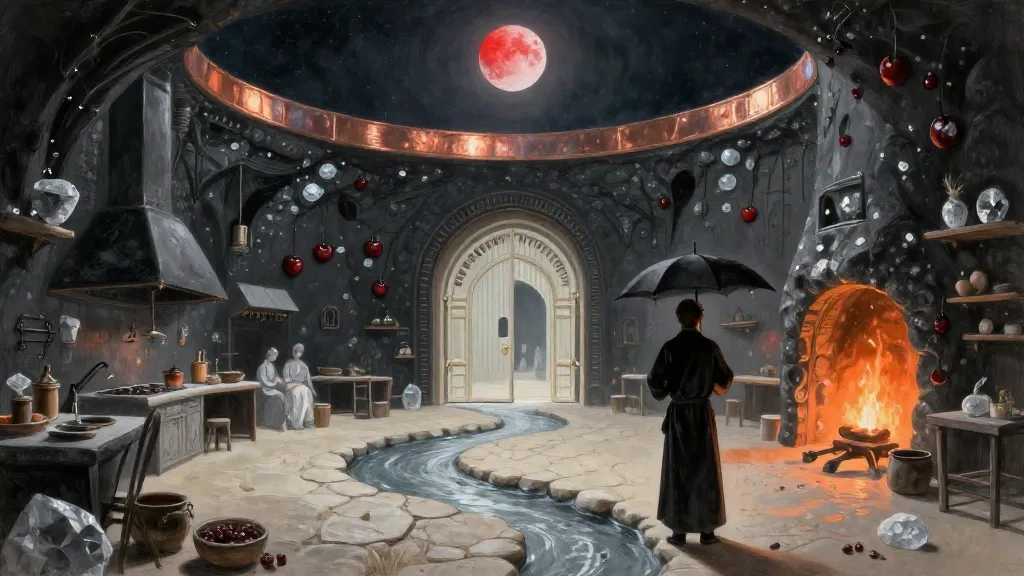
Mara first reached the monastery by following black water uphill.
The dry riverbed was named Vess, though no one remembered what it had carried. Its pale stones ran from the outer copper horizon into a crack in the comet, widening into a stairwell cut by generations of monks. Above her, the mountain turned slowly, dragging frozen orchards and cloudless blue around the chapel. Bells marked the passage of the stars by sounding at irregular hours.
In the lowest kitchen, iron pans hung beneath black cherry beams. Salt glittered in the walls. The air smelled of scorched plums, limestone, and distant snow.
Mara unpacked her traveling case: three knives, a blackened pot, a bundle of bitter herbs, and the family ledger wrapped in oilcloth.
Her grandmother had told her that the Vess kitchen possessed a recipe without a name. Whoever ate it vanished from the table but remained somewhere beyond the monastery gate. The family called it proof of the afterlife. Mara called it a story grown tall because no one had returned to shorten it.
She intended to finish the argument herself.
What the Recipes Remembered
The monastery cook was Brother Sairn, whose left hand had been ruined by an old oven. He studied the grease-stained pages Mara spread across the table.
“Your grandmother came here,” he said.
“She left.”p>
“That is not an answer.”
“It is the one she gave.”
He pushed the ledger toward the stove flame, but Mara caught his wrist.
“Make it. Then I will tell you how she vanished.”
The recipe demanded seven things: water taken from Vess, bread baked under a new moon, salt from a grieving mouth, cherries black before sunrise, a bone from an animal that had never been killed, and a guest who had already departed.
Mara had brought every ingredient except the last.
At sunset, Brother Sairn placed a black umbrella against the kitchen wall. Its handle was carved from pale stone, its ribs curved like a spider’s legs.
“My predecessor carried it to the gate,” he said. “He returned without a shadow.”
“Did he find the people who left?”
“He found no one. The gate had already taken his payment.”
Mara understood only then. The cost was a memory. To pass, one surrendered the reason for opening the gate, and the gate would never ask twice. Brother Sairn had paid for a journey he could no longer remember.
Her grandmother’s recipe asked for a departed guest. Perhaps that guest was the cook who had left her family’s story intact. Perhaps proving the legend meant proving the omission.
The Gate Beyond the Copper Air
They climbed after midnight.
The comet’s interior narrowed into a passage with no torchlight. Mara led by touch, one hand on the dry river’s old channel and the other around the umbrella handle. Far above, a fissure in the shell admitted a horizon made of copper. The moving stars cast it across their skin.
They found the gate in a circular chamber where the riverbed ended. It was black wood reinforced with bone-white stone. Letters had been carved into its grain, but each time Mara looked directly at them, they rearranged themselves.
Beyond the slats waited a dining hall. Dozens of people sat beneath a red moon, eating from white bowls. An old woman at the far end lifted her face.
Mara recognized her grandmother.
Then Brother Sairn’s grip tightened. “I am remembering my sister,” he whispered. His eyes filled with tears. “Before we came here, I could not remember why I was crying.”
The gate had begun taking its price from him, though he had not touched it.
Mara seized the umbrella and opened it. The black canopy burst wide, blocking the vision of the banquet. The letters stopped moving. The gate released a breath smelling of black cherries.
“It is not the journey it forbids,” she said. “It forbids desire that survives arrival.”
She opened the family ledger. Across twelve generations, every account of the legend had repeated the same error: asked where the vanished went. None had asked who they were while they were gone.
Mara spoke through the wood.
“Grandmother, I did not come to bring you home. I came to prove you were never lost. Show me what you chose.”
Silence. Then a voice older than the red moon answered from within.
“Prove it by feeding yourself.”
Mara’s family had built its legend around reunion. The gate heard the same hunger.
The Empty Place
They returned to the kitchen at first light.
Mara cooked the nameless dish using everything the recipe required. She borrowed the guest from the empty chair opposite her, the same stranger who had occupied it the previous night without casting a shadow.
The bread browned. The bitter herbs loosened. Black cherries collapsed into violet juice.
When the seventh ingredient was added, Brother Sairn remembered his sister. Not all at once. A blue ribbon. An argument. Her hand closing around his at a funeral. Memory entered him painfully, and he wept without shame.
Mara understood. The departed guest was not one of her ancestors. It was the part of herself that had never learned to remain hungry.
She served the meal to the empty chair.
No one appeared. The gate did not open. Her grandmother did not return.
Then a black cherry appeared on the rim of the bowl.
Mara ate it.
Taste flooded through her: the monastery kitchen seen through a child’s eyes, her grandmother tying cherries into a black cloth, the copper horizon turning above an open door. The grandmother had found peace in a place where names were not needed, and had chosen never to become a destination for regret.
No gate opened. None was required.
When Brother Sairn asked whether the legend was true, Mara placed the black umbrella beside the finished meal.
“True,” she said. “But incomplete.”
Outside, the dry river glittered under the first pale sun. The family legend had changed from a road home into a narrower truth: love did not vanish because someone left. Some departures survived by becoming choices, not wounds, and a cook could honor them without cooking up a ghost.





