 Netwrck
Fairy-Tale Fiction.
The Measure at Blackwater Quay
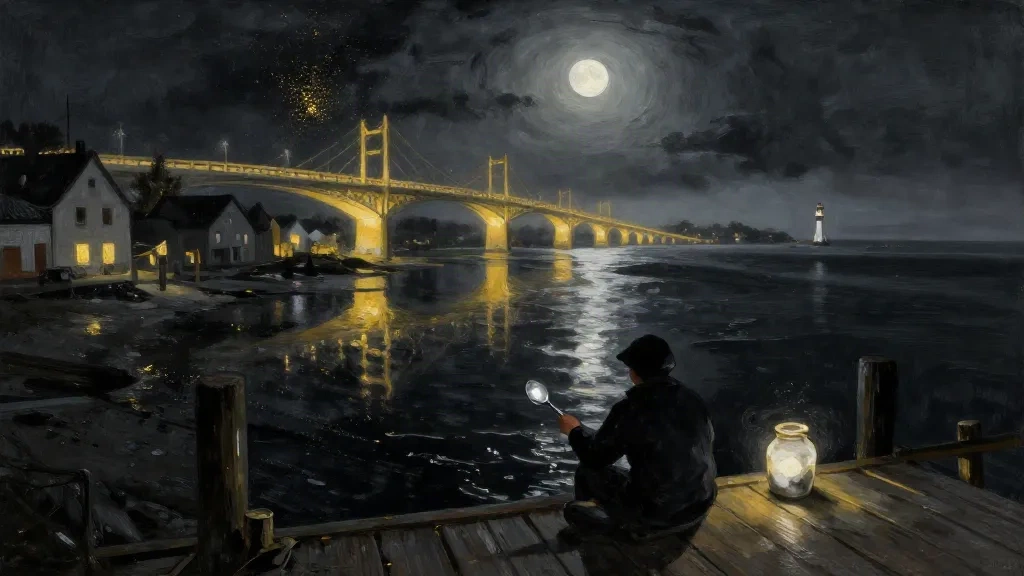
At low tide, Orin the river surveyor lowered his feet to the mud beside Blackwater Quay and waited for the moon. When its cold light touched the river, he drew a silver spoon from his coat and held it above the surface. The spoon carried no shine of its own. It borrowed the moon, then gave the moon back bent and trembling.
His father had taught him this measure. Each evening for seventeen years, Orin recorded the angle in a narrow black book: grief leaning downstream, hope moving upstream, anger rippling where stones disturbed the current. The book was private. Fear, he wrote, remains beneath the surface.
That was the part he feared the town would see.
The sea returned at the change of the hour. It slid beneath the pier without thunder, drawing black lacquer from every hull and gold dust from the shutters. Children stopped their games. Shutters closed. The townspeople of Bellweather believed the tide brought back only forgotten things, but Orin had seen what it brought him.
One silver spoon, polished by the moon.
The River Beneath Every Bridge
Orin had mapped every road, ford, causeway, and drowned footbridge in the district. The river remembered them all. When he touched its surface, names rose beneath his fingers in pale script: the merchant bridge, the widow’s crossing, the bridge of nine bad promises. Each name carried a tremor of feeling long gone from stone.
That night, the script ran beneath Blackwater Quay and stopped at a name he knew: Orin’s Bridge.
He remembered building it as a boy. He remembered the black wood beneath his hands, the river below, and a girl calling from the far bank. He remembered nothing else. No year. No season. Not even the girl’s face.
The river supplied the missing record. A small bridge appeared in the reflection, with a silver spoon nailed to its rail. Beside it stood a salt jar sealed in wax. A woman in a blue coat was crossing toward him, carrying a lantern shaped like an empty house.
Orin tried to look away, but the river made looking difficult. Every bridge he had ever mapped returned at once: some bright with banners, some broken, some burning beneath remembered flames. Their voices rose in the dark.
We were here. We carried what you left.
The Public Measure
The next morning, Orin carried his black book to the market square. In one hand he held the silver spoon. In the other he held the salt jar. The townspeople watched from behind their shutters.
“I have measured the river alone,” he said. “Tonight you will measure it with me.”
Some demanded explanation. Others called it superstition. Orin opened the book to the first page and read the names the river had given him. Then he placed the salt jar beside the fountain. The market children laughed until the jar’s lid lifted by itself.
A white pinch of salt rose into the air. It settled on the black lacquered post beside the square, sparkling like gold dust. The fountain began to flow uphill.
People stepped forward. The baker, the ferryman, the woman in the blue coat appeared at the edge of the square, though Orin had never seen her enter. She looked at him as though he had finally finished a journey.
“The river cannot be owned,” she said. “But it can be witnessed.”
The Last Crossing
At sunset, the whole town gathered at the quay. Orin held the spoon over the river. This time, hundreds of faces leaned toward the water. The silver surface brightened. Every bridge appeared at once, linked in a procession across the moonlit current.
Orin’s Bridge stood nearest the shore. The woman in blue crossed it, and with each step the town remembered a piece of the lost year: a red scarf on the wind, a mother singing, snow melting from an iron rail.
At the far end she lifted the lantern. Its little windows filled with gold dust.
Orin understood then that his private ritual had been a lock, and fear its key. The river had preserved what he could not bear to name, not because it condemned him, but because memory requires more than one person to carry it.
He lowered the spoon. The bridges remained.
“Measure it with me,” he said.
One by one, the townspeople stepped to the water. The river measured their sorrow, their courage, their stubborn little hopes. By dawn, the black book was full, but the title had changed.
He crossed it out and wrote, in letters bright as cold moonlight:
The Bridges We Remember Together.
Far below, Orin’s Bridge waited. Its missing rail shone beneath the moon.





