 Netwrck
Mythic Fiction.
The Bell of Borrowed Summers
Mira Venn was seventeen when the monastery came loose from its orbit.
It did not fall. Monasteries do not fall. One white-fingered morning, the monks found the building hanging above the valley on a shell of blue ice, and across the valley, where the village street had always been, spread a dark plain of cobalt shadow. The village people called it the Unquiet Road. The monks called it a correction.
Mira lived in the monastery’s lower workshop, where furnaces glowed sand-orange beneath the comets. Her hands were still narrow, her sleeves always brushed with metal filings, and the bells hanging around her carried names no one owned yet.
Her master had explained the rule when she was six: a bell never calls the dead. It calls a memory waiting to happen. The first note gives it a place. The second gives it a face. The third makes it impossible to deny.
That evening, after the long correction, Mira cast a bell for the first time without mold or fire. The metal gathered itself from meteor dust and the green glass crushed in an old saint’s window. It was no larger than a plum.
She struck it once.
The sound went beneath the floor.
Twice, the walls answered. Three times, every lamp in the monastery turned sea-glass green.
On the workbench appeared a black umbrella, its ribs stitched from the hair of horses that had never been born. Beside it lay a brass compass whose needle did not point north. It pointed down, toward the Unquiet Road, and trembled with the patience of something that had always known her name.
What the Street Had Hidden
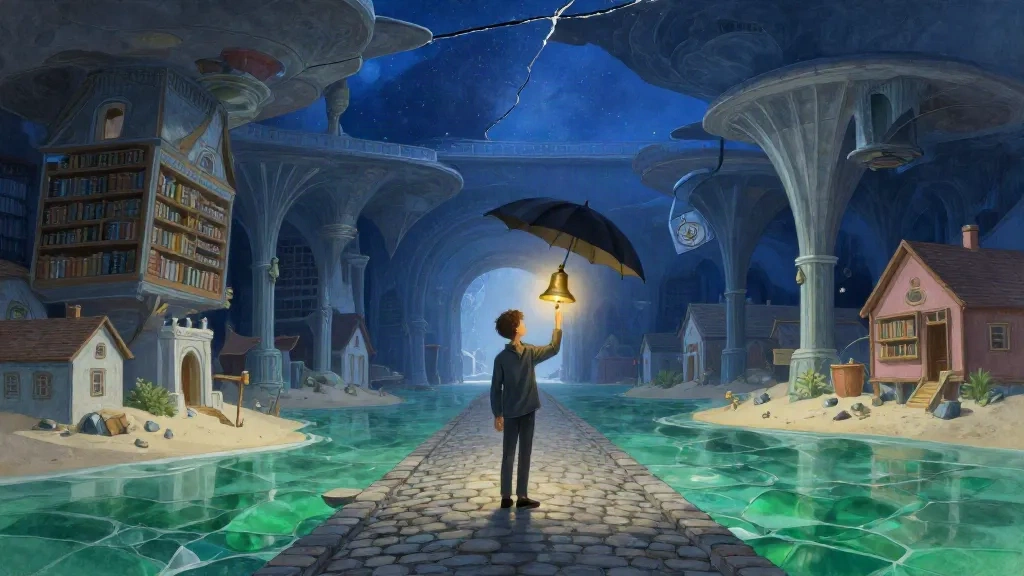
The umbrella opened by itself when Mira carried it beyond the monastery gate. Under it, the shadow on the plain did not deepen. It revealed.
Cobbles appeared one by one beneath her feet. A butcher’s sign swung where no butcher had lived. Rain dripped from an awning and became a river flowing upward. The village street was there, but upside down, as though the whole world had turned its pocket and shaken out its forgotten things.
Mira knew that street. She had crossed it to school, stolen pears from the corner market, and stood outside her mother’s door on the night she left for the monastery. Yet beneath each familiar place was another: a library drowned beneath the well, a railway running through the sky, a garden where tombs grew upside down with flowers.
The compass spun.
Every turning brought another layer. She saw her own house beneath her own house, its kitchen lit by a sun that rose in the west. In its front room, a woman sat sewing a mourning veil. The woman’s hands were older than Mira remembered.
She wanted to call out. The bell in her palm answered instead, sounding a memory of childhood: her mother’s thumb pressing the bruise on her wrist, the smell of rain in the courtyard, a promise made twice because once had not been enough.
Then the black umbrella lifted toward an archway hidden in the shadow.
Beyond it waited the world’s true shape.
The Holiday Without a Name
At dawn, the village sent word through a horn carried by a boy with sand on his lips. The following day was the public holiday of Unnamed Grief.
It was not held for any known death. Every year, at sunset, the people left bowls of water at their thresholds and hung small bells beneath their doors. In exchange, the village was allowed to forget one sorrow completely.
Mira had always hated the custom. Her mother said grief without a name was a room with no door, and should not be given keys. Mira had forgotten this.
She remembered it now beneath the street.
The archway opened onto a city made of rooms. Each room held a loss: a red shoe, an empty cradle, a letter never sent, a familiar voice calling from the next room. In the smallest room sat the people of the village, young and old, sleeping beneath wet black umbrellas.
Their forgotten sorrows rose from their chests as dark birds.
“If we return them,” said a voice behind Mira, “they will remember everything they have lost.”
She turned. The monk waiting in the shadow was old, with a face polished by starlight. In his hands was the master’s ledger.
“That is not why you are here,” he said.
Mirа looked at the compass. Its needle now aimed at the sleeping village.
“They are not mine to give back,” she said.
“No. But the street is.”
Then the ground began to close.
The Last Footstep
Mira ran.
The hidden city folded around her, rooms becoming streets, streets becoming veins of sand. Her umbrella snapped in the first wind. The compass flew from her hand. Above her, the monastery drifted across the sky like a pale ship.
She followed the only thing still ringing: the bell for a memory she had not owned.
At the final arch stood a small door. Beyond it lay the familiar street, ordinary again, with its baker, its pool, its blue evening shadow. On the other side, her mother sat sewing by the window.
Mira could have crossed.
Instead she struck the bell.
Its sound shook the city awake.
Every forgotten grief returned at once, and every room remembered its door. The sleeping villagers rose beneath their umbrellas, weeping but no longer hollow. The unnamed holiday became something else: not a forgetting, but a promise to carry what could not be fixed.
The old monk caught the compass as it fell into Mira’s palm. Its needle pointed upward now, toward the monastery.
“The true shape of the world,” he said, “is the shape left by what survives you.”
Mira looked back. Her mother had not appeared. The door held only a room, empty and bright with sand.
Then Mira climbed through it.
That night she hung a new bell over the Unquiet Road. It had no clapper, so it made no sound. Whenever someone passed beneath it, the brass compass in Mira’s pocket turned toward a street they had forgotten.
Some roads led upward. Some led to the dead.
At least one led home.





