 Netwrck
Romance.
The Two Hundredth Silence
Mara Bell had made two hundred bells, though she had never counted the last one twice.
They waited in the observatory workshop, each on a cedar shelf above the sleeping volcano: little copper throats for a childhood dog, silver shells for an ocean crossing, a cracked iron flower for the day someone learned to forgive her. Her father had taught her that every memory had a sound waiting inside it. Mara made that sound visible, wearable, small enough to carry in a coat pocket.
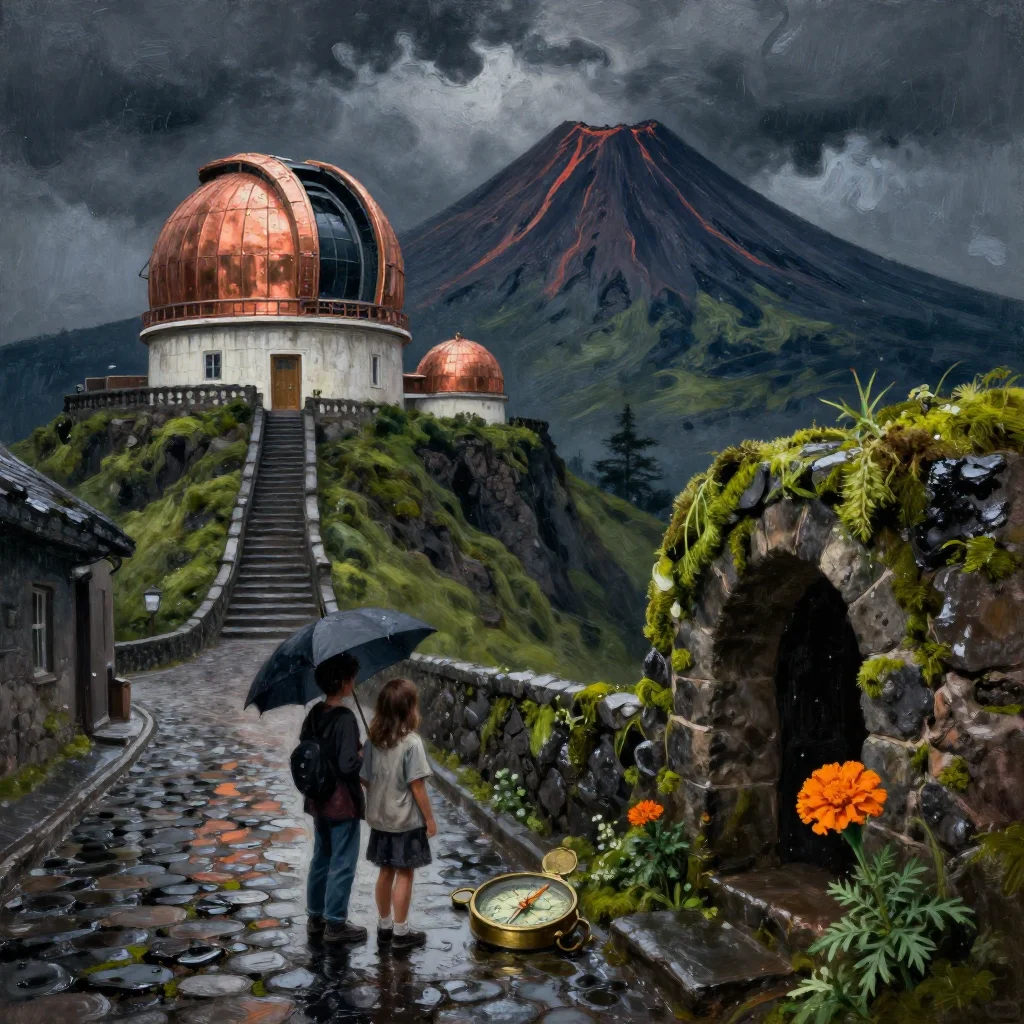
She polished the newest bell with a cloth of moss green. Beneath the floor, the mountain breathed mineral cold. Through the round windows, the familiar street clung to the slope below: cobbles silvered by rain, chimneys breathing smoke, the bakery where Mara had eaten too many buns after her mother left.
The world she knew ended at the observatory steps. The world she wanted began beneath them.
That evening, the brass compass in her pocket turned toward the floor.
Then the bell rang.
The Name No One Carried
Its note was neither bright nor mournful. It was the sound of a crowd holding its breath.
Outside, lanterns moved along the street. The town had prepared a holiday for Unnamed Grief, an observance held every autumn for every loss that had never received a name. People tied black ribbons to the bakery doors. They left bowls of salt on window ledges. They did not speak the dead aloud, because speaking them would make the absence official.
Mara found the others at the summit: Elian, the mapmaker, with his sleeves rolled against the wind; Ilya, who repaired the observatory lens; and Tomas, who had been her brother before the mountain took his name.
“This bell wasn't in the catalogue,” Ilya said.
Mara looked at the compass. Its needle pointed not north, but downward.
“It came from under the street.”
Elian unrolled a damp map across the stone table. Lines wandered between familiar names, then vanished beneath the town. “There is another layer,” he said. “Older than the roads.”
Mara pressed her palm to the bell. Heat touched her skin.
“I want to see it.”
“The holiday forbids opening the western stair.”
“The stair is not a grave.”
That silenced them. In the blue dusk, Tomas watched her with the quietness she had learned to miss.
Below the Familiar Street
The western stair began behind the bakery, where wet stone held the warmth of the ovens. Marigold petals glimmered in the cracks. At its lowest landing, a black umbrella leaned against the wall, beaded with rain that had not yet fallen.
“You,” a voice said from the dark.
A girl emerged carrying a lantern. Her hair was the green-black of deep moss. She did not look at Mara; she looked at the bell.
“I remember this sound.”
“You cannot. It was made tonight.”
“Not here.”
The lantern revealed a street beneath the street. Its houses had no doors. Windows held warm slices of rooms Mara recognized from her childhood: her father's desk, the upstairs hallway, the bench where Tomas used to wait for her. The air smelled of wet stone and oranges.
“Sera,” the girl said. “The city keeps what people refuse to name.”
Behind them, the others called. The stair began filling with black water.
Mara stepped into the buried street. Sera took her hand, then let go when the bell rang again.
This time, two notes answered from every window.
A Memory Before the Bell
They found the source in a house without a door. Inside, a table held a white cup, a child's shoe, and a strip of blue ribbon.
Sera touched the cup. “My brother gave this to someone before the flood. He never spoke of her. Everyone believed he had no one.”
“But he did.”
“The city turned his loss into a holiday so it would not have to return it to him.”
Mara understood then why the bells rang for memories not yet owned. Grief was not always an ending. Sometimes it was a name waiting on the other side of forgetting.
Sera looked at her. “You made the bells.”
“I made this one.”
“No. I made the memory. I was the one who forgot.”
The black umbrella fell. Its shadow spread beneath the table, hiding a stair that led deeper.
Mara took Sera's hand. Above them, the town celebrated its nameless loss. Below them, the buried houses waited for someone to speak.
“Say it,” Mara whispered.
Sera faced the cup.
“I remember,” she said, and the mountain answered with a sound like morning.
Two hundred bells rang. Only one had been hers.
When they climbed back into the rain, Sera kept the brass compass. Mara kept the black umbrella. Neither explained why. On the familiar street, the bakery windows shone, and every nameless loss had finally found a sound.





