 Netwrck
Mythic Fiction.
The Bell for the Missing Street
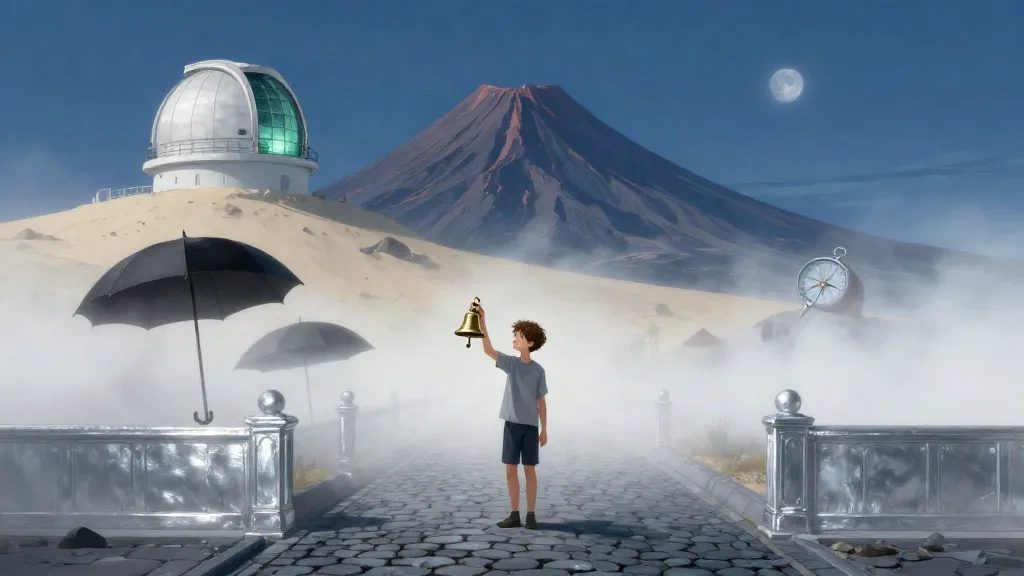
At sixteen, Nera Venn had cast thirty-one bells. Nine of them rang for birthdays, two for weddings, one for an execution nobody would name, and the drowned bells of Saint Orra, which the observatory kept in a sealed case and rang once a year for the dead who had no families left to ring for them. The workshop sat inside the mountain, under windows glazed the green of shallow seawater, looking down at a volcano asleep under its own gray blanket. Soot came in on the west wind and settled on the sills like ash from a fire that had not happened yet.
Her bells had a fault her father insisted was not a fault. A proper bell announces what is. A Venn bell announced what was coming: the marriage before the question was asked, the leaving before the suitcase was packed. The sound never carried far. It was no louder than a knuckle striking glass, and yet the whole mountain leaned toward it, the way a dog leans toward a whisper in another room.
Nera had learned young that anticipation is a kind of violence done politely. At thirteen she cast a small bell for a girl in the ashworks, whose name she did not then know, to keep her from taking the north road. The bell rang true. The girl turned south, where the slope gave, and survived. And for eleven years afterward, whenever Nera passed a south-facing door, she felt the specific weight of that girl's life folded into her ribs, and she could not tell whether she had saved a person or merely spent one.
Her father, Ansel, ran the crucibles with the patience of a man who considered fire a colleague. He was a large, unhurried person who had once declared the western quarter of the city impossible, and therefore safely forgotten, which was, as Nera understood later, a practical kind of faith rather than an honest one. Her mother had made the opposite kind of declaration. She had held the west quarter in her memory the way other people hold a tune: entirely, without effort, so that strangers on the lane asked after her by the names of the houses.
Three years before, Ansel had cast a bell for Ilva Venn to keep a single day from going under. The casting had misfired. The day did not sink. It was taken out whole, surgically, along with a room of smaller rooms, and Ilva walked out of the mountain one morning unable to say why the west side of the city smelled like anything at all. She was alive. She was polite. She made tea for a daughter she recognized on the evidence of a birthmark and a shared habit of biting her thumbnails.
No one was charged. Bells were licensed instruments; miscasts were a professional embarrassment, not a crime. But the Bureau of Unnamed Absences had opened a file anyway, because a street had gone out of the record in the same month, and the Bureau collected coincidences the way other offices collected stamps.
On the eve of the Mourning of the Unnamed, Nera found a white slip folded inside the mouth of her latest bell, the way a bone is folded into a bird. It said:
At sunrise the public will observe the loss of that which was called by no one. All households are invited to carry what they remember and leave it at Hollow Square. Nothing will be required. Nothing will be returned.
"The holiday honors grief with no name," her father said, reading over her shoulder. "A city can administer most burdens. Not every absence has acquired a form."
He set a brass compass in her palm. It had gone with him before the bells were invented, he said, and she suspected he had said that to make the object feel older than his ownership of it. The dial had no north, south, east, or west. Only a pale arrow turning beneath a sand-colored star.
"I want to find it," Nera said.
"Most lost things prefer to stay lost."
"Most lost things were never lost. They were unlisted."
That silenced him, which she noted, and did not enjoy.
What the Compass Remembered
She went down through the observatory at midnight, past the galleries where old moons had been polished by tools no hands had survived, and out through a narrow passage she had believed led only to the ash flues. The compass pulled west with a steady, unromantic tug, like a dog on a leash that had stopped pretending to be distracted.
The passage ended at a door of green wood. Beyond it waited her street: Aunt Pell's nettle fence, the blue door of the kitesmith, the loose stone where Nera had dropped a piece of bread beneath her shoes at five years old because she had been hungry and had not wanted to be seen eating. She knew the paving stones by name. Knowing them made no difference. The lane did not continue west. There should have been thirteen more houses, then the climb toward the green windows.
Instead a silver line ran across the road, humming faintly, the way a wire hums in weather. Past it stood fog.
Nera rang a small bell. Through the fog came a market at night. Black umbrellas crowded the stalls, shoulder to shoulder, and where fruit should have hung there were bells, each mouth turned sideways and each silent. At a long brassing table a clerk accepted objects from files of mourners: a mitten, a fishing line, the corner of a wedding dress, a key that had never been described accurately by anyone who owned it.
"This is where the street went," Nera said.
"The street was never taken," the clerk said, without looking up. His badge read UNDER-CLERK, and beneath it, in smaller letters, a number. "It was never entered. There is a difference, and the difference is my whole occupation."
She said her name. He wrote it down, and then wrote something else beside it, and the shape of what he wrote made her stomach drop in a manner she was later grateful for, because it meant he had found her in a ledger.
"A line closes," he said. "Not on a thing. On an address. And when the address closes, the thing it was pointing at stops being anywhere in particular. Not gone. Merely unaddressable. Your street is not buried under the volcano. It is standing in a room with no door, being very quiet, for three years."
"Who closed it?"
"That is a question about a person. I am a question about a form." He turned a page. "I will tell you what the form says. The western lane was struck from the civic register in the eleventh month of the year Ilva Venn was documented as recovered. A street is not lost when its people forget it. A street is lost when the last person who could say its name is unable to say it. Your mother held the entire register of that lane in her head, and the lane had no copy. Do you understand the enormity of trusting one woman with a map?"
"Yes," Nera said. "She trusted it too."
The Assessor and the Form
By morning she had climbed back up through the mountain and taken the tram down to the Bureau of Unnamed Absences, a sandstone building with the cheerfulness of a dentist and a queue going out the door and around the block. The holiday had drawn them. People stood in it with bundles held against their chests like children at a funeral, and the intake clerks worked fast, stamping each surrender and handing back a numbered receipt, because a receipt was the only way to prove you had given something up voluntarily.
Assessor Ilme Duraldi received her in a room with two chairs, one window, and a coat hanging on a nail at a height that suggested it had never been worn by anyone taller. Duraldi was sixty-odd, thin, and entirely calm, and had the terrible fluency of a person who has never once had to improvise.
"Miss Venn. Your file is unusually thick for a person your age."
"I want the west lane reinstated."
"I know. Everyone who has come up this week wants something reinstated; the holiday brings them in like a tide." Duraldi turned a form around and pushed it across. "Here is the lawful route. I will not pretend it is cruel. It is only expensive. A reinstatement requires a living witness who can name the lane from memory, and a witness who can be found by the Bureau thereafter. A street cannot be restored on the word of a ghost."
"And the fee?"
"Memory. One of the witness's, surrendered to the holiday, irreversibly, at intake. The Bureau does not choose. The citizen does." Duraldi's pen made a small dry sound. "You are the obvious candidate. You are a bellmaker's daughter with a document-grade memory and no dependents to be confused by your absence. One day, gone cleanly, and the lane returns to the address it never lost, and everyone on it can pay their water bill like a person."
It was, Nera thought, the most honest offer anyone had made her in a year. Her mother was honest in exactly this fashion, in her remaining polite way. The Bureau had found a family resemblance and mistook it for a method.
"There is another witness," Nera said. "A registered instrument. Old, and no longer carried by any person, and therefore still findable."
Duraldi stopped writing. For the first time the calm lifted, not into alarm but into a kind of professional appetite, which frightened her more. "You are describing an object that has been out of custody since before the ashworks charter."
"I'm describing my father's compass."
"Then your father is not a witness, Miss Venn. He is a defendant. Filing him as a witness reopens the miscast, reopens the causal chain, and reopens the question of whether an unlicensed instrument was used to alter a civic record in the first place." Duraldi set down the pen, which was worse than shouting. "He would be found. By us. Within the quarter. And a man who is found is a man who is corrected."
Outside, in the square, a boy of about nine set down a sealed jar and stood very still while a clerk logged it, and the smell of bread came off it in the cold air, and the boy did not look at it, and Nera understood that the whole square was full of people performing exactly the arithmetic she was being asked to perform, and getting a different answer.
The Holiday of Carried Things
At sunrise the square filled. A widower carried a green door on his shoulders with two neighbors helping, and it was not the door he had lost but a door of the right color, which the intake clerk accepted without comment because the form did not ask. A police officer of about fifty came in with something folded into the lining of his coat; when the clerk asked him to state the item, he said, "My sister's laugh, and the argument we had after it," and Nera watched him decide in real time to surrender the whole afternoon, the way a man pays a debt he has been carrying uphill.
Then the city's official mourners came, and the square went silent, because they carried nothing. Absence itself, in a wheeled cart, under a gray cloth.
Each small grief opened a place in the fog. Through the gaps Nera saw the west lane assembling itself in the market behind the clerk: a baker stringing striped awnings across a gap, a cat climbing the blue gate of the kitesmith's fence, three children under a window that shone like a green bottle, all of them lit from within and none of them casting a shadow.
It flickered. The baker's hands went transparent. A child Nera did not know turned and looked directly at her through two hundred yards of fog and raised one hand in the universal small salute of the very frightened.
"The holiday only makes room," the Under-Clerk said, appearing at her elbow with a receipt he did not offer her. "It does not say what belongs. Room is not a floor. You have brought me a wet room and now you want a chair."
"I am not bringing a room. I am bringing a witness."
"Then bring it to intake, and fill the form, and I will process it, and it will be lawful, and your father will be found in the spring." He turned a page. "Or ring the bell. Your way. And understand that a bell does not file anything. A bell only makes the claim loud enough to be true, and true is a very heavy word to hang on thirteen houses."
Nera stood in the square with her father's compass warm in her fist and understood the moral shape of the morning exactly. There was no innocent option. The law was a door with a person standing in it, and the miracle was a door with the person standing in it on fire. The only question was whether the lane deserved to be a place, and it did, and she was the only one present who had grown up on it, and she was sixteen, and she was a bellmaker, and she had been carrying other people's futures in her ribs for three years.
She rang the bell cast from her father's broken crucible.
The sound was small. The square's cobbles rang back a half-tone under her feet, and the wheeled cart of official mourners buckled, and somewhere in the fog behind the market the striped awnings snapped taut with a sound like a sail.
The Shape Underfoot
It took from her in the order it was spent. First the smell of wet stone. Then the taste of the iron cup her mother used before the forgetting. Then the specific quality of her father's hands on the bellows at four in the morning, which she had not known she had stored, and which she understood, kneeling on the cobbles while the square emptied around her, she had loved most and least at the same time.
The mourners did not know they were giving anything. That had been the bargain and the cruelty of it: they had brought their grief to be witnessed, and the bell had called it all by name, and names, once called aloud over a closed register, count as testimony. The officer's sister came back first, mid-sentence, standing behind him in a blue coat he had never once seen her wear. He turned around. She was saying something about a bus. He sat down in the road with his hands over his mouth, and Nera moved the compass forward a step so that she would not have to watch.
Across the silver line, the bricklayer of the lane surfaced from the fog and remembered a doorway. He put his hand flat on the air the way men do when they are steadying a ghost.
"Fourteen," he said.
And there it was, out of the market, out of the fog, into the light: a cobbled lane of black sand curving east beneath the square, where people walked in daylight with their umbrellas up, carrying blue doors, green apples, wedding rings, river stones, their arms full and their faces entirely ordinary. Underfoot. It had never been beneath the volcano. It ran beneath every footstep the city took without looking down, which is to say it ran beneath nearly all of them.
Her father came up through the fog with a black umbrella beaded with rain he had not been standing in. He looked sixty. He looked like a man who has just been found.
"You filed me," he said.
"I filed the compass."
"You filed me." He did not raise his voice; the city was listening in the way it listens to any sound it might be obliged to file. "Nera. I called that lane impossible. I cast the bell that took your mother. I did both, and the Bureau has been extremely fair to let me keep the one thing I got wrong, which was saying so."
She had prepared a dozen things to say and found she had prepared the wrong ones. "I am not asking you to return. I am not asking her to remember. I am asking to know the way."
That was the moment the sentence turned. She felt it go into him, felt the arrow of the compass swing in her fist, no longer pointing at the lane but pointing back up the mountain, at the workshop, at the crucible, at the unfinished work on his bench.
"Then it is filed," he said.
Passage Venn, and the Work After
In the following spring the city cut a lantern arch over the seam and named it Passage Venn, which Nera considered a kind of vandalism, and she asked for a smaller sign, and got one, which read simply LANE, in the ordinary letters, in paint that was already fading. Four hundred and six residents, the intake office eventually reported, which was a number nobody in the Bureau had expected and which the Assessor received without comment, because the number, once written, was true, and the Assessor's profession had never once been about whether things were true.
The lane kept only what the mourners had spent. Every house stood. Nobody could agree on the faces. The baker remembered awnings and no face. The children of the green window were nine and five and, in the reconstruction, eight and four. A woman named Mute Pell put her fence back up and cried the entire time she nipped the nettles, because her sister lived four doors west and had not existed for three years and now existed at the same address, and the two of them stood in a kitchen and were both real and neither could remember a single evening of the other, and had to build a hundred new ones from nothing but tea.
Ansel Venn lost his license. He did not lose his workshop, which surprised everyone including him, and for eight months he cast nothing but ordinary bells for ordinary lives, ringing each one in the courtyard before he delivered it, which was forbidden, and hearing it come back to him slightly wrong every time, like a song sung in a room with one door missing. He said this was the correct way to work. Nera, who could no longer forget a single day of her own life, said nothing, and thought: he is the only person in the city who can still lose something on purpose.
And she could not stop hearing the far side of any street. That was the price nobody had itemized. Bells had always announced what was coming, and now that she had rung one over a closed register, she could not stop hearing what a place was about to become: the coal chute that would be moved, the family that would arrive in November, the two neighbors who would not speak for six years and then would. It came at her from every direction, all day, a noise like weather she had made herself, and she learned to sleep by lying on her side with the pillow over the ear that still worked, which is a thing a girl of seventeen tells no one.
She rings the white bell at every new moon. The Under-Clerk sends her a receipt, unsigned, which she keeps.
And lately, more often than the new moons, at the bottom of the stair, or the far end of a tram platform, or once outside the Bureau itself in the rain, she hears the bell that has not been cast yet: a sound no louder than a knuckle on glass, from something that has not happened, in a place that has not been missed.
She goes toward it, carrying what she has, which is everything.





