 Netwrck
Romance.
The Bell Beneath the Street
On the morning the rain turned every paving stone the color of mussels, Nell rang the bell beneath her father’s abandoned workshop.
She was seventeen, broad-handed from handling bronze, and lonely in the specific way of someone whose family had filled rooms with expectations but left the important questions unopened. The bell had belonged to a railway crossing: a small, stern thing rescued from a junkyard. Hung under her workbench, it had remained silent for years.
Then, at noon, it spoke.
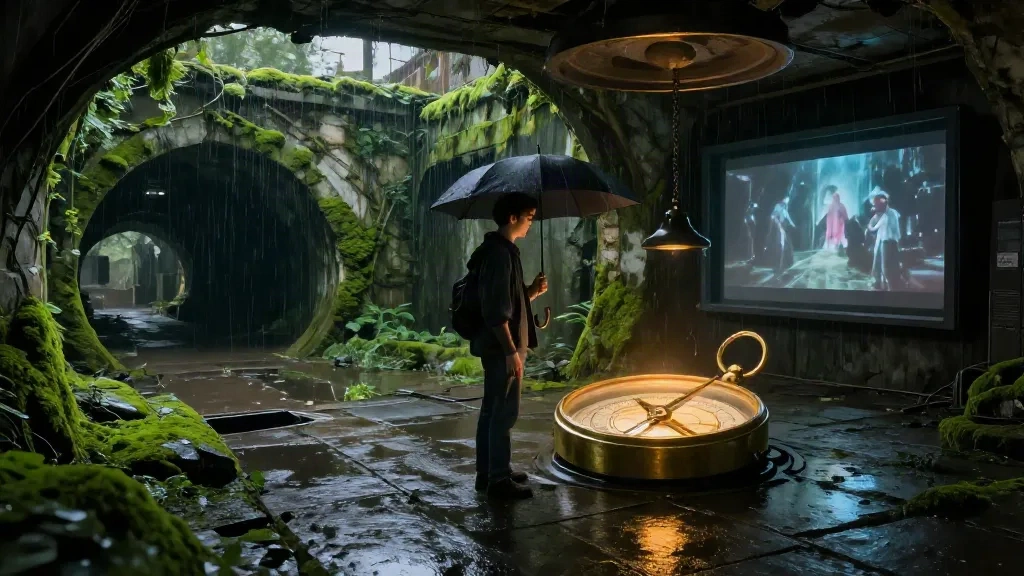
One clear note rolled through the floorboards. Across the street, hidden gardens shivered. A black umbrella opened inside a locked shop, though no one stood beneath it. From Nell’s pocket, the brass compass she used to find loose wires in old machinery spun hard toward the earth.
She followed it to the derelict Orpheum cinema, where rain leaked through the letters of its marquee. In the ticket booth she found a reel of film, warm as if just projected. Its label read Bellwether Street, One Possible Tomorrow.
Inside, the seats waited beneath a green emergency light. Nell threaded the reel into the projector. The screen showed Bellwether Street exactly as it looked now, except the shops were burning with marigold lanterns.
Futures Almost Taken
People stepped from doorways no longer standing. A watchmaker of sixty ran after a train that had gone decades ago. Two children played football in a flooded garden, laughing as water rose to their waists. Every future on the film had nearly happened, the silver screen briefly making regret visible.
Then Nell saw herself.
She stood outside the cinema beside a young man with rain in his dark hair. He held the black umbrella. In his palm lay her brass compass, its needle turned east, where the dead tramline ran beneath Bellwether Street.
“You shouldn’t wake the bell,” he said in the film.
“You shouldn’t have stolen my compass.”
“It was under the street. You dropped it there.”
Onscreen, they descended by iron steps into a chamber tiled with wet stone. A crowd filled it, carrying wreaths without names. Above them hung a banner: THE GRIEF WE COULD NOT NAME.
Every year, Bellwether observed a holiday for the sorrow left by the final tram accident: one bereaved, two lost, forty-one futures canceled. No family had claimed the dead. No poet had given them a single name. So the city buried the accident beneath itself and made remembrance public without allowing it to become personal.
The film ended in frost. Nell lifted her head and found the young man watching from the back row.
What the Holiday Required
He rose. He was warm, solidly present, and badly unsurprised.
“Ari,” he said.
“You were in the future.”
“You were too.”
“Those are different.”
He held out the black umbrella, still flecked with rain, though neither of us had gone outside. “Tomorrow was a version where we changed the city’s calendar. We met below, argued about whether one public grief could be truly public, and—yes—fell in love.”
“But it almost happened.”
“That does not mean it happened.”
“It does not mean this will.”
My bell rang from the workshop three streets away. Ari’s face tightened. The film flickered, and beneath the screen appeared a second staircase, descending farther than the first.
Below lived the true shape of Bellwether Street: platforms branching through bedrock, old tunnels crowded with discarded plans, kitchens from demolished courts, cellars dug for river water before the river was moved. The city was not a map. It was every map the city had abandoned.
“The unnamed dead are here,” Ari said. “The holiday keeps them close, but it also keeps them unheard. To learn the street, we must give one of them a name.”
“They had families.”
“Names can be family. Names can be strangers. They must only be claimed.”
The final future flickered between us. I saw his hand almost touching mine, then withdrawing. I heard my own voice say, I want the truth beneath the street, not the story beneath your grief.
A Name of Our Own
We descended together. Ari kept the umbrella above us, though the underground was dry. My compass pulled toward a sealed chamber where forty-one iron tablets waited beneath moss-green water. Each had a date and a blank beneath it.
“The bench knew the street before the builders did,” Ari said. “When they tried to name one dead child, it cracked. So they made a holiday instead: loss without a person. Fairness without intimacy.”
The bell’s note traveled through the stones. I remembered a boy named Thomas who had died one street away when I was nine. I barely knew him. I remembered his red bicycle, his mother at the gate, and how adults had called him the accident boy, as if that were a name.
“That is theft,” Ari said quietly. “Making grief belong to everyone because no one is allowed to belong to themselves.”
I touched the compass to Thomas’s tablet. The needle steadied. The black umbrella trembled over us.
“Thomas Bellwether,” I said. “A boy. A neighbor. Ours, and not ours.”
Water broke across the chamber. The tablets opened like dark flowers. Above us, in tomorrow’s discarded film, Bellwether Street appeared again—not perfect, not chosen by chance, but known in all its buried directions.
Ari took my hand beneath the marigold flare of an underground signal lamp. His future was no longer on screen. I could not promise we would meet there, still less that love would survive what the city had buried. But the compass pointed toward him, and for once the needle was not searching.
It had found a direction of its own.





