 Netwrck
Mythic Fiction.
The Bell for a Stranger
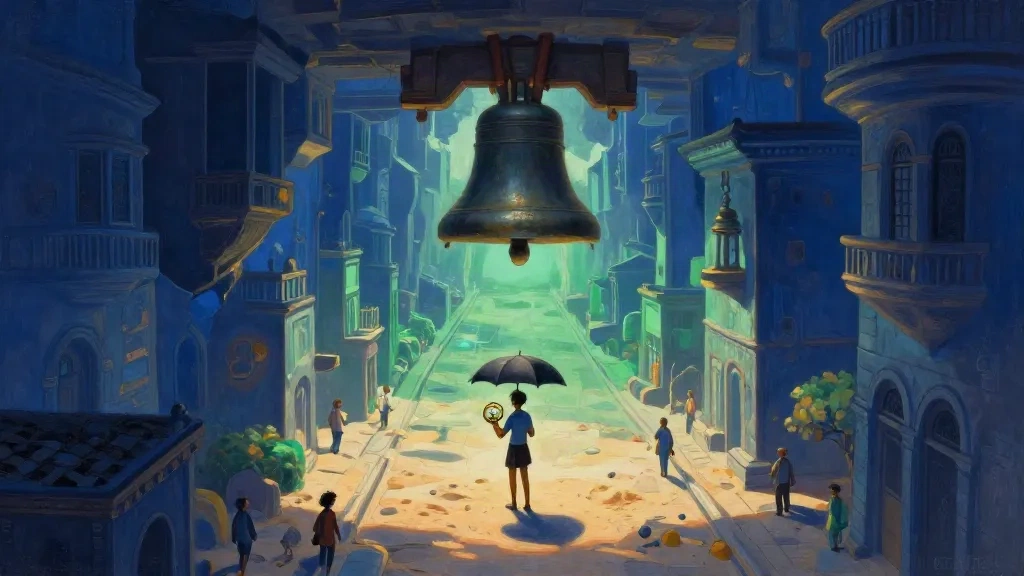
On the last morning before the Nameless Mourning, Mara Venn hung a new bell beneath the copper awning of her shop. It was tuned to a note no one had earned yet.
Mara was seventeen, long-handed and stubborn, apprenticed to a bellmaker whose eyes had clouded from making too many wedding bells. The city lay above her in cobalt shadow. Every citizen owned a shadow, and every shadow owned a citizen: the thin ones kept council seats, the broad ones swept the avenues, and the smallest hid beneath babies’ cradles until they were old enough to choose their own darkness.
Her street, Quarry Lane, was familiar as a palm. Sand drifted between its blue paving stones. Sea-glass green awnings shaded the tea houses. At dusk, the shadows loosened from their citizens and went to the public gardens, where they gossiped in voices like wind through reeds.
That morning the black umbrella leaned outside Mara’s door. No one owned it. Its brass handle was shaped like a sleeping heron, and beneath its canopy someone had left a compass pointing straight down.
Mara turned it once. The needle remained fixed toward the cellar stones.
“A direction,” said the umbrella, folding itself shut, “is not the same as a destination.”
She put the compass in her apron. When she rang the new bell, a memory rose from every nearby shadow: somebody’s first winter, a forgotten birthday, the exact sound of a father singing. The memories did not belong to Mara. They were offered to her, bright and loose as salt.
She did not take them.
The Holiday Without a Name
Across the city, people began preparing for the Nameless Mourning. No one knew what had died. The holiday arrived anyway, inherited with the custom of carrying white reeds through the streets and leaving one empty chair beneath every window.
At noon, the shadow Senate sealed the gates. The living citizens were told to remain indoors. When the shadows went out, they would keep the city’s shape, and the living would have to remember which streets belonged to them.
Mara slipped through a cellar hatch. Her compass needle trembled, then pointed toward an old stair beneath the bakery. The walls were damp and warm. At the bottom, a door opened onto a cavern of sand.
Under the city lay another city, upside down in blue light. Its towers hung from the sky of the cavern. Its streets ran along the undersides of the familiar ones. Tiny citizens moved there with their shadows attached above their heads, walking upside down as easily as fish.
At the cavern’s center stood a vast bell with no clapper. Around it gathered every shadow in the city.
“We are the mourning,” a shadow told her. “The city built us from what its people could not bear to name.”
Mara looked through the floor of the cavern. Quarry Lane floated above her, and beneath its stones she saw the true shape of the world: not a square, not a map, but a circle around an absent place.
There was a silence beneath the silence. It had a size. It had a hunger. It was shaped like an empty chair.
The Memory Not Yet Owned
The shadow people showed her the first grief. It had belonged to everyone at once, before birth, when the city was only a bright idea in a larger world. They had named it together, and naming had made it real. Real things could be lost. The grief had been lost.
“Then why do you keep mourning it?” Mara asked.
“Because an unnamed grief cannot be inherited,” said the great bell. “It can only be postponed.”
The black umbrella opened above her. In its shade appeared a corridor of doors, each one marked with a memory she had never owned.
The brass compass pointed toward one.
Behind it, the city above began to shake. Nameless Mourning had begun early. Every living person was forgetting which shadow belonged to them. Streets blurred. Doors opened into other people’s rooms. The citizens ran in circles beneath the blue shapes of their own abandoned grief.
Mara’s new bell rang beneath the great bell. The sound traveled through stone and sand.
It gave the unnamed grief a name.
Not a private name. Not a dead person’s name. The name was the place where the world had been broken open so something new could begin.
The shadow citizens remembered. The city above remembered. In Quarry Lane, the tea-house owners stepped into their own darkness, and the shadows stepped back into their owners.
The holiday ended. Mara climbed home carrying the black umbrella and the brass compass. The compass needle pointed down, then west, then toward the first bell she had ever made.
She sold neither.
Every year on the Nameless Mourning, she descended beneath the city to listen at the great bell. Beneath its bronze shoulder, in the cold dark where no memory had been given a name, something breathed.
And Mara, who had once believed a bell belonged to the person who owned it, stood beneath the street and listened until the world remembered her back.





