 Netwrck
Adventure.
The Bell That Waited
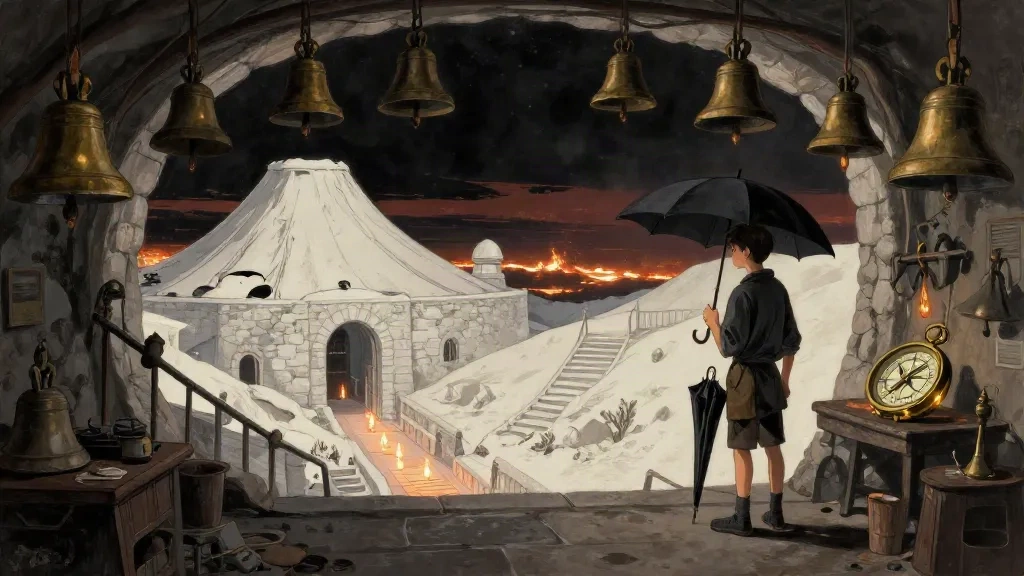
Mara Venn spent her afternoons in the observatory workshop, where brass inherited from sleeping fires hung beneath the cracked windows. The mountain was a volcano with its appetite folded shut. Around its shoulder, the observatory clung like a silver beetle, its domes green with frost and its corridors warm from underground springs.
She was sixteen and made bells for memories people had not yet owned. The smallest chimed when someone imagined a child. The largest answered when a stranger decided to leave. Mara did not know who had taught the old craft, or why. Her mother had placed the tools in her hands and said only, Listen for the empty place.
On the morning of the public holiday, the mountain rang without wind. Every bell in the workshop answered at once.
Mara carried a black umbrella and her mother’s brass compass through the rain. The compass needle pointed not north but downward. Below the observatory, where tourists never walked, an old stair descended into pale stone. She knew that stair, yet remembered no entrance.
The Name the City Kept
At the square, people had gathered beneath a copper-colored sky. They brought wreaths, bowls of salt, and small objects tied with black thread. The holiday commemorated a grief that had never received a name. No statue marked it. No song carried its story. Once each year, the city remembered that someone had lost something so important that language had failed to keep it.
Mara’s mother had refused to attend.
“There is no grave,” she had said. “Only a street that refuses to stay in one place.”
Among the mourners, Mara saw a woman holding a folded street map. A black umbrella stood beside her, beaded with rain. When Mara looked again, the woman was gone, but the umbrella remained.
She took it. Beneath its black canopy, the pavement shone. Between the cobbles ran a thin line of copper, winding toward the mountain. Her compass needle swung with it.
They followed the line into the old stair.
The Shape Beneath Things
The underground street was intact and wrong. Shop fronts stood beneath the earth, their windows lit by pale flames. Doors opened onto rooms containing sea beaches, forests, and fields under unfamiliar stars. People moved through them carrying bundles of memories, all of them searching for the address of home.
At its center rose a bell tower without a bell.
The woman beneath the umbrella waited there. She was old, bareheaded, and dressed in the same black fabric as the canopy Mara had taken. Her face was familiar in the way a room is familiar after a fire.
“You heard the empty place,” the woman said.
“My bells ring for memories not yet owned.”
“Then you know the world has a hidden floor.”
Mara looked down. The tower’s stones had been removed one by one, exposing the world’s true shape: a vast spiral descending toward the mountain’s core. Streets were only its outer ridges. Buildings, gardens, and years rested on the same buried pattern.
“My mother knew this,” Mara said.
“Your mother remembered too much.”
The Unnamed Bell
The woman pointed to the bell tower’s empty frame. Inside it hung a small black cherry, fresh and wet.
“This holiday began when a whole district was lost,” the woman said. “Not destroyed. Forgotten in one breath. The city built a new street over it, but the world kept the old one beneath. Grief without a name became a room with no door.”
Mara raised her brass compass. Its needle pointed at the cherry.
Her workshop bells had taught her that an empty place was not an absence. It was a shape waiting for its first sound. She climbed the tower, opened her black umbrella, and set the cherry inside the empty frame. The umbrella caught the pale flame-light and opened like a dark bell.
Mara’s smallest bell began to ring.
The note passed through stone and copper and the sleeping earth. One by one, hidden rooms answered. Doors appeared beneath the city. Names returned to empty chairs. The mourners in the square lifted their faces as something old and unnamed moved through them, not solved, but no longer solitary.
At dawn, the observatory bells fell silent. The brass compass pointed north again.
Mara stood beside her mother, who had come without being summoned.
“You found the street,” her mother said.
Mara looked down over the pale stone, the black cherry trees, and the copper horizon burning beyond the mountain.
“No,” she said. “I found the world beneath it.”
The Shape We Keep
Years later, the observatory would ring whenever the city forgot itself. Mara would make bells from the recovered metal, each one tuned to a memory someone had nearly lost. Her mother would keep the black umbrella folded beside the door, never explaining why its handle was warm.
The brass compass stayed in Mara’s pocket. It never pointed north again unless the old street called her home.





