 Netwrck
Romance.
Films Without Sound
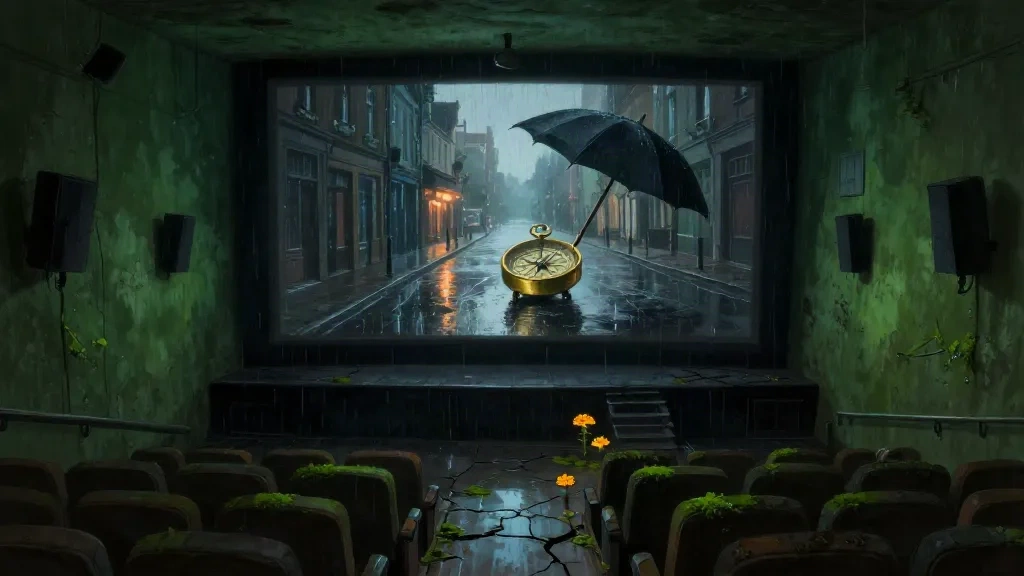
On the last afternoon of the Unnamed Mourning, I found a cinema beneath the bus depot.
Its doors were bricked over. Moss filled the letter slots, and rain pooled in the hollow where the ticket window had been. Yet behind the wall, a projector threw pale rectangles across an empty auditorium. I heard no projector, only my own brass compass trembling inside my coat.
I was sixteen, the youngest bellmaker in town, and I had come to hear the bell my missing mother made before she left. Not a recording. People said the dead do not leave recordings. They said this gently, as though gentleness made the lie bearable.
The screen showed a street I knew. Rain silvered the chemist, the laundrette, the locked bookshop with its blue-painted door. My mother crossed the square carrying a black umbrella. In every film, the umbrella opened. In none did she look up.
Behind me, someone breathed.
“You came early,” said the girl in the third row.
Her name was Iona Vale. She sold sea glass outside the ferry office, though no sea had touched this coast for eighty years. A damp curl stuck to her cheek. She pointed at the screen.
“That one is two years from now. That one is forty. In this one, the street survives.”
The Holiday Without a Name
At noon, bells tolled across the wet roofs. The Unnamed Mourning began.
No one could explain its origin. The oldest records called it a day of civic silence. Children received grey ribbons and were told not to ask about the dead. Shopkeepers hung black cloth. The mayor stood beneath the clock tower and recited a list of precautions, never a name.
“Everyone grieves,” I said to Iona.
“That is what they tell everyone.”
In the cinema, the film changed. My mother turned down Bell Street, struck the pavement with her heel, and listened. Beneath the floor, a hidden city answered: shutters rattling, doors opening, thousands of small bells moving through stone.
I pressed my compass flat against the boards. Its needle spun toward my mother.
“You make bells for memories,” Iona said. “The ones people haven’t earned yet.”
“I make them for the memories I cannot remember.”
She glanced at me. “Which is different.”
Then she took my hand. Her pulse was quick, frightened, alive.
“Not that kind of different,” she said, though I had not spoken aloud.
A Compass Points Down
We followed the black umbrella across the screen until midnight. It waited outside a chemist on Bell Street, enormous beneath a red moon. Iona held the brass compass while I read the film’s subtitles, though no text appeared. My mother entered the shop. The real shop had been closed since before I was born.
Inside, shelves held jars of wet soil. Behind the counter, a brass door led down.
“That is the shape beneath the street,” I said.
“What shape?”
“The one we cover when we build the street above.”
We descended through rooms no map admitted to. A bakery crouched beneath the courthouse. A garden bloomed under the reservoir. In one chamber, thousands of names had been written across wet stone and painted over. In another, people sat in rows, holding bells to their chests.
The bells rang for memories not yet owned.
Their sound entered me. I remembered my mother teaching me to cast a bell, remembered her humming while rain dried the street. I remembered leaving the cinema, taking a black umbrella from the rack, and forgetting the walk home.
“You forgot me,” I said.
“I forgot the way back to you.”
Her voice came from every bell.
The Sound Under the Stone
The screen above us flickered with the final film. My mother stood on the square, the holiday crowd behind her. This time she opened the umbrella. Under it was not a roof, but a map of every street in town, drawn in marigold ink.
“Iona,” I called.
She was already answering from the dark.
Her bells rang in unison. My compass pointed upward, toward the hidden city, then down, toward the room full of names. The two directions pulled at the needle like a heart deciding what to keep.
“The world beneath the street is not another world,” she said. “It is what the street refuses to remember.”
“And the holiday?”
“A lock dressed as a ceremony.”
My mother’s voice came again, thin but certain.
“You cannot restore everything. Restore the crossing.”
I took the brass compass from Iona. She cupped my hands around it. Her warmth steadied the needle.
Then I struck the largest bell.
The sound passed through stone, through shopfronts, through the clock tower and the grey ribbon around the mayor’s throat. Every bell in the hidden city rang at once. Above us, the cinema trembled, and the painted street split open along a seam of marigold light.
When I climbed back, the square was quiet. The holiday had ended before anyone could name it. At the chemist’s door, a black umbrella leaned against the wall, still dry.
I opened it. Beneath it lay a map drawn in the language of bells. I took Iona’s hand and followed the first line toward the life we had not yet owned.





