 Netwrck
Adventure.
The First Unowned Bell
Mara Bellmaker was seventeen, with ink on her thumbs and a hammer too heavy for her hands. Her mother had left her the monastery’s smallest workshop, cut into the pale stone flank of a comet, where the walls trembled whenever the sky moved. Each morning, Mara tested the new bells she had cast. Most rang loudly and said nothing useful. The oldest, inherited from the vanished abbey below, made a sound like someone remembering a door.
On the morning before the public holiday, it rang without being struck.
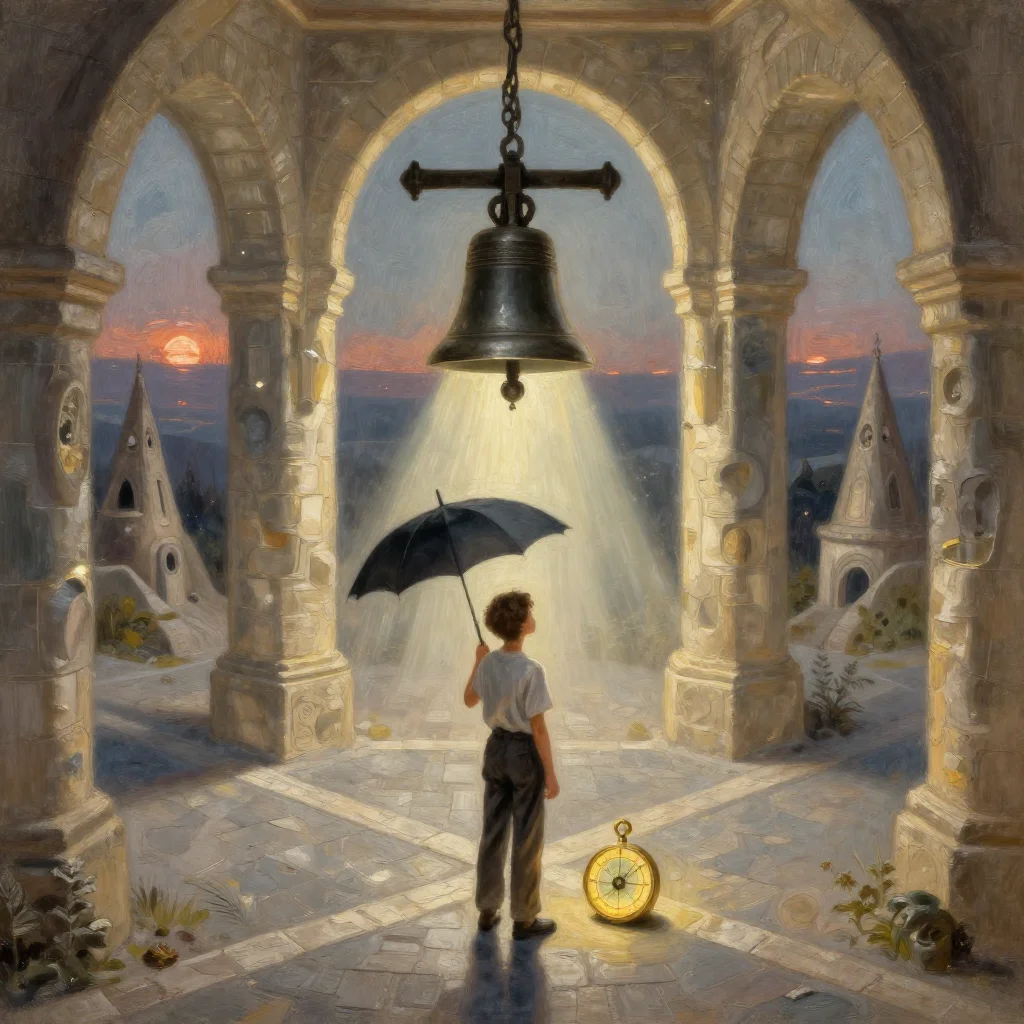
Mara followed the sound through a narrow stair, past the copper-bright observatory and down into a passage where the stone was damp with something that smelled of winter apples. Her black umbrella dragged behind her, catching on the roots of the mountain. In her pocket, her grandfather’s brass compass trembled despite having no needle. It always pointed toward the street she knew best: Lantern Street, with its crooked laundries, blue awnings, and bakery that opened before dawn.
At the bottom of the passage, a bell the size of her fist hung in an empty doorway. Its bronze skin was black cherry.
A Holiday for the Unnamed Dead
The bells rang at noon. Across the city, people left bowls of milk on their windowsills, burned gray thread, and set one chair facing the wall. The holiday honored the dead whom the city had never known: victims of fires, accidents, wars, and sudden absences. Their names had been lost before the first records were written. The dead received no flowers. They received silence, carefully measured.
By order of the civic choir, the bells were to be silent that day. Mara watched from the monastery as the sun turned copper along the comet’s horizon. Then the little bell rang again, and every other bell answered.
She descended to the passage. The doorway had widened into a street.
It was Lantern Street, but not the Lantern Street above ground. Here the bakery smelled of rain instead of bread. Shutters displayed memories instead of prices. A child stood beneath a black cherry tree, holding a brass compass identical to Mara’s. He was crying without making a sound.
“You took my tomorrow,” he said.
Mara looked down. His shoes were full of dust. Behind him, the street ended in a pale stone wall.
“I don’t know your name,” she said.
“Neither do anyone else.”
The Map Underfoot
The true street revealed itself in pieces. A seam in the pavement shone like copper. Mara laid her umbrella against it and opened the map case on its handle. The map had been blank when she left the workshop, but now lines were appearing beneath the rain: a circle beneath the bakery, a crooked stair beneath the school, a blue door under the abandoned signal tower.
Her compass pointed down. She followed the child through three arches that existed only in the map and along a road tiled with black cherry stone. The holiday’s processions moved above them, muffled and distant. People carried empty lanterns. At every crossing, a forgotten memory rose from the gutters: a daughter calling from a window, a lover leaving a hat on a fence, a key turning in a lock after the house had burned.
The child led her to a square where five streets converged. Each street ended at the same pale wall. In the center stood a bellmaker’s furnace, cold except for one coal.
“My mother is here,” he said. “She says I can go back if I ring for her.”
Mara saw the memory attached to him: a small hand released in a crowded market. No name. No grave. Only the child’s grief, preserved by the city because it could not preserve the truth.
The Bell That Belongs
She placed the child’s hands around the little bell.
“A bell for memories not yet owned must not speak over the dead,” Mara said.
She struck the bell once. Its note did not ring outward. It sank through the five streets and found the missing moment. The market returned around the child: a blue awning, a dropped glove, a woman turning back before the crowd swallowed her. He remembered her face, but not her name.
“That is not enough,” he whispered.
Mara turned the furnace coal with her compass. Its needle pointed at the child.
She realized the gift had been mistaken for ownership. The dead did not need to be recovered. They needed room to remain unresolved without being erased.
She struck the bell a second time. The five streets opened, and above them the city’s lanterns leaned toward the shafts of daylight. The brass compass began to point north.
At dawn, the holiday ended. Mara climbed back to the workshop with the black umbrella blackened by comet dust. The child was gone. In the furnace rested a new bell, small and unstruck.
Its sound would be hers, she knew, whenever the world was ready to admit it had been lost.





