 Netwrck
Romance.
The Unowned Hour
On the first morning of the Unnamed Mourning, the people of Vesper lost their shadows, and the shadows lost their people.
I found mine curled inside the bell on my workbench. It was a small, damp creature with my elbows and its too-long fingers. When I lifted the bell, it folded itself into my coat and tugged toward the floor.
“Mara,” said Bell Master Orin, “you have one hour before the holiday swallows the market.”
He had no shadow either. His face floated above his boots like a moon seen through dirty water.
Across Bell Street, citizens stood inside their silhouettes, waving from the backs of their own shoulders. Their shadows walked away with black umbrellas, brass compasses, and names whispered like passwords.
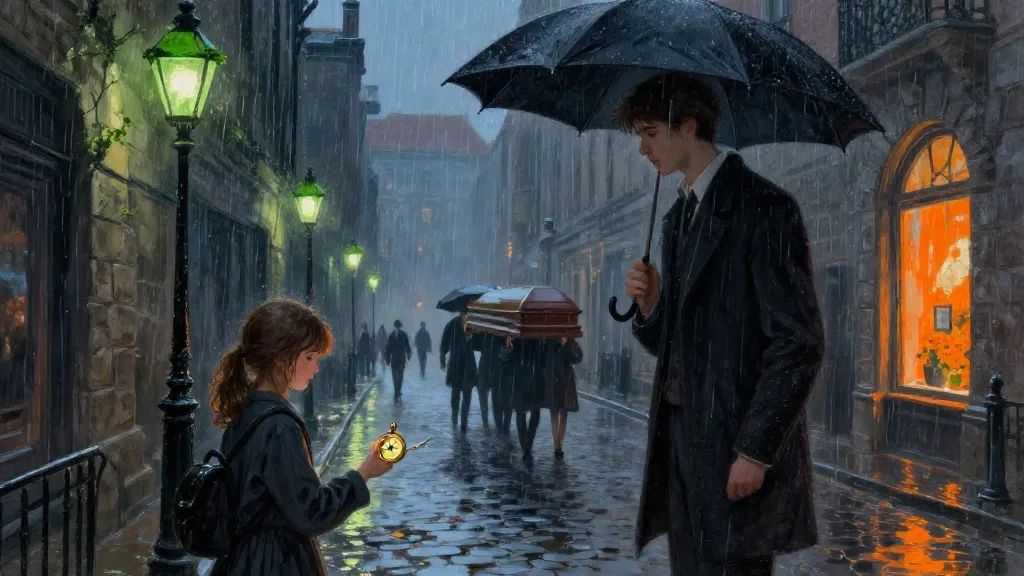
My apprentice, Ilyan, was among them. His shadow was taller, older, and walking beneath a black umbrella. On its wrist flashed a marigold scar: the mark lovers shared when one heart had found another.
I had made that scar into a bell three months before, and Ilyan had taken it without a word.
“Wait,” I called.
His shadow turned. Ilyan’s face did not.
The Wrong Shape of Morning
My bells rang for memories not yet owned. Brass remembers the hand that shaped it, the fire that softened it, the intention hidden beneath the maker’s silence. When a person hears the right bell, the memory enters them as if it had always been there.
That morning, every bell in the city rang without being struck.
The sound came from under Bell Street. I followed it through a doorway that existed only when the shop was closed, down steps slick with rainwater, and into a city beneath our feet.
Here the street was wet stone upside down. Houses hung from the sky like chandeliers. Moss-green lamps burned in the hollows of giant leaves, and beneath them moved people made entirely of shadow.
They carried the citizens above on their backs: limp, silent, dreaming. The people in the shadows went wherever their shadows had gone.
Ilyan stood at the crossroads, holding my brass compass. Its needle pointed not north, but downward.
“You took the memory,” I said.
“I took the lie.”
He opened his hand. The marigold scar had become a small burning door.
“Your bells do not ring for unowned memories,” he said. “They ring for memories stolen from their owners. Every sound you have made has returned some part of someone to Vesper.”
Below us, the holiday began. A procession of shadows carried an empty coffin through the blue-gray streets, mourning a grief no one could name.
“Without its name,” Ilyan said, “it cannot end.”
What the Brass Remembers
We followed the procession beneath the overturned market. Marigold petals floated in gutters filled with black rain. Each time the coffin passed beneath a lamp, the shadows around it grew heavier.
The stolen citizen-shapes began to wake.
“The world is not a lie,” Ilyan said. “It is a place shaped by what we refuse to call it.”
I understood, then, why my bells had sounded beneath the street. The city above had buried an entire district during the first flood. Everyone remembered the flood. No one remembered the people it erased.
The holiday was their grief, kept nameless so it could not divide the city against itself.
At the crossroads stood Bell Master Orin, small and bloodless, with my shadow wrapped around his shoulders.
“You taught the city to forget,” he said, “because you could not bear to hear what happened to your mother.”
I put my palm against a wall of wet stone. The brass in my bones went cold.
She had vanished when I was seven. I had spent ten years making bells for memories other people could afford to reclaim.
Ilyan held out the compass.
“Give the grief a name,” he said, “and the lost city can choose whether to return.”
“And us?”
He glanced at the black umbrella above us. “We can stop being echoes.”
The Bell Under the City
We found the drowned district where the street ended.
Its doors floated beneath a ceiling of storm clouds. In one window, a woman with my crooked smile shook water from a red scarf. I recognized the rhythm of her hands before I recognized her face.
I rang a bell beneath the street.
The first tone was hers: a summer kitchen, burnt honey, her singing in the shower.
The second was mine: her disappearance, the empty chair, every morning I had chosen the sound of bells over the silence of grief.
The third was theirs: the flood, the buried houses, the child who had survived because a stranger opened a cellar door. Not one crime, then. Not one failure. A whole city holding its breath until someone finally spoke.
I called it by its name.
“The Flood of the Unnamed.”
The brass compass spun. The empty coffin opened. Inside was no body, only a bell blackened by river silt.
My shadow stepped free of Orin’s shoulders. Ilyan’s shadow released him and lifted the black umbrella over both of us.
Above, in the waking city, names began to return.
Then my mother’s shadow came over the horizon, carrying the red scarf. I ran toward her, but Ilyan caught my wrist.
“If you cross now,” he said, “you will only remember her. The others will be lost again.”
He was right. Love had narrowed the world to one room.
So I opened the black umbrella over all of us and held the brass compass beneath the rain. Its needle finally pointed toward the missing district.
“Not the past I wanted,” I told him. “The truth beneath it.”
Then we rang the drowned bell together.
Its sound rose through stone, through streets, through every room where someone had been afraid to say what had been lost.
My mother’s shadow kissed my forehead. Then it stepped back, carrying the red scarf, and walked home among thousands of others.
At dawn, Ilyan and I stood on Bell Street beneath a clear black umbrella, both of us casting two shadows.
They leaned toward one another. The brass compass between us pointed neither north nor down.
It pointed along the street, where the world was finally beginning to show what shape our love had made.





