 Netwrck
Adventure.
The Bell That Remembered Tomorrow
Mara Venn was seventeen when the sea returned a silver button to Bellwether Quay.
It appeared at low tide beneath the breakwater, small as a fish scale and shining with the dull patience of old silver. The next morning it lay on the pavement outside her father’s workshop, wet though the street had not seen rain. By noon, half the town had stopped to stare at it.
“Belongs to the drowned,” said Old Pell, leaning on his black umbrella. “Or the forgotten.”
Mara did not answer. Her hands were already moving.
She made bells in the workshop behind the chandlery, hammering brass into shapes that were not quite round. When struck, each bell rang for a memory its owner had not yet experienced. A wedding. A departure. A winter morning in a house that no longer stood. Mara never knew whose life had been sold in the sound, only that the sound made people go quiet and touch the nearest thing they loved.
Her father had said the family trade was honest work. He had not explained why the finished bells vanished from their hooks before dawn.
That evening, Mara hung a new bell above her door. It gave a single clear note.
Every face in the street turned toward the black-cherry trees.
Under the paving stones, something shifted.
The Unnamed Holiday
Bellwether Quay held one holiday no calendar admitted. On the first day of the autumn storms, people placed pale stones on their windowsills and burned kelp in the square. They did not speak the dead’s names.
“For what?” Mara asked.
“For the loss,” said her father.
“Whose loss?”
He looked at her as if she had asked the tide to repeat its footsteps.
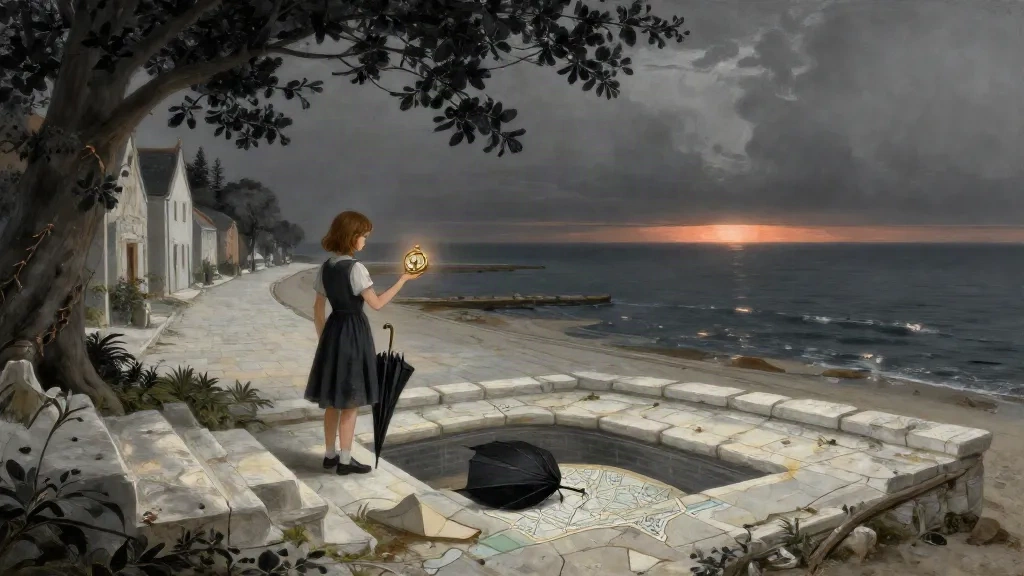
At dusk, the square filled with umbrellas. They were all black, though the sky was clear. A brass compass appeared on the memorial stone, its needle trembling toward the ground.
Mara took it.
The needle spun north, south, down, then pointed directly at the oldest part of Bellwether: a street called Gannet Row, where the houses leaned toward one another like tired witnesses.
Under her boots, the cobbles felt hollow.
She found a seam beside the fountain, no wider than a hair. When she knelt and touched it, her unfinished bell rang inside her chest.
The sea returned a childhood memory Mara had never lived: a girl in a red coat kneeling on Gannet Row, holding a brass compass while a black umbrella sheltered someone whose face had been carefully erased.
Mara recognized the coat. It had been folded in her mother’s trunk for as long as Mara could remember.
Gannet Row Opens
At midnight, the holiday began without lanterns.
Names rose from every pale stone. Not the names of those who had died, but the names of those the town had lost while still living. A mother’s face vanished from a son’s memory. A sailor returned home unable to recognize his wife. A child laughed in a room where the adults had agreed never to speak of fire.
The grief moved through Bellwether like a cold tide.
Mara followed the compass to Gannet Row. The seam in the pavement widened beneath her palm. Stone became water; water became black earth. She descended along steps that existed only in the bell’s remembered note.
Below the street was a map made of pale slabs, each one labeled with a place the town had erased. At its center stood a child-sized figure holding the black umbrella.
“Are you the one who took our names?” Mara asked.
The figure lifted the brass compass.
“We took nothing,” it said. “You buried us.”
Mara saw then why the town’s grief had no name. Naming it would have required admitting that Bellwether had been built over a living sanctuary, and that its people had traded one another away for prosperity.
Above her, the unseen street began collapsing into the sea.
The Name Under the Bell
Mara raised her unfinished bell.
“I do not know your name,” she said. “But I know what was taken.”
She struck it once.
The note rose through stone and water, carrying every lost memory into the town. Mothers found their sons in crowded markets. Sailors looked at their wives and remembered the first embrace. The red-coated girl beneath the earth looked up at Mara and smiled.
The sanctuary did not return the past. It gave the living back their power to face it.
At sunrise, the brass compass rested on Mara’s workbench, its needle fixed on a small patch of wet ground behind the workshop. The black umbrella leaned beside it, dry beneath a sky without rain.
Mara dug there and found only a bell-shaped hollow, a scrap of red cloth, and one pale stone.
She did not name the dead. She struck the bell instead.
Across Bellwether Quay, windows opened. The sea withdrew, carrying away one forgotten object and leaving behind the sound of people remembering what they had chosen to lose.





