 Netwrck
Folk Horror.
Orbit Was Safer
Mara Vale had not touched earth in nineteen years. From the station’s highest cupola, she watched the planet become a pale thing beneath weather: a blue suggestion, a story told by older instruments. When the emergency broadcasts began repeating that the world had become uncertain, she tightened the bolts on her hatch and remained where she was.
Her body had been trained to endure. Her heart could survive the thin pressure. The mind was less reliable.
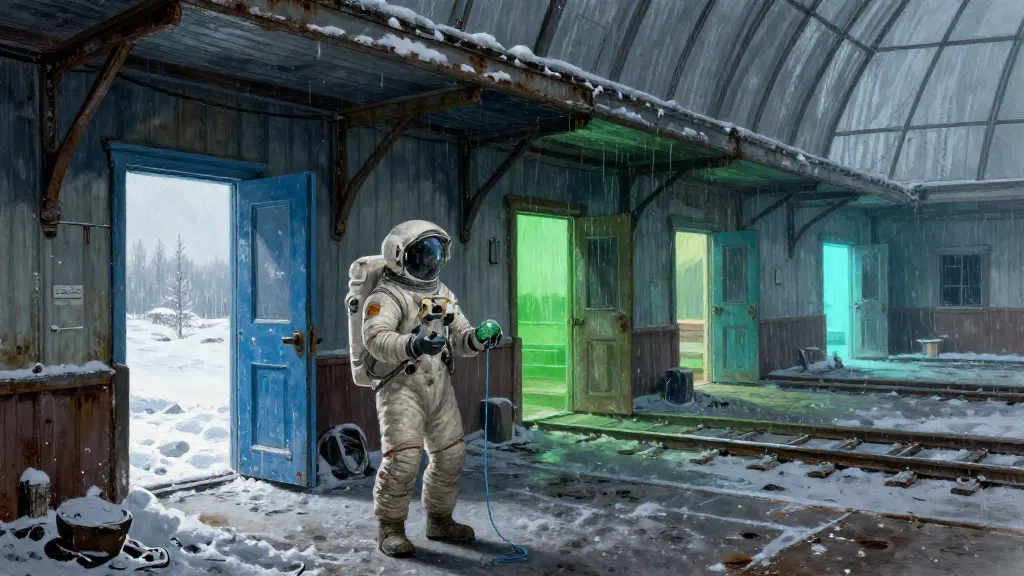
Down in the station’s low halls, winter had entered through the walls. Frost silvered the iron ribs of the ceiling. The lamps shone with the soft cyan of an impossible dawn. Somewhere beyond the platforms, a bell sounded beneath the floor, though the station had no bell.
Mara kept a small green stone in one pocket. It had come from the last launch, worn smooth by her glove. In the other pocket she carried a length of blue thread, tied around a photograph she no longer looked at. The stone was for weight. The thread was for remembering where she had put things.
She had come to the station for one purpose.
The Voice Behind the Announcements
On the station’s oldest timetable, a train departed for the season before the flood. Its destination was written in a language that shifted when read aloud. The conductor wore a coat of rusted iron and carried no lantern. Passengers boarded through doors painted pale blue, each opening onto weather that did not belong to the platform.
Behind every arrival, a voice spoke. It counted casualties, named forgotten villages, announced harvests that no living farmer had witnessed. Mara knew the voice. Once, it had been hers.
She had recorded an apology before her last return to orbit: a message for the families of the experimental crew, for the people who had called the accident a rumour, for the child who asked whether leaving meant no longer belonging. The transmission had been swallowed by static. History had kept only the warning tone beneath it.
“I want my voice back,” Mara told the conductor.
He considered the green stone, then the blue thread.
“Everything returned here,” he said. “Nothing leaves with its own name.”
Doors in the Storm
The storm arrived without clouds. Snow climbed the windows in vertical sheets, and the doors began to move.
One opened inward. Another opened outward. A third appeared halfway through a wall of solid frost. Passengers vanished through them, shouting from summers where lightning struck the station’s empty windows.
Mara seized the conductor’s sleeve.
“My door is moving.”
“All of them are.”
He pointed toward the platform. A blue-painted door had opened halfway, its threshold packed with snow. Through it came the smell of wet grass and hot machinery. A man in an ancient spacesuit staggered out, his visor opaque.
“Do not let it close,” he said.
Behind him, Mara heard her own voice.
It said one word: stay.
The storm struck the roof. Lightning turned the frost white, then blue. The conductor’s iron coat rang like a struck bell. He told Mara the door was carrying her into the season before the flood, where the lost transmission had remained intact.
“You can go through,” he said, “but the door will return without you.”
“Then I go when the station is inside.”
He understood. The train was not outside the doors. It was between them, moving through the rearranged station like a needle through torn cloth.
History’s Background Noise
Mara entered the changing door.
Inside was a carriage without windows. Seats faced backward. Every passenger held a small object that had failed them: a cracked visor, a child’s shoe, a key, a green stone.
At the front stood a recording machine older than the station. Its reels turned beneath a label marked with the date of her departure. The warning tone played, then Mara’s voice emerged, thin and distant.
She stepped forward.
Every passenger turned with her.
On the floor lay a length of blue thread, tied around the machine’s switch. The green stone in her pocket grew warm. She understood the warning now. The voice had not been lost. It had been made into a floor beneath history, a noise used to cover the unbearable fact of individual lives.
She took the stone from her pocket.
“This is not an apology,” she said to the machine. “It is a witness.”
Then she put the stone into the reel.
The carriage bucked. Doors slammed somewhere behind her. The machine stopped, and Mara’s voice spoke without static, clear across the winter station, across orbit, across the rumour of earth.
“I was here. I chose to leave. Do not make my leaving mean I did not love you.”
When the signal ended, the train opened its doors. Mara stepped onto a platform washed in impossible cyan. Behind her, one by one, the passengers returned to their own seasons.
The conductor gave her the blue thread.
“For the next door,” he said.
Mara tied it around her wrist. At the station’s edge, the storm began to snow again. She watched the doors rearrange themselves, each one opening onto a different world, and waited for the one that led nowhere.
This time, she would board with her name intact.





