 Netwrck
Gothic Fantasy.
The Future Catalogue
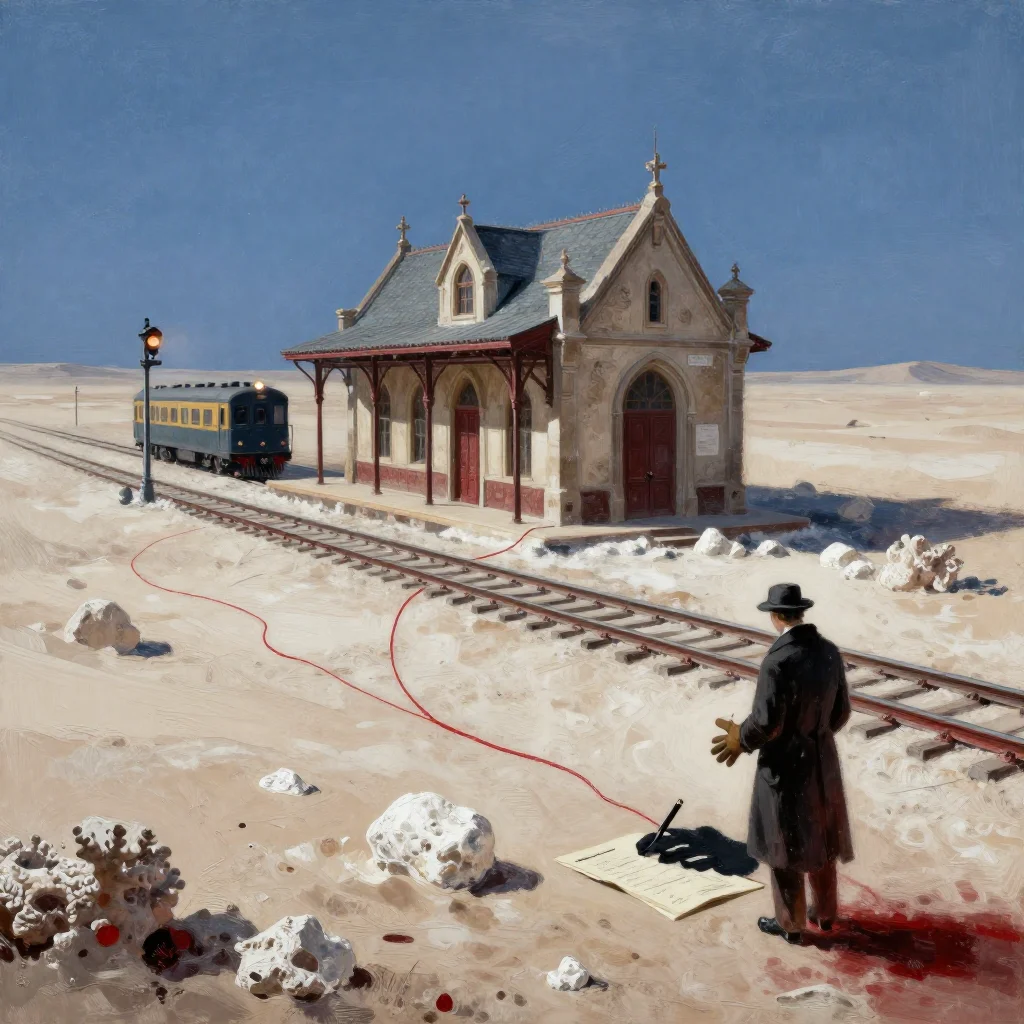
At the desert station of Saint Orra, the rails ran east into a country of salt and stopped beneath a sun that had forgotten how to set. The station had one platform, one signal box, and a waiting room whose walls were painted white coral, though the wind wore them back to bare stone.
Ilse Vey arrived with a glass seed in her coat pocket and a wool glove missing its partner. She was an archivist, assigned to catalogue everything the railway carried: parcels, names, sealed histories, and the small objects people abandoned when they thought the train was leaving forever.
The future catalogue had been delivered by a train from another century. It arrived at dusk with no engine sound, its windows opaque and warm. Inside lay three hundred pages of names, each written in a hand more precise than any clerk’s. On the final page, beneath LOCAL NAMES AWAITING RETURN, she found her own.
ILSE VEY — LAND HOLDER, UNKNOWN — TO BE RESTORED TO SAINT ORRA.
Below the entry was a date one hundred and six years hence. In the margin, someone had drawn a red thread through the letters of her surname.
The Signature Under the Lamp
The station master denied the catalogue existed. He said the old platform had been closed for forty years, and that trains no longer came from the east.
“Then who delivered this?” Ilse asked.
He looked at the ledger beneath his hand. “Someone signed for it.”
On the desk was a black document folder, its seal broken and its signature wet with ink. The handwriting belonged to no living person Ilse knew. It began with the same angular stroke as her own name.
At midnight, the shadow beneath the signal lamp detached from the post. It had the shape of a tall traveller, shoulders bowed beneath invisible luggage. A red thread ran through its chest, tied to a wool glove lying beside the tracks.
“That glove is not mine,” the shadow said.
Its voice came from the station loudspeaker, softened by static. “But the name is.”
Ilse picked up the glove. Inside it was a folded strip of paper, covered in names. The first was her mother’s. The second was the station master’s. The third belonged to a town erased from every map after a flood.
The shadow reached toward the paper. Its hand passed through the table and emerged holding a pen.
The Land’s Record
Ilse remembered the glass seed. It had been found in the ruins of a house south of Saint Orra, hard as a drop of frozen water. Her grandmother had called it a seed because it contained a grain of white coral dust, but the old woman had warned her never to plant it.
“A name is a seed only when the land has forgotten where to bury it,” her grandmother had said.
Ilse crossed the track to the station wall, where a century of desert wind had exposed a narrow crack. Behind it was a metal door buried to its hinges. The lock was shaped like a document seal. The shadow knelt and signed its name across the wax.
Immediately the station shifted. A red thread appeared beneath the white coral paint, running along every crack, every tile, every silvered rail. It led through the buried door and into the ground.
“You cannot restore a name by writing it,” the shadow said. “You can only return what was taken.”
“Then open it.”
The shadow placed its pen inside the keyhole. The door swung inward. Cold air rose from a chamber filled with shelves, each shelf lined with jars. In every jar lay a strip of wool, stained red at one end.
Saint Orra had been erased from the land by signing away its inhabitants. The station was the last surviving room of that buried town. Ilse’s name was the newest theft.
The Name Beneath the Seed
She broke the glass seed against the threshold. The white coral dust scattered over the red thread. The wool glove warmed in her hand.
Then she spoke the catalogue entry, but not as a claimant. She spoke the name as a question.
“Who is held here?”
The shelves shuddered. From every jar came a whisper, layered like wheels on a rail. The shadow opened its ledger. Hundreds of blank pages lifted from the floor and filled themselves with names. The future catalogue had not predicted Ilse’s return. It had been waiting for someone to make the record complete.
Ilse pressed the wool glove into the red thread and pulled.
The thread drew tight across the chamber, through the shelves, across the platforms, and into the white coral horizon. The buried town rose beneath the station in a single breath. Houses unfolded from sand. Wells opened dark and deep. A bell rang where no bell had hung.
The shadow tried to sign its name over Ilse’s.
She caught the pen with the bare hand. Ink burned her palm, but she struck through the final entry and wrote beneath it:
RETURNED TO THE LAND, NOT CLAIMED BY IT.
The shadow folded inward. The catalogue burst into sparks of red thread. The train from another century pulled away without a sound.
At dawn, Ilse left the station with no catalogue and only one glove. Behind her, the buried town shone under the coral sky. In the sand where the rails ended, a red thread crossed the new road, leading east. It did not lead away.
It led home.





