 Netwrck
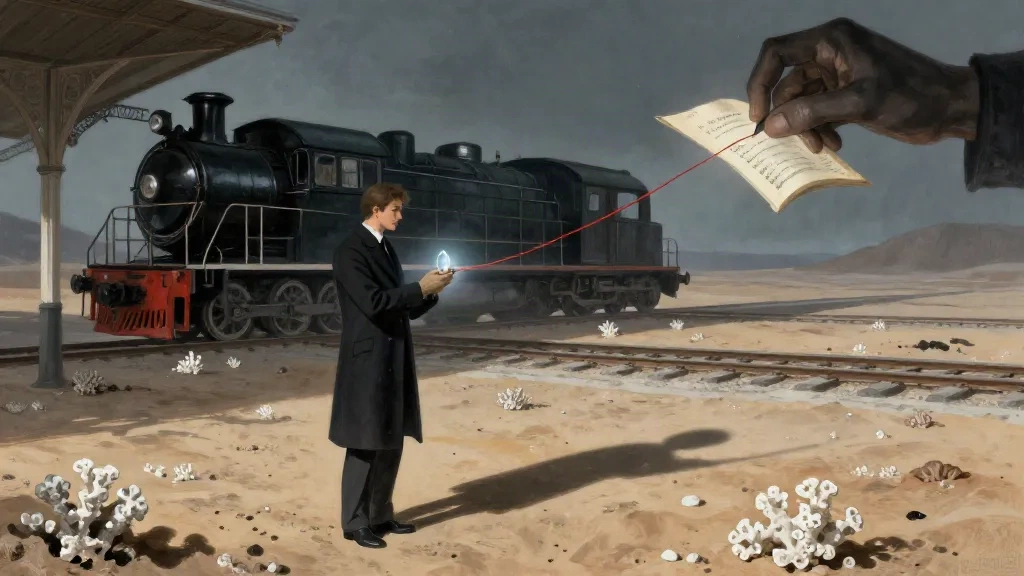
Gothic Fantasy.
The White Coral Platform
At four in the afternoon, the railway station cast a shadow longer than the horizon.
Maren Vey stood beneath the white coral canopy while heat trembled above the rails. The station had no town, only nine rooms cut into the cliff and a platform polished by vanished passengers. Every surface bore a red thread: around the drinking fountain, across the timetable, stitched through the wooden handle of the dispatch box.
She was an archivist, though the desert did not know that word. She kept records of names removed from wells, names buried beneath boundary stones, names whispered by people who feared inheritance. Her notebook was sewn with black thread. In her pocket lay a glass seed, empty except for a grain of white coral.
The timetable listed no trains. Then the rails began to sing.
A locomotive emerged from the heat without smoke or shadow. Its carriages were made of dark glass, and behind them stood passengers in clothes from another century. One carried a clock with no hands. Another held a lantern filled with black sand.
When the doors opened, a brass catalogue slid across the platform.
A Name in the Future Record
Maren caught it before it touched the dust. The cover bore the station name, the date, and a seal she recognized from her own archive.
She opened it. The first page listed the train's arrival: 1893, departing from a city that no longer existed. The second page recorded passengers. The third recorded freight.
One line had been added in blue ink.
ARCHIVIST OF THE UNRETURNED: MAREN VEY. She gave the forgotten name back to the land.
Maren's fingers went numb. She had been born in this century, under a different name. Her mother had never spoken of the desert. Her first memory was red thread crossing a white door.
She searched the final pages. Beneath them, a small note had been cut from the catalogue.
When the shadow learns to sign, ask what it inherited.
The platform darkened.
The Shadow's Handwriting
It rose from beneath the station wall, tall as a doorway and thin as a buried blade. It wore a copy of Maren's coat. Its face remained smooth, but its hands were human.
One hand held a wool glove, the kind worn by railway guards in winter. The other held a pen.
The shadow offered the catalogue.
“Sign the return,” it said. “Then the name belongs to the land.”
“I don't know this name.”
“You will.”
It placed the pen in her hand. The ink smelled of rain on hot stone.
Maren looked through the locomotive windows. The passengers had vanished. At the far end of the platform, a woman in a red coat waited beside a grave-shaped mound of pale sand.
“What does the name unlock?” Maren asked.
“The station.”
“What happens to the person named in it?”
The shadow signed the catalogue itself. The pen moved in elegant loops, ending with a flourish identical to Maren's own.
“The land keeps what the living abandon,” it said.
Maren understood then. The future catalogue was not a prophecy. It was a claim. Her name had been written because she had spent her life preserving other people's, never once offering one home.
The Red Thread of Return
She drew the glass seed from her pocket and placed it on the platform. The shadow lunged. The wool glove struck the glass, but the seed did not break. Inside it, the grain of white coral began to glow.
“You are not the first forgotten thing,” Maren said. “You are the first thing that learned to imitate a hand.”
She took the red thread from her notebook and tied it around the pen.
Then she wrote the catalogue entry in reverse: not the name she might become, but the name the land had hidden beneath the old platform. The letters appeared as shadows in the sand.
ELIAN VEY, SHE WHO KEPT THE WIND.
The shadow screamed without a mouth. The station roof peeled away. White coral dust lifted into the red-threaded sky.
The train sounded its horn. All its dark-glass doors opened.
Maren crossed the threshold, carrying the glass seed and the wool glove. Behind her, the shadow's copied signature burned away. Before her, the passengers stepped into a century that had not happened yet.
At dawn, the rails were empty. The catalogue lay open on the platform, its last page already drying.
Maren wrote the new name again, then closed the book.
Below it, a red thread led through the sand.
She followed.
Under the station, something living turned toward the sound of her footsteps.





