 Netwrck
Folk Horror.
The Houses That Missed Their People
Every bridge in Bellwether was a promise, and every river a witness.
The old stone bridge promised the village that it would hold. The footbridge promised the children that it would not shake. The narrow iron bridge promised the dead that someone would still come for them. The Frostmere kept the records. It did not forgive a broken word.
Mara Venn was the village nurse, though she had never been able to explain why houses came to her instead of people. They opened their doors at impossible hours. They left lamps burning in empty rooms. Once, a farmhouse had shuffled across its garden until its chimney rested against Mara's cottage, as if seeking warmth.
She treated them with tinctures, needle and thread, clean sheets, and silence. A homesick house, she told her patients, was not haunted. It was lonely. It had once known how to be inhabited and could not remember the shape of that life.
In the last week of winter, the widow Bell stopped speaking.
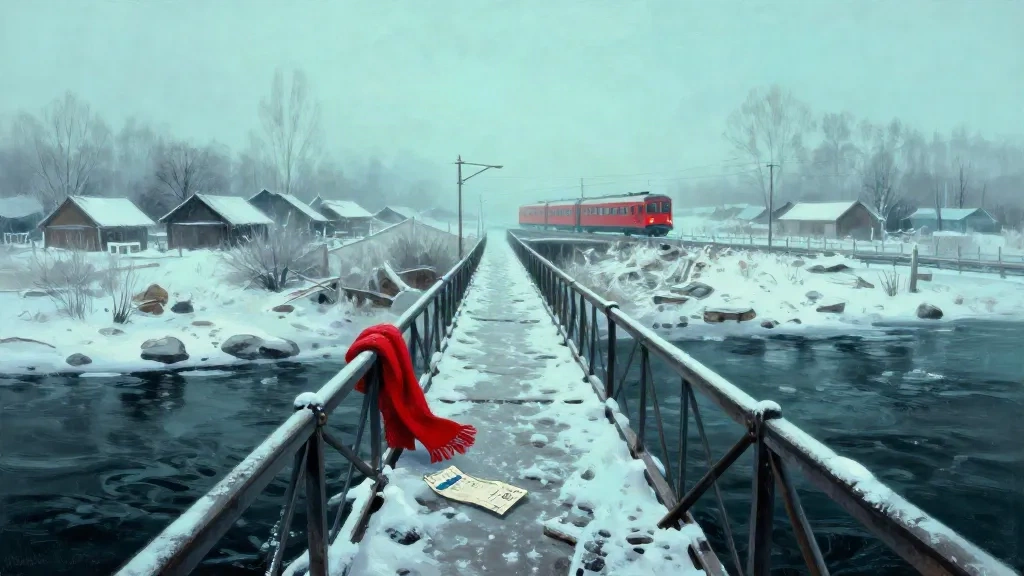
Mara entered the kitchen and found every chair occupied by the absence of someone. Cups floated half an inch above the table. A red scarf lay folded beside the stove, smelling of railway smoke and cedar. On the windowsill waited a train ticket, its date rubbed away.
“Tell me what you miss,” Mara said.
The house breathed through its pipes.
“I miss being promised,” it whispered.
The Man Who Corrected Fate
At dawn Mara found stationmaster Iven Rook waiting beside the tracks. Frost silvered his whiskers. He carried a brass schedule stitched with black thread.
“Your mother’s train is due,” he said.
Mara looked at the empty platform. “She died eleven years ago.”
“Death is a scheduling error.” Rook snapped his book shut. “I keep the timetable. If a journey is not completed, it must be held until the proper carriage arrives.”
He showed her the route: Bellwether, Frostmere Bridge, Saint Orra, then a place Rook named only by drawing a line through the page.
On the platform lay a second red scarf. Mara recognized the stitch at its end. Her mother had taught her that stitch during the winter they stopped speaking.
“She asked me to forgive her,” Mara said.
“Everyone asks that on the platform.” Rook glanced toward the river. “The trouble is answering in the wrong tense.”
Beyond the station, the houses were moving. Windows climbed walls. Doorways opened into chimneys. A child’s bedroom crawled along the lane, dragging a blue blanket behind it like a torn sail.
Mara climbed aboard the red carriage when its engine sighed from the frost.
What the River Remembered
The train ran without rails. The Frostmere rose beside the windows, black water holding the reflected sky like a plate of iron. At every bridge, the river whispered the promise made there.
We will hold.
We will return.
We will not be forgotten.
At the Frostmere Bridge, Mara found her mother waiting on the far side.
She looked exactly as Mara remembered: one glove missing, eyes tired, mouth set against grief. Between them stood the bridge, every stone slick with impossible cyan light.
“You came to repair something,” her mother said.
“I came to fix a house.”
“Then you already understand.”
The stationmaster’s whistle tore across the water. The carriage began to move. Mara’s mother stepped toward the train.
“If I leave now,” she said, “I will take the last word with me.”
Mara saw the red scarf around her mother’s neck. The ticket was still warm in her pocket. She understood then that the stationmaster had not lied. This was the last departure. If she boarded, the relationship could be completed, but never repaired. If she stepped onto the bridge, the promise would remain unfinished—and the houses might be forced to remember it.
The Crossing at Soft Dawn
Mara did not take the carriage.
She put her hand on the bridge’s cold railing and spoke the sentence she had withheld for eleven years.
“I forgive you for leaving. I do not forgive you for making me believe I was the reason.”
The river witnessed it. The bridge answered.
Her mother stepped back from the carriage. The whistle failed. In the first pale cyan of dawn, the train became a line of white frost, then a scatter of red scarf, then nothing.
Rook’s schedule lay open on the platform. Every departure had been crossed out. He looked at Mara with something almost like grief.
“Now the house must speak,” he said.
They returned to Bellwether before sunrise. The village had gathered outside the widow’s walls, holding pots, blankets, and the objects they had carried through the years. Mara opened the door.
The house drew a long breath. Lamps went dark. A child’s chair scraped back from the table.
From upstairs came the sound of luggage being packed.
Mara looked at the red scarf in her hands, then at the ticket.
She tore the ticket in half and placed one piece beneath the front door.
“No one leaves without saying where they are going,” she told the house. “And no promise gets to keep you prisoner.”
By full morning, the road had opened. The houses stood still. Along the Frostmere, the bridge shone iron-gray, holding every promise that had been spoken and every promise still waiting to be kept.





