 Netwrck
Magical Realism.
The Courtyard Behind Platform Three
Amira Venn planted stories for a living. In the whitewash district, where dust entered through broken roof beams and neighbors had forgotten each other’s names, she cleared neglected courtyards and planted a sentence in the soil. A story about two sisters crossing the desert became twin oleanders. An old man’s lie about a buried spring returned as a shallow pool, though everyone continued to draw their water from the communal tap.
Her own family story was not for planting. Her grandfather had told it only once, on the night before he boarded the midnight train from Bellwether station.
“At the end of every line,” he said, “there is a door for people who have nowhere else to arrive.”
He had placed a brass key in her hand and promised to send it back when he returned. Instead, the train carried him into a century that left no timetable, only weather on the rails.
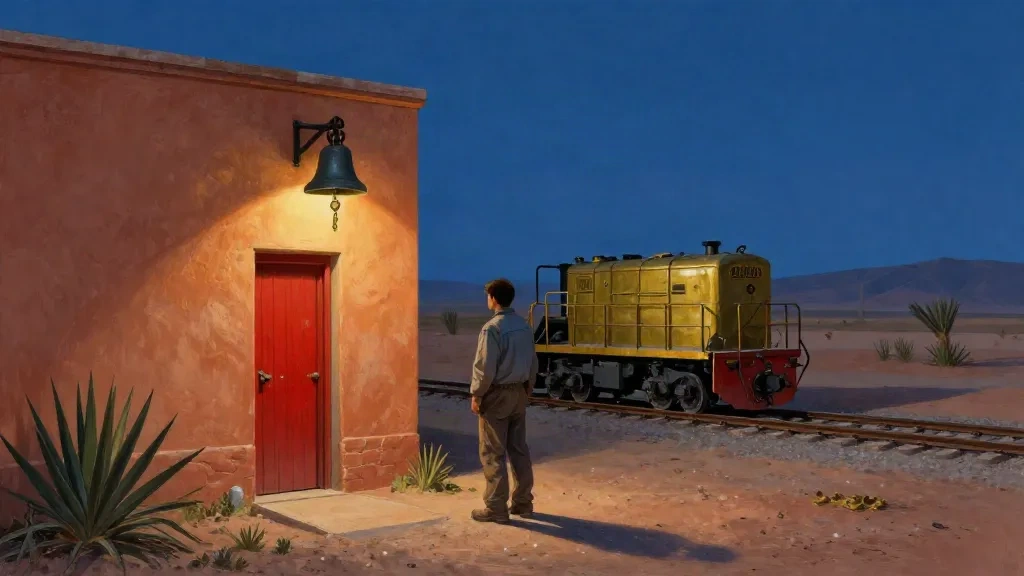
Behind platform three, Amira had cleared a courtyard enclosed by ochre walls. Above its gate hung a cracked station bell, mute for forty years. She intended to grow her grandfather’s story there, but stories needed roots. This one had only an absence.
The Machine Against Belief
The machine arrived without a carriage.
It stood on the tracks at noon, a brass engine the size of a wardrobe, with a domed glass head and a single red door painted across its front. The stationmaster, a severe man named Pell, refused to approach it.
“Nothing comes from there,” he said, nodding toward the southern horizon.
“Then it is late,” Amira replied.
Inside the machine was a small wheel, a tin cup, and a hand-lettered notice: This mechanism operates only while nobody believes in it.
Pell declared it a joke. Amira laughed. The station boys threw stones. A woman waiting for her husband said the machine was probably a water pump, and Amira had to admit that sounded reasonable.
By sunset, the machine had become useful again.
Amira fed the machine a memory.
She remembered her grandfather’s hands opening the brass key, remembered the red scarf around his neck, remembered how he had said her name as if it were a destination. She placed these things inside the tin cup. The wheel turned once without anyone touching it.
A second cup appeared beneath the notice. Then a third. A printed line formed across the glass head: Memory accepted. Shelter pending.
Amira believed she saw the courtyard growing behind her.
What the Strangers Needed
At dawn, the red door stood in the courtyard wall.
It had no hinges and no lock, but a brass key rested in its center, warm as a held hand. Beyond it waited rooms made from unfinished stories: a room where lost letters continued arriving, a kitchen where hunger learned to be polite, a balcony overlooking a country where every train arrived on time.
People gathered outside. A coal miner with a burnt thumb. Two children who had escaped a flooded town. A woman carrying a sealed envelope she had spent nine years unable to send.
They wanted the door opened. They wanted the rooms, the water, the stranger who would ask nothing of them.
But belief gathered with them. The miner trusted the shelter. The children had already begun calling it home. The woman believed the rooms might understand her envelope.
The wheel stopped.
The red door remained, but the rooms beyond it vanished.
Amira understood then that the machine did not require doubt. It required the absence of certainty. She must offer strangers a place so plainly unbeautiful that none of them would call it salvation.
So she opened the gate, swept the courtyard, hung the cracked bell over the entrance, and set out three dry cups on a crooked table. Above them she nailed a sign:
No one is expected.
No one is remembered.
Come in if you wish.
The stationmaster called this foolishness. The children called it boring. They went inside and slept beneath an awning that smelled of rain, though no rain had fallen for a year.
The Door Without Arrival
By spring, Bellwether station had gained a second platform and a timetable nobody could read. Trains arrived from other centuries, disgorging scholars, children, gardeners, and people who had mistaken the moon for a station lamp.
They slept beneath the awning. They repaired the walls. They traded stories for water.
No one praised the shelter. No one claimed to have invented it. That was how it survived.
Amira planted her grandfather’s sentence in the courtyard’s center. It rose as a thorn tree, white-flowered and stubborn. The cracked bell began to ring when a stranger arrived after midnight, its fractured voice carrying across the desert like an answer.
One evening, an old man came through the red door carrying a small suitcase.
His scarf was red. His hands were familiar. A brass key hung from his neck.
Amira did not recognize him. The station had taught her that some people return without bringing the person who left.
He sat beneath the thorn tree and listened to the bell.
“Is there room?” he asked.
Amira looked at the red door, the dry cups, the strangers sleeping under the midnight-blue sky. The machine stood beyond the wall, silent and unbelieved.
“There is always room,” she said.
Then she planted another story, this one for the space between departures.





