 Netwrck
Speculative Fiction.
The Unbound Platform
Dr. Saira Vale kept her clinic beneath the station clock, where the brass pendulum answered every gust with a single dull knock. Her patients arrived carrying luggage their bodies had forgotten: a child who dreamed of snow, a railway clerk whose wife slept on the far side of an empire, a widow who pressed her palm against every red sandstone wall.
“Homesickness is not missing a house,” Saira told them. “It is a disagreement between the body and the map.”
She prescribed reunions where possible and correspondence where not. Some needed only a letter with the wrong scent. Others arrived each night at Platform Two, listening for a whistle that sounded, impossibly, like their childhood.
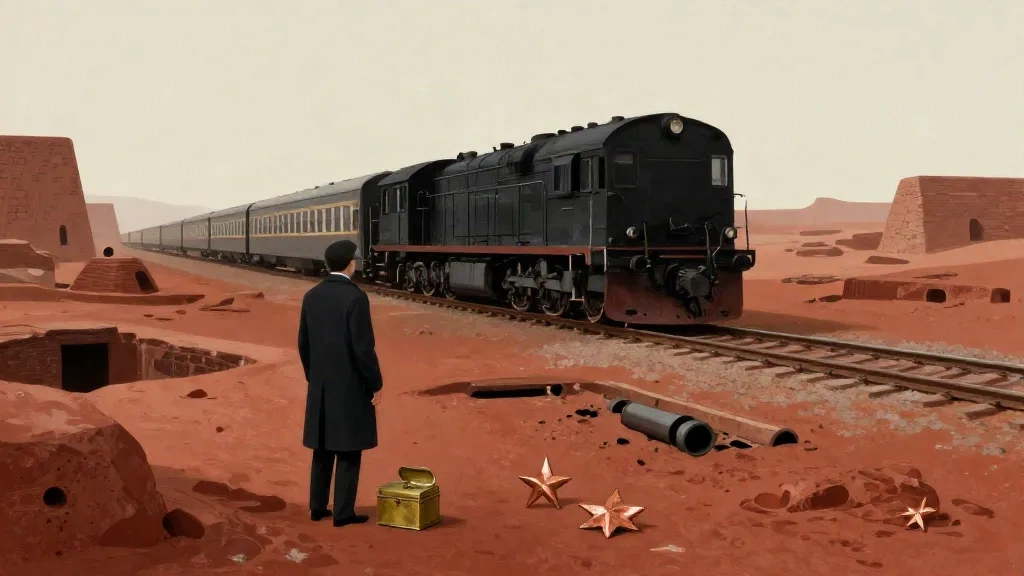
The century train came at dusk on the first day of winter. Its engine had no locomotive, only a long charcoal hull ribbed with windows. Pale light spilled beneath it while the desert wind carried rust-red dust across the tracks.
One passenger stepped down wearing a brass breastplate polished to the colour of old blood.
He carried a small music box and a copper star in one hand.
What the Flood Found
He gave his name as Oren Venn, chief engineer of Meridian Nine, a city the century train had passed through three hundred years ago.
“I have returned to take delivery,” he said.
“Delivery of what?”
He set the copper star on Saira’s desk. Beneath it lay a city, impossible but exact: streets, reservoirs, gardens, homes arranged around a station.
“Our platform. Our future. The train will keep arriving, and eventually your descendants will board. This model is the blueprint.”
Before dawn, rain fell into a desert that had known none for a century. It entered the station through a crack beneath the drinking fountain and rose around Saira’s ankles.
Water uncovered rust-coloured pipes in the square. Then stairways. Then walls bearing official seals.
They were the foundations of Meridian Nine.
Not a vanished city. A city condemned before construction. The civic records named the reason: mass exile, unstable weather, and the arrival of a machine said to make one chosen place permanent across time.
Oren claimed the citizens had rejected it. Saira read the flooded pages. They had never been asked.
The Beautiful Machine
Inside the music box was a tiny mechanism of sapphire teeth. Each tooth carried a different year.
“The station is the machine’s heart,” Oren said. “Without it, the crossing fails. With it, your age can remain in contact with every age to come.”
Saira saw then what no blueprint had shown: the beautiful machine would not merely preserve the station. It would preserve the station’s claim upon time. Future travellers would inherit a world narrowed to a platform, with every departure charged to those who had no claim to remain.
Her patients would recover from homesickness only by becoming prisoners of the cure.
She turned the winding key.
The music was twelve notes. The twelfth repeated until Saira recognized it as the station clock’s knock.
“Can it be stopped?” she asked.
“Yes. But the civic works beneath us will flood into the cutting. Your clinic, your patients, the rails—all of it.”
Oren smiled. “I did not travel three centuries to destroy a station.”
Saira took the copper star. Its points had dulled from handling. It was not a symbol of mastery, she realized, but a survey marker. Someone had once measured what the machine intended to take.
Arrival
At sunset, Oren boarded. Doors closed. The train gave no whistle. It simply stopped existing, the rails cooling beneath pale winter light.
Only the music box remained.
Saira carried it to the platform as the flood rose. The hundredth year she had recorded lay first. Then the fifty-second. Then years no calendar had named.
The city struck its roofs, chimneys, and sundials.
Saira’s patients were already leaving, guided by a railway clerk with a lantern. They carried letters, photographs, recipes, and a stranger’s key. None carried a copy of the station clock. None asked where they were going.
She opened the music box over the dark track.
Its twelve notes played, and the twelfth became silence.
Under her feet, Meridian Nine finished its journey into the earth. The station remained: chipped, ordinary, repairable. Its clock resumed, though now it measured time only by the changing angle of light.
Before dawn, a new train arrived from the desert.
No blueprint waited inside. No passenger claimed the right to stay.
Saira opened the doors herself.
Among the travellers was a boy holding a music box without a key. In his other hand was a copper star, bright with fresh metal.
He asked whether the place was home.
“No,” Saira said. “But we can learn to leave the door open.”





